
What Is the Money Supply Calculator?
The Money Supply Calculator estimates the total amount of money circulating in an economy based on the central bank's monetary base and the money multiplier. It applies the core monetary economics relationship taught in macroeconomics: the banking system creates additional money on top of the base supplied by the central bank through fractional-reserve lending. This tool is universal and works for any currency.
How to Use It
Enter the monetary base (also called high-powered money or M0 — the currency in circulation plus bank reserves) and the money multiplier. The calculator instantly returns the resulting money supply. If you only know the required reserve ratio, the multiplier is roughly 1 divided by that ratio (e.g. a 20% reserve ratio gives a multiplier of 5).
The Formula Explained
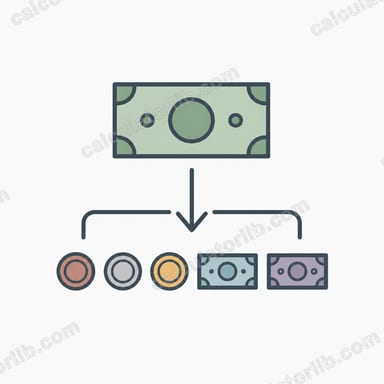
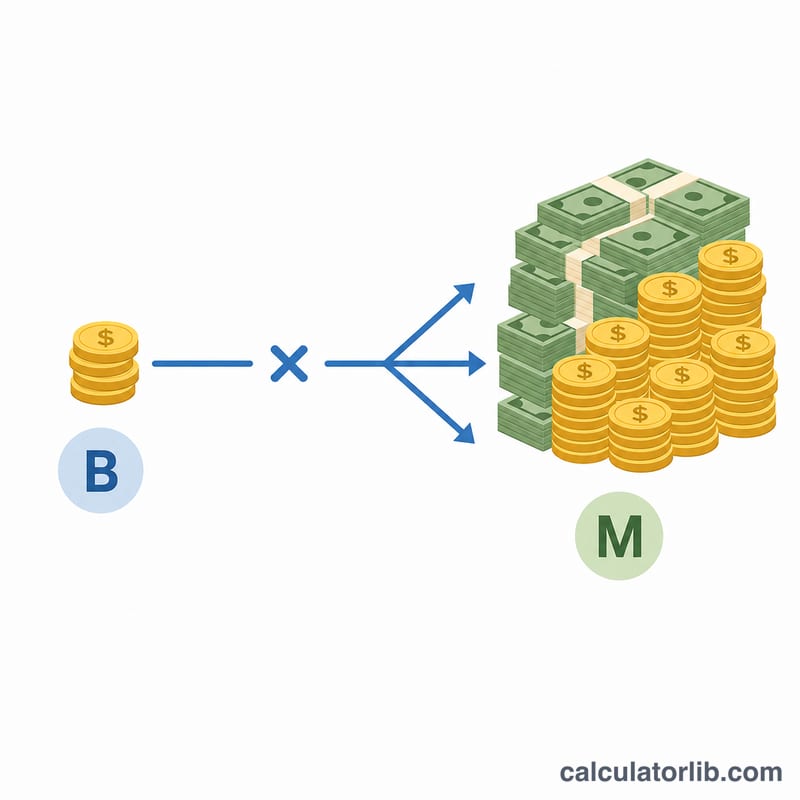
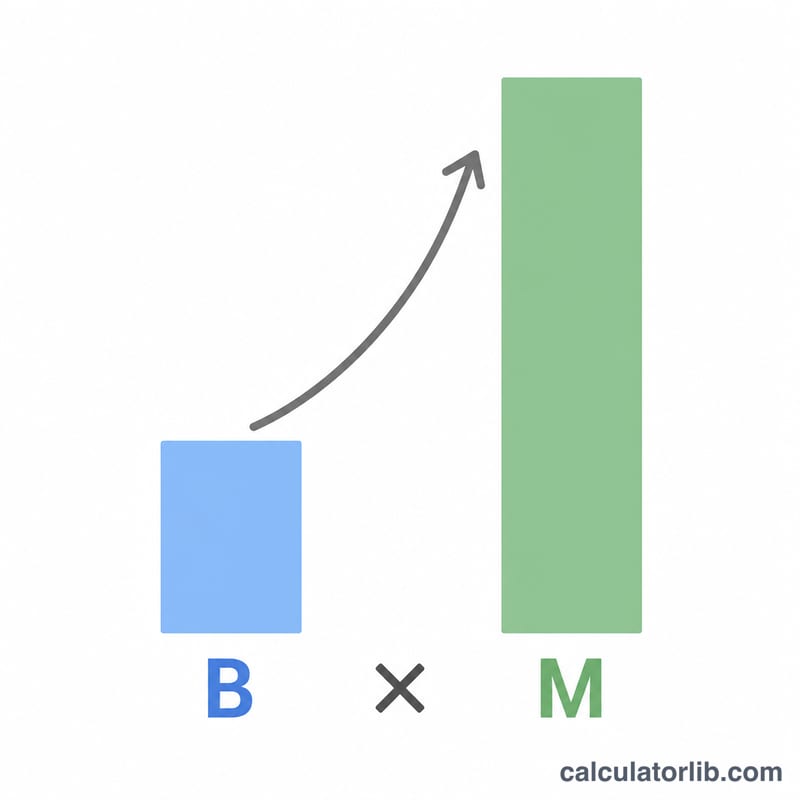
$$\text{Money Supply} = \text{Monetary Base} \times \text{Money Multiplier}$$ The monetary base is the money the central bank directly controls. As banks lend out deposits while holding only a fraction as reserves, each dollar of base can support several dollars of broader money. The multiplier captures how many times the base is amplified, and depends on reserve and cash-holding behavior.
Worked Example
Suppose the monetary base is $500,000 and the money multiplier is 5. Then $$\text{Money Supply} = 500{,}000 \times 5 = \$2{,}500{,}000.$$ If banks tighten lending and the multiplier falls to 4, the money supply drops to $2,000,000 — illustrating how the multiplier drives broad money even when the base is unchanged.
FAQ
What is the monetary base? It is the total of physical currency in circulation plus the reserves commercial banks hold at the central bank.
How do I find the money multiplier? A simple estimate is \(1 \div \text{reserve ratio}\). A more complete formula accounts for the public's cash-to-deposit ratio.
Why does the money supply exceed the monetary base? Because fractional-reserve banking lets banks re-lend deposits, creating new money each lending cycle, multiplying the base.