What is the SO₂ Wine Calculator?
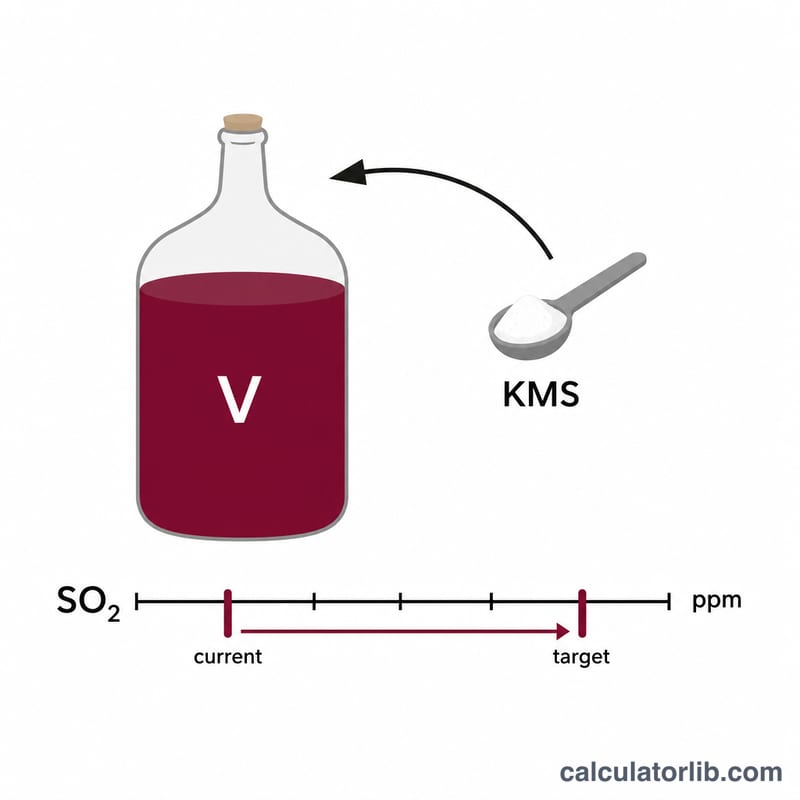
Sulfur dioxide (SO₂) protects wine from oxidation and microbial spoilage. Winemakers commonly add it as potassium metabisulfite (KMS), a stable powder that releases roughly 57% of its weight as SO₂. This calculator tells you exactly how many grams of KMS to dissolve and add to reach your desired free SO₂ level.
How to use it
Enter your target free SO₂ in ppm (mg/L), your current free SO₂ measured by titration or test kit, and the volume of wine in liters. The calculator returns the grams of KMS to add. If your current level already meets or exceeds the target, no addition is required.
The formula explained
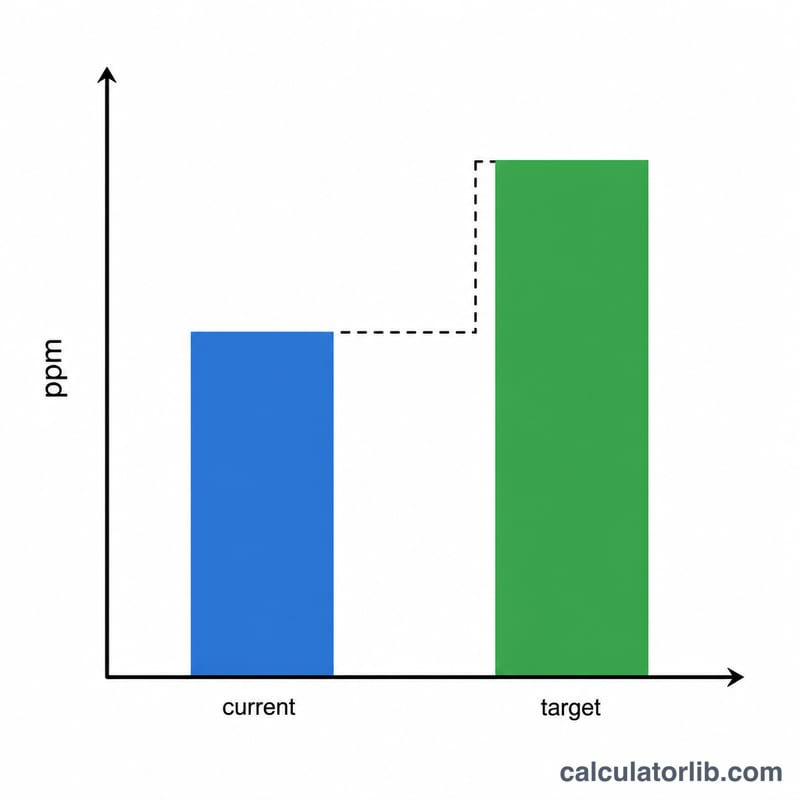
The dose equals the SO₂ increase needed (target minus current, in mg/L) multiplied by the volume in liters, which gives milligrams of pure SO₂. Dividing by 1000 converts to grams, and dividing by 0.5697 accounts for KMS being only about 57% SO₂ by weight:
$$\text{KMS (g)} = \frac{\left(\text{Target SO}_2 - \text{Current SO}_2\right) \times \text{Volume (L)}}{1000 \times 0.5697}$$
Worked example
Suppose you have 20 L of wine at 10 ppm free SO₂ and want to raise it to 35 ppm. The increase is 25 ppm. So $$\text{KMS} = \frac{25 \times 20}{1000 \times 0.5697} = \frac{0.5}{0.5697} \approx 0.878 \text{ grams}$$ of potassium metabisulfite.
Typical Free SO₂ Targets for Wine
The free SO₂ a wine needs depends on its style and, above all, on its pH. The figures below are widely cited winemaking guidelines. They vary between sources, so treat them as starting points rather than fixed rules.
| Wine style | Typical free SO₂ target (ppm) |
|---|---|
| Dry red | about 25–35 |
| Dry white / rosé | about 30–40 |
| Off-dry and sweet white | higher, often 40–60 or more, because residual sugar can be refermented by yeast and binds more SO₂ |
Only the molecular fraction of free SO₂ is antimicrobial. That fraction rises as pH falls, so a higher-pH wine needs more free SO₂ for the same protection. A commonly used target is 0.8 ppm molecular SO₂:
| Wine pH | Free SO₂ for 0.8 ppm molecular (ppm) |
|---|---|
| 3.0 | ~13 |
| 3.2 | ~21 |
| 3.4 | ~33 |
| 3.6 | ~52 |
| 3.8 | ~82 |
Legal limits (total SO₂): in the United States the maximum is 350 ppm total SO₂. In the European Union, limits for dry wines are roughly 150 mg/L for reds and 200 mg/L for whites and rosés, with higher limits for wines with more residual sugar. Always check the current rules for your own country or region. Good practice keeps total SO₂ well below these limits.
Quick KMS Dose Conversion Table
The calculator uses \(\text{KMS (g)} = \frac{ \Delta\text{ppm} \times \text{Volume (L)} }{1000 \times 0.5697}\), where \(\Delta\text{ppm}\) is target minus current free SO₂. The factor 0.5697 is the approximate fraction of potassium metabisulfite weight that is available as SO₂.
Unit conversions: 1 US gallon = 3.785 L, and 1 ppm = 1 mg/L.
| Increase in free SO₂ | 1 L | 1 US gal (3.785 L) | 5 gal (19 L) | 23 L carboy |
|---|---|---|---|---|
| 10 ppm | 0.018 g | 0.066 g | 0.334 g | 0.404 g |
| 20 ppm | 0.035 g | 0.133 g | 0.667 g | 0.807 g |
| 30 ppm | 0.053 g | 0.199 g | 1.001 g | 1.211 g |
Worked example: raising 19 L from 10 ppm to 30 ppm is a 20 ppm increase, so \(\frac{20 \times 19}{1000 \times 0.5697} = \frac{380}{569.7} \approx 0.667\) g of KMS.
Spoon measures: 1/4 teaspoon of KMS weighs about 1.5 g. Spoon weights vary with crystal or powder size and how the spoon is packed, so a scale accurate to 0.01 g is much more reliable. As a rough guide, 1.5 g in 19 L adds about 45 ppm, and in 23 L about 37 ppm.
Interpreting Your Result
The calculated dose is the amount of KMS that would raise free SO₂ by the chosen number of ppm if none were lost. In practice some SO₂ binds to acetaldehyde, sugars, pigments and other compounds, and some is oxidized. The measured free SO₂ may therefore come out slightly lower than planned. Mix the addition in thoroughly, wait about 24 hours, then re-test.
Factors that affect the outcome
- pH: pH determines the molecular SO₂ fraction. The same free SO₂ protects a pH 3.2 wine much better than a pH 3.7 wine.
- Temperature: warmer wine shifts the balance toward more molecular SO₂ and loses it faster. Cold wine holds free SO₂ longer.
- Oxygen exposure: racking, splashing, headspace and barrel storage all consume free SO₂ over time, so levels need periodic re-checking.
- Measurement error: Aeration-Oxidation and titration methods are fairly accurate in skilled hands, but red wine endpoints can be hard to read. Test strips are coarse, often with steps of 10 ppm or more. Use the same method each time so readings can be compared.
Risks of overdosing
Excess SO₂ raises total SO₂ and can cause sensory faults: a sharp, burning or sulfur smell, and a harsh, dry finish. It can also inhibit malolactic fermentation and slow or stall yeast, and total SO₂ must stay below legal limits. If you overshoot, aeration or racking lowers free SO₂ only slowly. It is better to dose conservatively, re-test, and add more if needed.
This is general winemaking information; local regulations and your own wine's chemistry may call for different targets.
FAQ
What is free SO₂ vs total SO₂? Free SO₂ is the active, protective portion; total includes SO₂ that has bound to compounds in the wine. Always dose against the free SO₂ reading.
Why 0.5697? Potassium metabisulfite (K₂S₂O₅) yields about 57% of its mass as SO₂ — this calculator uses 0.5697 (≈57%). Some suppliers cite 50–57%; check your product label and adjust.
How should I add the KMS? Dissolve the measured powder in a small amount of wine or water, then stir gently into the full batch. Re-test free SO₂ after mixing to confirm.