

What Is Baker's Percentage?
Baker's percentage (also called baker's math or formula percentage) is the standard way bakers express recipes. Every ingredient is stated as a percentage of the total flour weight, and flour is always 100%. This makes recipes easy to scale up or down and lets you compare formulas at a glance — a "65% hydration" dough means the water weighs 65% of the flour, no matter the batch size.
How to Use This Calculator
Enter your total flour weight in grams, then type the percentages for water (hydration), salt, yeast, and any other ingredients such as oil, sugar, or starter. The calculator multiplies each percentage by the flour weight to give you exact gram amounts, and adds everything together for the total dough weight.
The Formula Explained
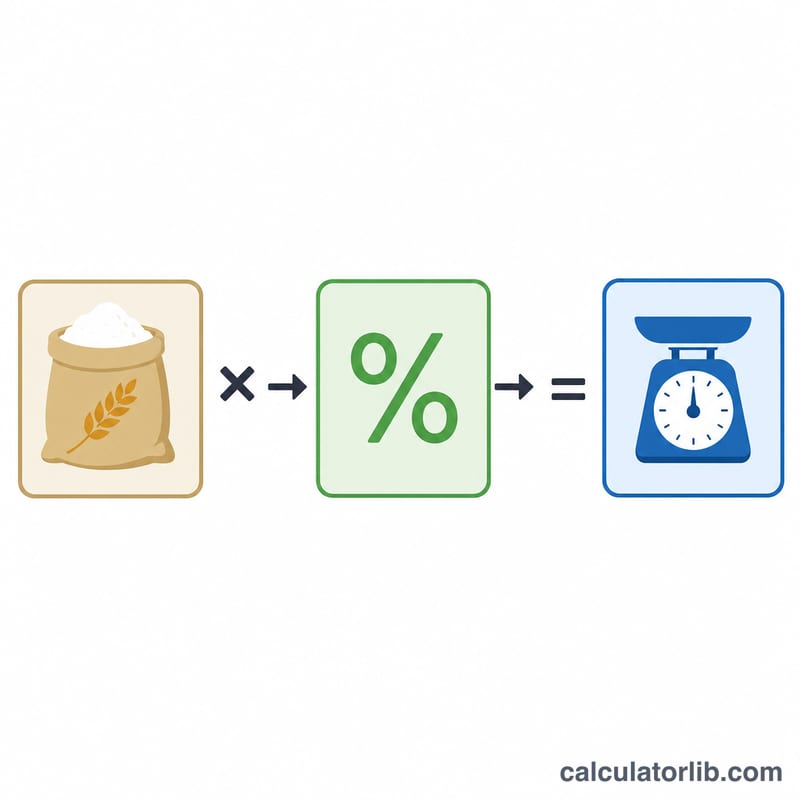
The core equation is simple: $$\text{Ingredient Weight} = \text{Flour Weight} \times \frac{\text{Ingredient \%}}{100}$$. Because flour is the 100% reference, you only need to know its weight to derive every other quantity. The total dough weight is the flour weight plus the sum of all ingredient weights.
Worked Example
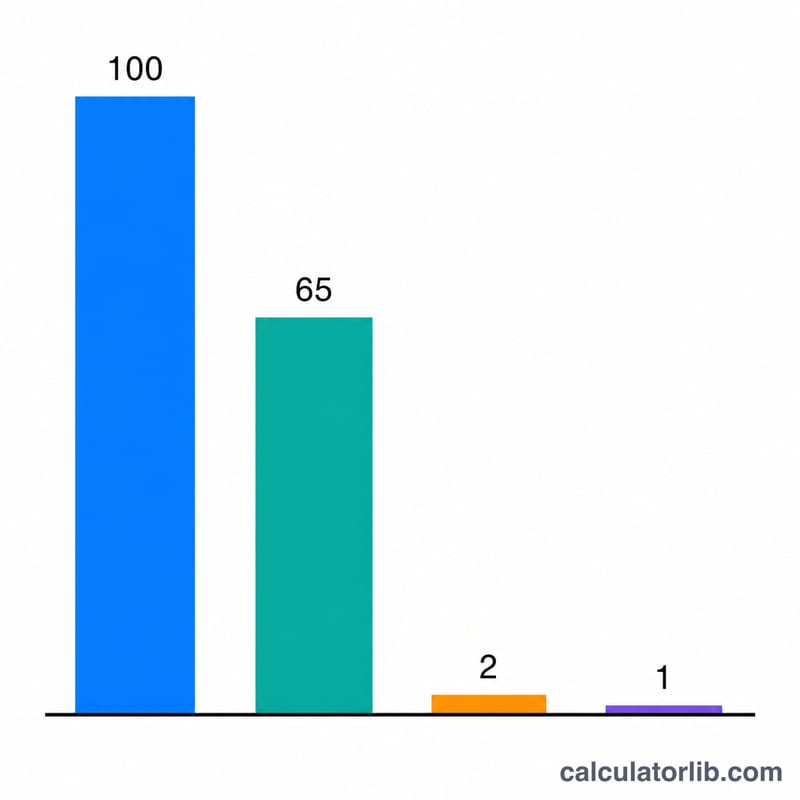
Suppose you bake with 1000 g of flour at 65% hydration, 2% salt, and 1% yeast. $$\text{Water} = 1000 \times 0.65 = 650 \text{ g}$$ $$\text{salt} = 1000 \times 0.02 = 20 \text{ g}$$ $$\text{yeast} = 1000 \times 0.01 = 10 \text{ g}$$ The total dough weight is \(1000 + 650 + 20 + 10 = 1680\) g — enough for two medium loaves.
Typical Baker's Percentages by Bread Type
In baker's percentage every ingredient is expressed as a percentage of the total flour weight, which is always 100%. The values below are typical working ranges for each bread style — actual recipes vary with flour strength, climate and personal preference. "Yeast %" refers to instant dry yeast unless the style is naturally leavened, in which case the figure is the levain or starter percentage.
| Bread type | Hydration (water %) | Salt % | Yeast / starter % | Notable additions |
|---|---|---|---|---|
| Sandwich loaf (pan bread) | 60–65% | 1.8–2% | 1–1.5% yeast | 3–5% oil or butter, 4–6% sugar, 2–4% milk powder |
| Baguette | 68–75% | 2% | 0.3–1% yeast (often with poolish) | None (lean dough) |
| Ciabatta | 75–85% | 2–2.5% | 0.5–1% yeast | 2–4% olive oil (optional), biga pre-ferment |
| Sourdough | 70–80% | 2% | 15–25% levain | None; whole-grain blends common |
| Focaccia | 75–85% | 2–2.5% | 0.5–1% yeast | 5–10% olive oil in dough plus oil for the pan |
| Pizza (Neapolitan) | 58–65% | 2.5–3% | 0.1–0.3% yeast (long ferment) | None traditionally |
| Brioche | 50–60% (mostly egg) | 1.8–2% | 1.5–2.5% yeast | 40–60% butter, 10–15% sugar, 40–55% egg |
| Bagel | 52–58% | 2% | 0.5–1% yeast | 1–4% malt syrup or sugar; very stiff dough |
Lean doughs (baguette, sourdough, pizza) keep additions minimal, while enriched doughs (brioche, sandwich loaf) add fat, sugar and dairy that soften crumb and slow staling.
Key Terms Defined
- Baker's percentage
- A recipe notation in which every ingredient is expressed as a percentage of the total flour weight rather than of the whole batch. Flour is the reference and always equals 100%, so a 2% salt means 2 g salt per 100 g flour.
- Hydration
- The water (or total liquid) expressed as a baker's percentage of the flour. A dough with 700 g water and 1000 g flour is at 70% hydration. Higher hydration generally produces a more open, airy crumb but a slacker, harder-to-handle dough.
- Total flour weight
- The combined weight of all flours in the formula — bread flour, whole wheat, rye, etc. This sum is the 100% baseline against which all other ingredients are measured. When a pre-ferment is used, its flour is included in this total.
- Total formula percentage
- The sum of all ingredient percentages, including the 100% flour. Multiplying flour weight by this total (divided by 100) gives the total dough weight, making it easy to scale to a target batch.
- Salt percentage
- Salt as a percentage of total flour, typically 1.8–2.2% in most breads. Salt controls fermentation rate, strengthens gluten and provides flavor; too little leaves dough slack and bland, too much inhibits the yeast.
- Yeast percentage
- Leavening (instant, active dry or fresh yeast) as a percentage of total flour. Lower percentages with longer fermentation develop more flavor; fresh yeast is roughly three times the weight of instant yeast for the same activity.
- Pre-ferment / levain
- A portion of flour, water and leavening fermented in advance — poolish, biga, sponge or sourdough levain. Its flour and water are counted within the total flour weight and hydration so the final dough percentages stay accurate.
- Total dough weight
- The combined weight of every ingredient in the finished mix, equal to flour weight multiplied by the total formula percentage. Dividing this by the weight per loaf tells you how many pieces a batch will yield.
FAQ
Why can percentages add up to more than 100%? Because every ingredient is measured against flour, not against the total. A dough can easily reach 168% total formula weight.
What is a typical hydration? Most sandwich breads sit at 60–65%, rustic and ciabatta doughs at 70–85%, and very wet doughs above 85%.
Can I use ounces or pounds? Yes — baker's percentage is unit-independent. Just keep every weight in the same unit; the percentages stay the same.