
What Is a Percentage of a Percentage?
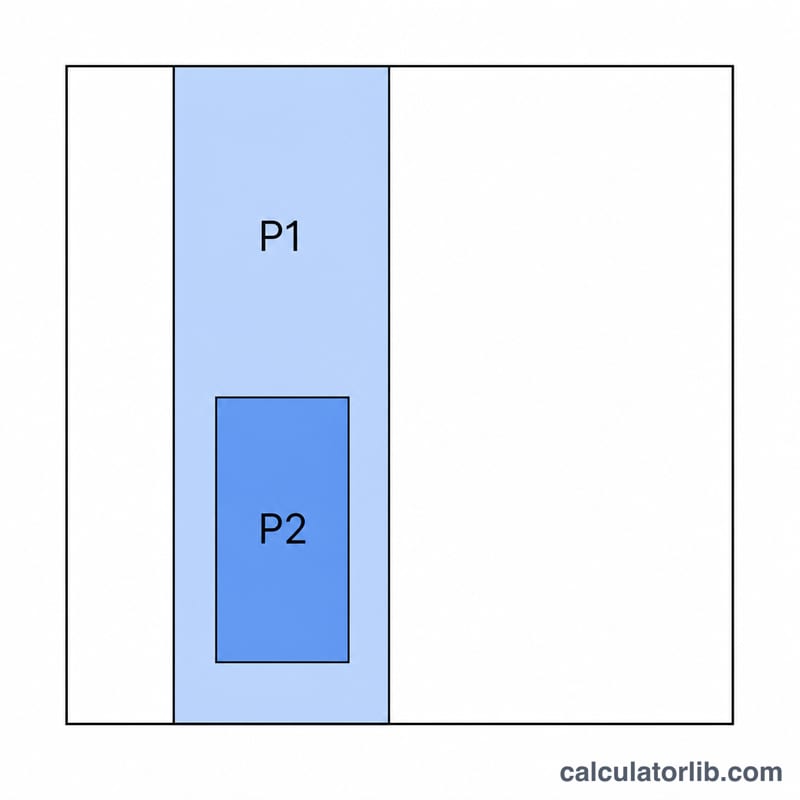
A "percentage of a percentage" tells you what you get when one percentage is applied to another. For example, "what is 50% of 20%?" The answer is not 50 or 20 — it is the combined effect of taking half of twenty percent, which equals 10%. This kind of calculation appears everywhere: stacked discounts, commission on commission, tax on a partial amount, or probability of two independent events.
How to Use This Calculator
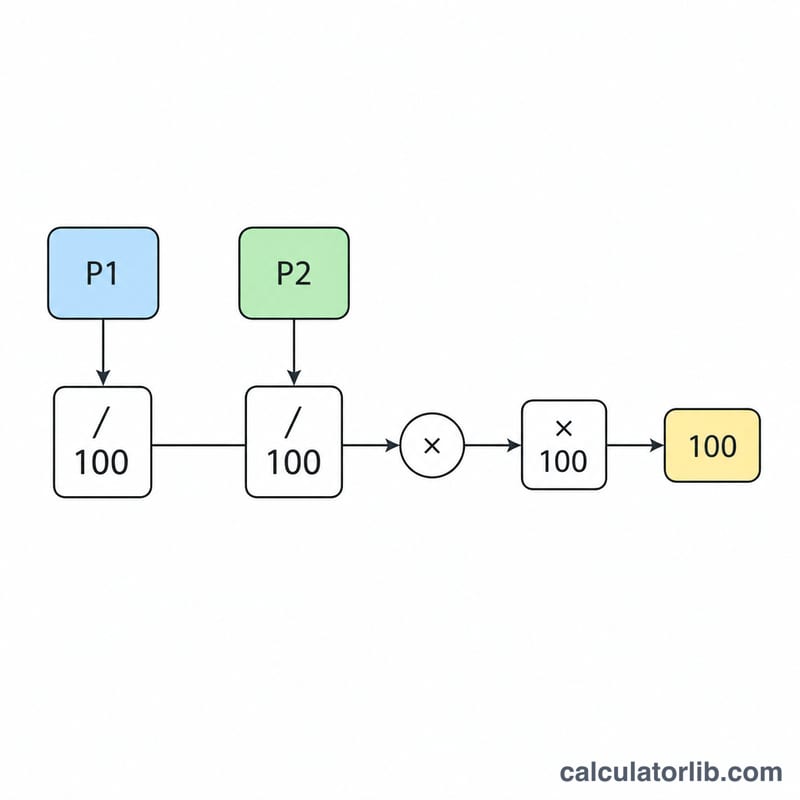
Enter the first percentage and the second percentage into the two fields, then read the combined result. The tool converts each percentage to a decimal, multiplies them together, and converts the product back into a percentage. There are no units to worry about — both inputs and the output are plain percentages.
The Formula Explained
The formula is $$\text{Result} = \frac{\text{P1}}{100} \times \frac{\text{P2}}{100} \times 100$$ Dividing each percentage by 100 turns it into a decimal (\(50\% = 0.5\)). Multiplying the two decimals gives the combined fraction, and multiplying by 100 converts it back to percentage form. This simplifies to $$\text{Result} = \frac{\text{P1} \times \text{P2}}{100}$$ which is a handy mental shortcut.
Worked Example
Suppose a product has a 30% discount, and you receive an extra coupon for 25% of that discount. What is 25% of 30%? Using the formula: $$\left(\frac{25}{100}\right) \times \left(\frac{30}{100}\right) \times 100 = 0.25 \times 0.30 \times 100 = 7.5\%$$ So the extra coupon shaves an additional 7.5 percentage points off the original price.
FAQ
Is 50% of 20% the same as 20% of 50%? Yes. Multiplication is commutative, so both give 10%.
Can I enter values over 100%? Absolutely — entering 150% and 200% gives 300%, which is valid for growth or scaling scenarios.
How is this different from adding two percentages? Adding gives the total of two separate percentages; this calculator multiplies them, giving one percentage applied to the other.