
What is the Exponential Integral Ei(x) Table Calculator?
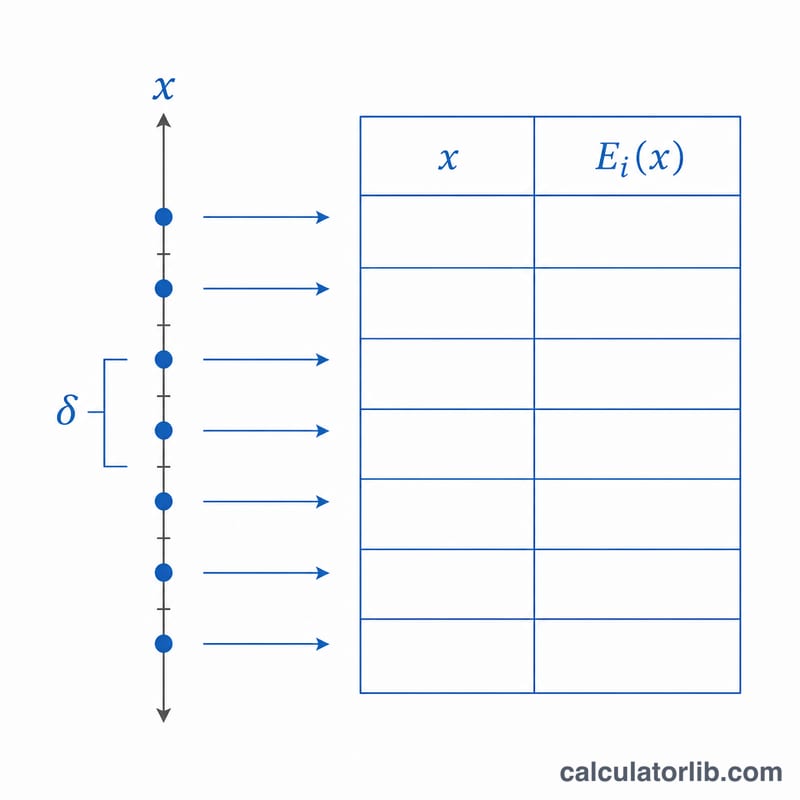
This tool builds a table of the exponential integral Ei(x) over an evenly spaced sequence of x values. You choose a starting value, a step size, and how many points you want, and it computes Ei at each x. The exponential integral is a special function that appears throughout physics and engineering, including radiative transfer, electron-beam simulation, and the asymptotic analysis of integrals.
How to Use It
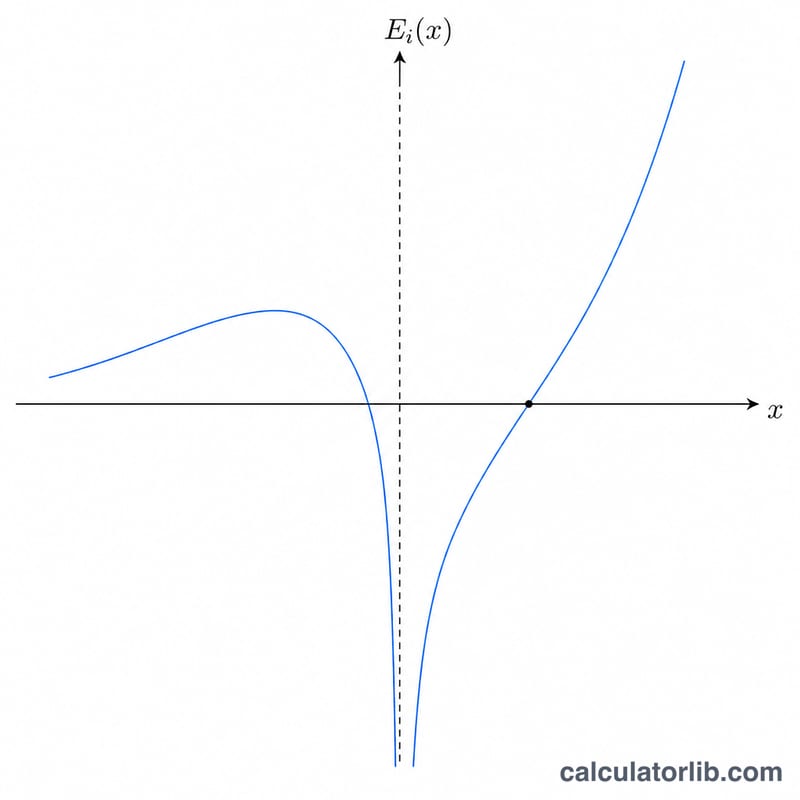
Enter the initial value of x (the first row), the increment added to x for each successive row, and the number of points (rows). The x value of row n is \(x_n = \text{startX} + n \cdot \text{stepX}\) for \(n = 0, 1, \dots, \text{pointCount}-1\). The calculator returns every (x, Ei(x)) pair plus a quick summary of the first and last rows. A step of zero produces a constant column; \(x = 0\) is undefined because Ei has a logarithmic singularity there.
The Formula Explained
The convergent series used is $$\operatorname{Ei}(x_n) = \gamma + \ln|x_n| + \sum_{k=1}^{\infty} \frac{x_n^{\,k}}{k \cdot k!}$$ where \(\gamma\) is the Euler-Mascheroni constant \(0.5772156649\). The absolute value in \(\ln|x|\) together with the alternating powers of x correctly produce Ei on both the positive and negative branches. For large \(|x|\) (beyond about 40) the series suffers cancellation, so an asymptotic expansion \(\operatorname{Ei}(x) \sim (e^x / x) \sum n!/x^n\) is used instead.
Worked Example
For \(x = 1\): \(\ln|1| = 0\) and the series sum is about \(1.3179022\), so $$\operatorname{Ei}(1) = 0.5772157 + 0 + 1.3179022 = 1.8951178$$ matching the standard tabulated value. Likewise \(\operatorname{Ei}(2) = 4.9542344\) and \(\operatorname{Ei}(-1) = -0.2193839\).
FAQ
Why is \(x = 0\) undefined? Ei(x) has a logarithmic singularity at the origin (\(\ln|x|\) diverges), so the value is reported as not-a-number.
How accurate is the table? The series reproduces standard Ei values to roughly machine precision for moderate \(|x|\), with an asymptotic fallback keeping large arguments stable.
How is Ei different from E1? They are related by \(\operatorname{Ei}(x) = -E_1(-x)\) for \(x < 0\); this calculator returns the principal-value Ei.