
What this calculator does
This tool computes, for a circle of radius r, the side length and area of every regular polygon that can be inscribed in that circle — from a triangle up to as many sides as you like. It builds a table with one row for each integer number of sides n between your chosen minimum and maximum, and also reports the circle's own area so you can watch the polygon area converge toward it.
How to use it
Enter the circle radius r (any consistent unit — the side comes out in that unit and the areas in that unit squared). Set the range of polygon sides: from n (at least 3) to n (at least the minimum). The table is capped at 200 rows to keep it fast and readable. Larger n means the polygon hugs the circle more tightly, so its area gets closer to the circle area.
The formulas explained
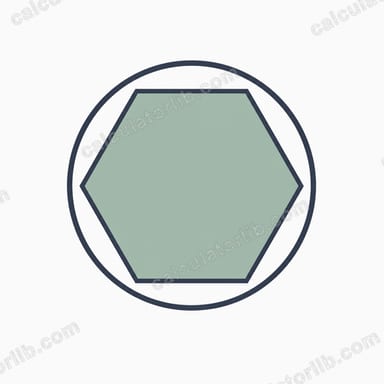
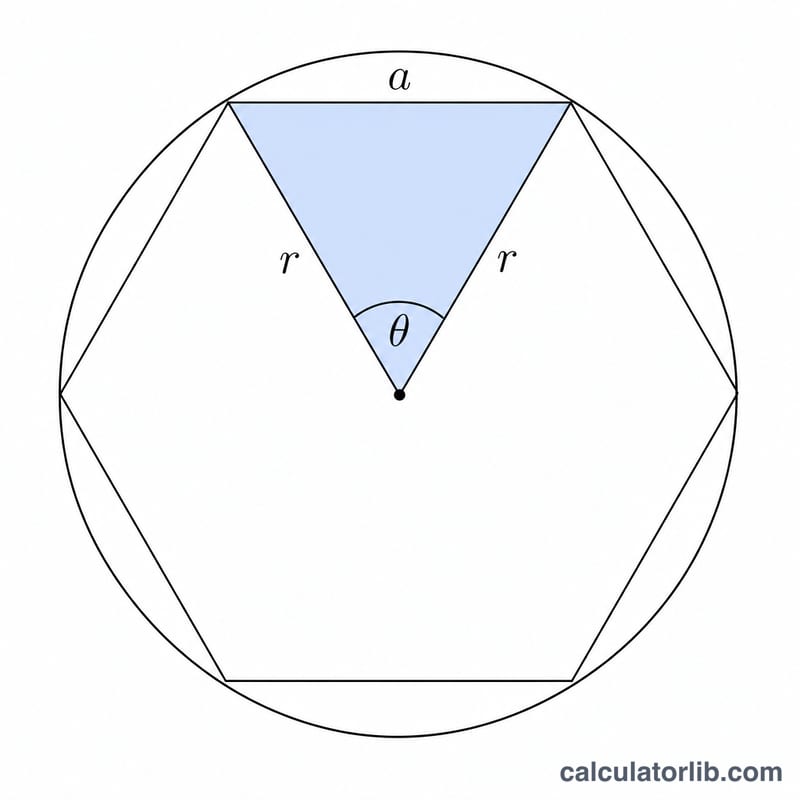
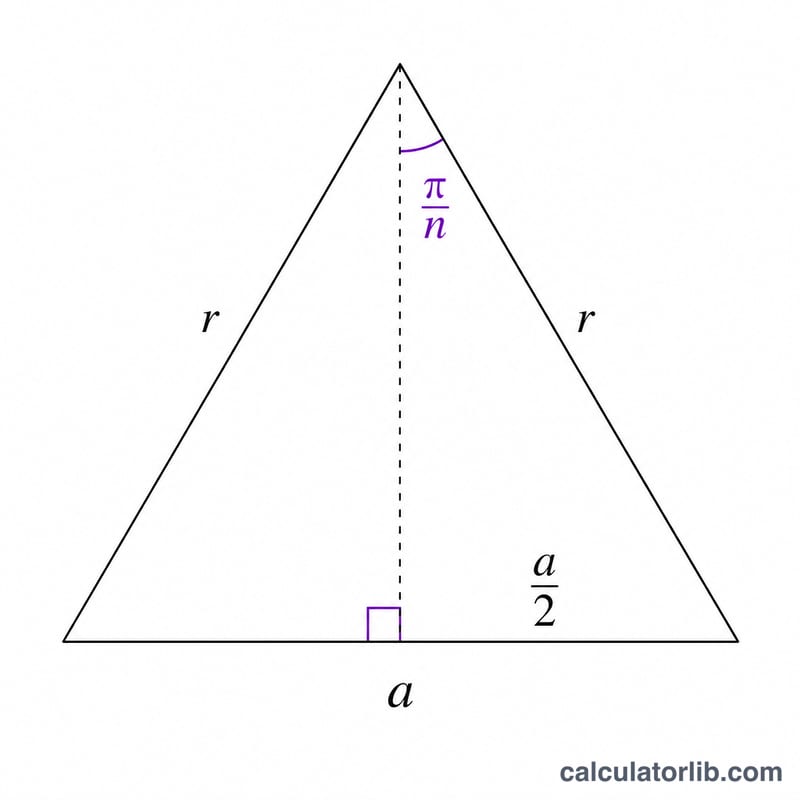
An inscribed regular n-gon splits into n identical isosceles triangles. Each has two radius-length sides meeting at the center with an apex angle of \(\frac{2\pi}{n}\). The polygon side is the triangle's base, \(a = 2r\cdot\sin\!\left(\frac{\pi}{n}\right)\) (using the half-angle \(\frac{\pi}{n}\)). Each triangle has area \(\frac{1}{2}r^{2}\cdot\sin\!\left(\frac{2\pi}{n}\right)\), so the whole polygon area is
$$S_p = \tfrac{1}{2}\cdot n\cdot r^{2}\cdot\sin\!\left(\frac{2\pi}{n}\right)$$The circle area is simply \(S_c = \pi r^{2}\). As \(n \to \infty\), \(S_p \to S_c\) — the classic limiting argument for the area of a circle.
Worked example
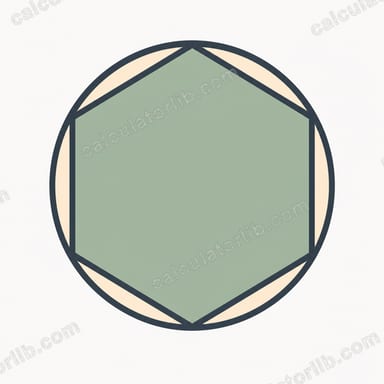
For \(r = 1\) and a regular hexagon (\(n = 6\)):
$$a = 2\cdot 1\cdot\sin\!\left(\frac{\pi}{6}\right) = 2\cdot 0.5 = 1.0$$$$S_p = \tfrac{1}{2}\cdot 6\cdot 1\cdot\sin(60°) = 3\cdot 0.8660254 = 2.5980762$$The circle area is \(S_c = \pi \approx 3.1415927\), so the hexagon already fills about 83% of the circle.
FAQ
Why must n be at least 3? A polygon needs a minimum of three sides; fewer cannot enclose an area.
What units should I use? Any — the radius is used directly with no conversion. If r is in cm, the side is in cm and areas in cm².
Why does the polygon area approach the circle area? Each extra side makes the polygon a better approximation of the circle, so for large n the area difference shrinks toward zero.