
What Is a Circle Inscribed in a Square?
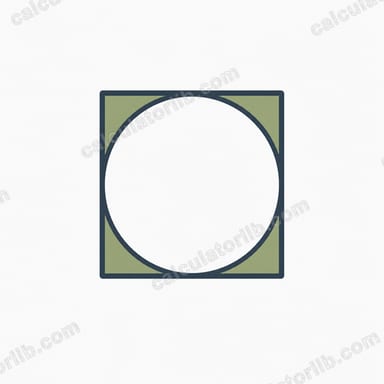
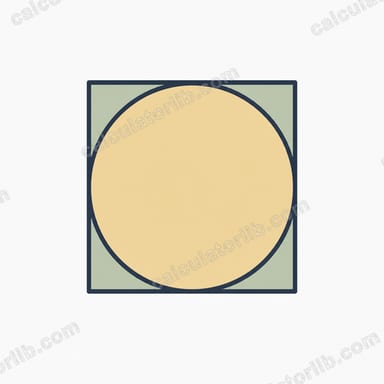
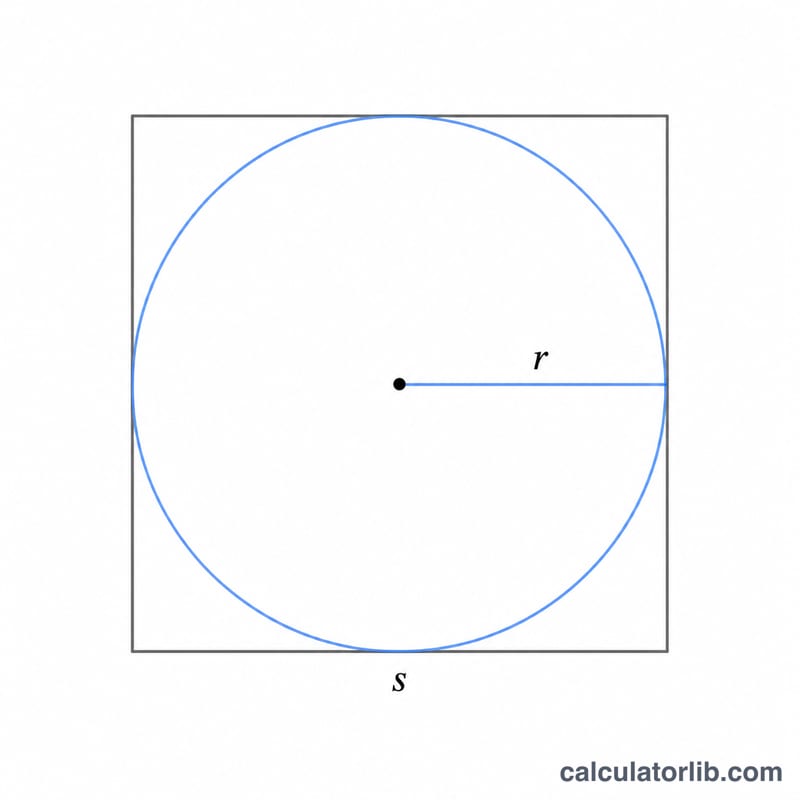
An inscribed circle is the largest circle that fits perfectly inside a square, touching each of its four sides at exactly one point. Because the circle spans from one side to the opposite side, its diameter equals the side length of the square. This calculator takes the square's side length and instantly returns the inscribed circle's radius, diameter, area, circumference, and how much of the square the circle covers.
How to Use the Calculator
Enter the side length \(s\) of your square in any unit you like — centimetres, inches, metres, etc. The results use the same unit (lengths in your unit, areas in your unit squared). The tool computes everything automatically, including the leftover area in the four corners that the circle does not cover.
The Formula Explained
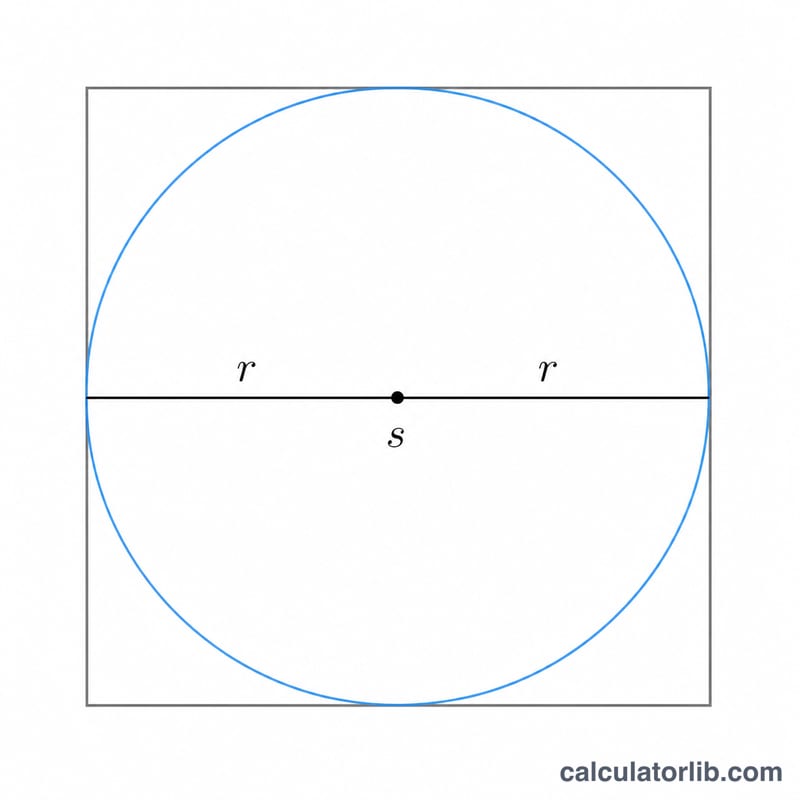
Since the inscribed circle touches both pairs of opposite sides, the diameter \(d\) equals \(s\). The radius is therefore half the side: \(r = s/2\). Plugging this radius into the standard circle area formula \(A = \pi r^2\) gives $$A = \pi\left(\frac{s}{2}\right)^{2} = \frac{\pi s^{2}}{4}$$ The circumference is \(C = \pi d = \pi s\), and the square's area is simply \(s^2\). The fraction of the square covered by the circle is always \(\frac{\pi}{4} \approx 78.54\%\), regardless of size.
Worked Example
Suppose a square has a side of 10 units. The radius is \(r = 10/2 = 5\) units. The circle area is $$\frac{\pi \times 10^{2}}{4} = \frac{100\pi}{4} = 25\pi \approx 78.54 \text{ square units}$$ The square area is 100, so the leftover corner area is \(100 - 78.54 = 21.46\) square units, and coverage is 78.54%.
FAQ
Why is the diameter equal to the side length? Because the largest circle touches all four sides, it must stretch the full width of the square, making its diameter equal to \(s\).
What percentage of the square does the circle cover? Always \(\frac{\pi}{4} \approx 78.54\%\), no matter how large the square is.
What units should I use? Any consistent unit. Whatever unit you enter for the side, lengths come back in that unit and areas in that unit squared.