
What this circle calculator does
This tool solves a circle completely from a single known measurement. Pick which property you know — radius, diameter, circumference, or area — enter its value, and the calculator returns all four quantities. It also expresses the circumference and area "in terms of pi," meaning as a clean coefficient multiplied by pi (for example \(C = 10\pi\) or \(A = 25\pi\)).
How to use it
Choose a calculation mode that matches what you already know. Type the value into the single input field. Optionally override pi (handy if your homework wants 3.14 or 22/7), pick a display unit (purely a label — no conversion is performed), and choose how many significant figures to round to. Every answer is computed at full precision internally and only rounded for display.
The formulas explained
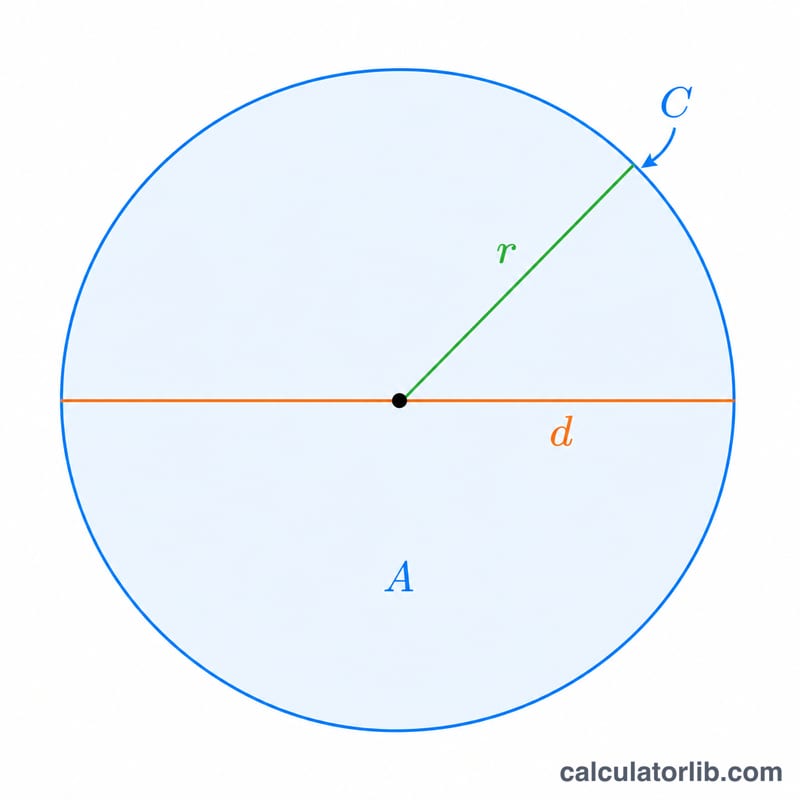
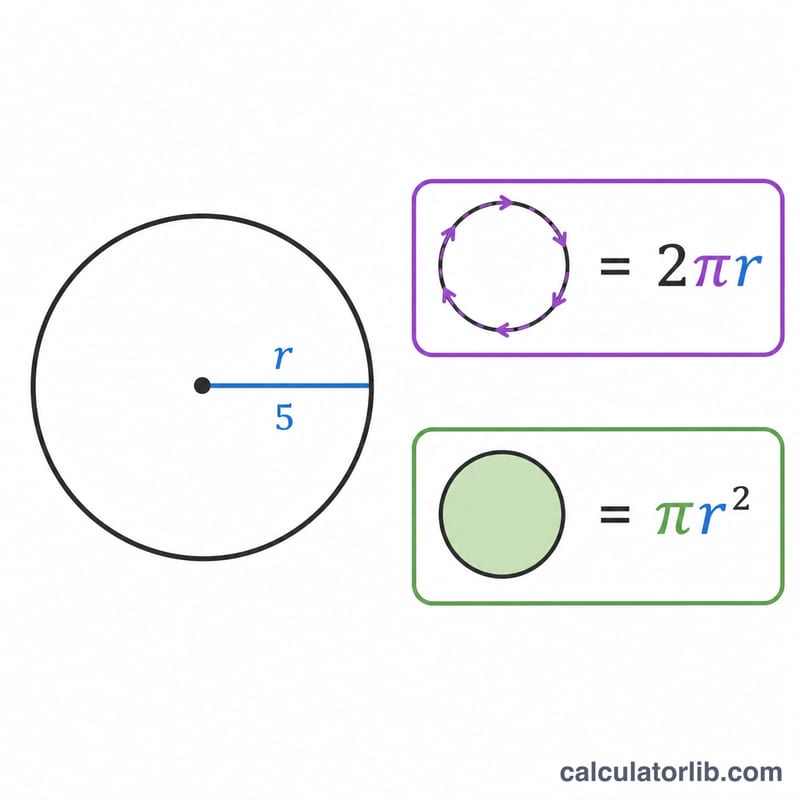
All circle relationships flow from the radius \(r\). The diameter is simply twice the radius, $$d = 2r$$. The distance around the edge is $$C = 2\pi r$$ equivalently \(\pi d\). The enclosed area is $$A = \pi r^2$$ Working backwards, if you know the area then \(r = \sqrt{A / \pi}\); if you know the circumference then \(r = C / (2\pi)\); if you know the diameter then \(r = d / 2\). The "in terms of pi" coefficients are just \(C / \pi\ (= 2r)\) and \(A / \pi\ (= r^2)\).
Worked example
Suppose the radius is 5 cm with pi = 3.14159265359 and 6 significant figures. Then $$d = 2 \times 5 = 10 \text{ cm},$$ $$C = 2 \times \pi \times 5 \approx 31.4159 \text{ cm},$$ and $$A = \pi \times 5^2 \approx 78.5398 \text{ cm}^2.$$ The symbolic forms are \(C = 10\pi\) and \(A = 25\pi\).
FAQ
Does changing the units convert my numbers? No. The unit dropdown only adds a label suffix (and the squared label for area). All outputs stay in the same unit as your input.
Why let me change pi? Many textbooks specify a rounded value of pi such as 3.14 or 22/7. Overriding pi lets your answers match the expected solution exactly.
What does "significant figures: auto" do? It shows the full computed precision with no forced rounding, useful when you want the most exact result.