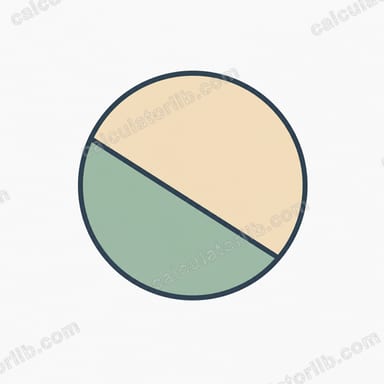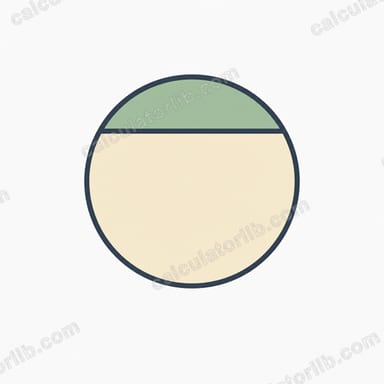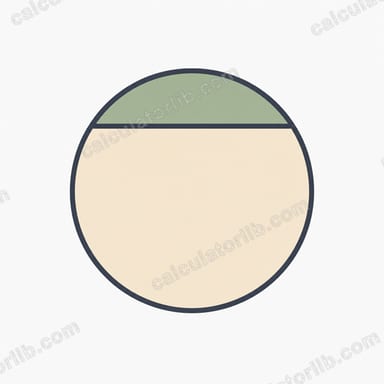

What is a circular segment?
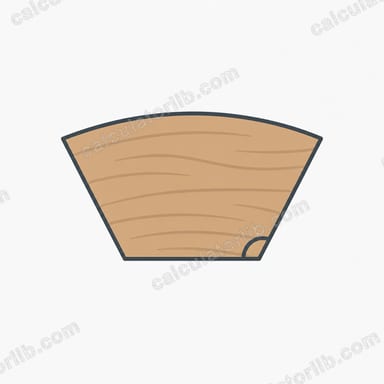
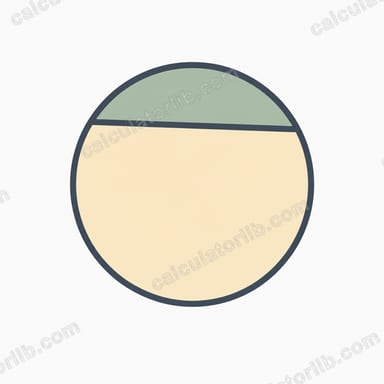
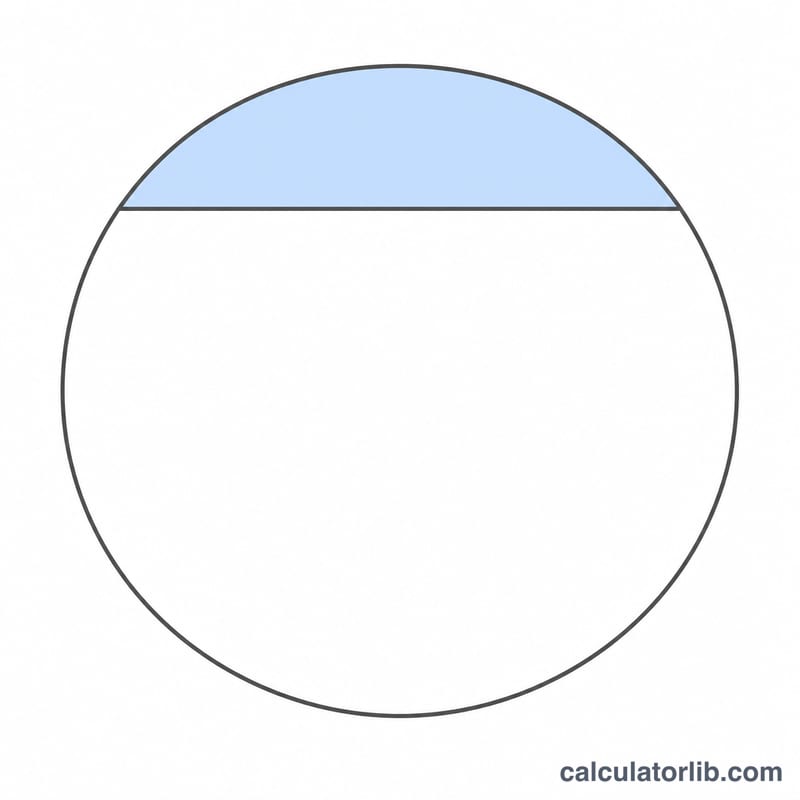
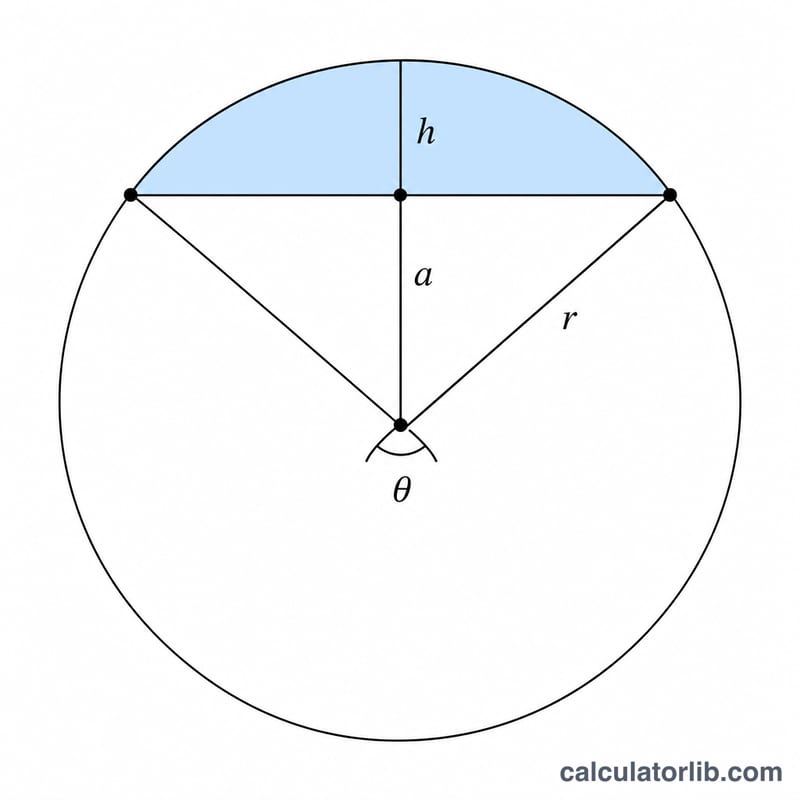
A circular segment is the region of a circle bounded by a chord (a straight line joining two points on the circle) and the arc that the chord cuts off. It looks like a slice with a flat top. The segment is defined by the parent circle's radius r and the central angle theta that subtends the arc. This calculator returns every key property at once: chord length, arc length, segment height (sagitta), the distance from the center to the chord, the area, and the perimeter.
How to use it
Enter the circle's radius and choose its length unit (mm, cm, m, km, in, ft, yd or mi). Enter the central angle and pick degrees or radians. The calculator converts internally to SI units, computes the geometry, and reports lengths back in your chosen unit, area in that unit squared, and the angle in both radians and degrees. The valid range for the angle is 0 to 360 degrees (0 to 2 pi radians); at 180 degrees the chord is a diameter and the segment is a semicircle.
The formulas explained
With theta in radians and r the radius: the chord is \(c = 2r\cdot\sin(\theta/2)\), the arc is \(s = r\cdot\theta\), the height is \(h = r(1 - \cos(\theta/2))\), the distance from center to chord is \(d = r\cdot\cos(\theta/2) = r - h\), and the area is \(A = (r^2/2)(\theta - \sin\theta)\). The perimeter is simply \(P = c + s\). The area formula automatically returns the larger (major) segment when theta exceeds 180 degrees, because sin theta becomes negative there.
Worked example
For a radius of 5 cm and a central angle of 90 degrees (theta = 1.570796 rad): chord $$c = 10\cdot\sin(0.785398) = 7.0711 \text{ cm},$$ arc $$s = 5\cdot 1.570796 = 7.8540 \text{ cm},$$ height $$h = 5(1 - 0.707107) = 1.4645 \text{ cm},$$ apothem \(d = 3.5355\) cm, area $$A = 12.5(1.570796 - 1) = 7.1350 \text{ cm}^2,$$ and perimeter \(P = 14.9250\) cm.
FAQ
Is a segment the same as a sector? No. A sector is bounded by two radii and an arc (a pie slice); a segment is bounded by a chord and an arc. The segment area equals the sector area minus the triangle area.
What is the sagitta? The sagitta is the segment height h, the greatest perpendicular distance from the chord to the arc.
Can the angle be more than 180 degrees? Yes. Angles between 180 and 360 degrees describe the major segment, and the area formula handles this case directly.