
What is the Bowl Segment Calculator?
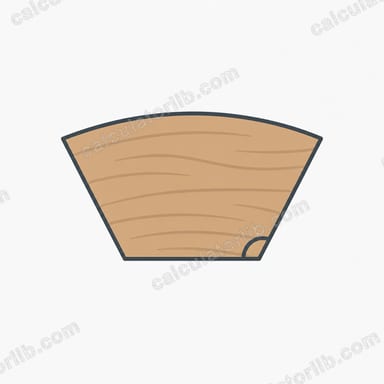
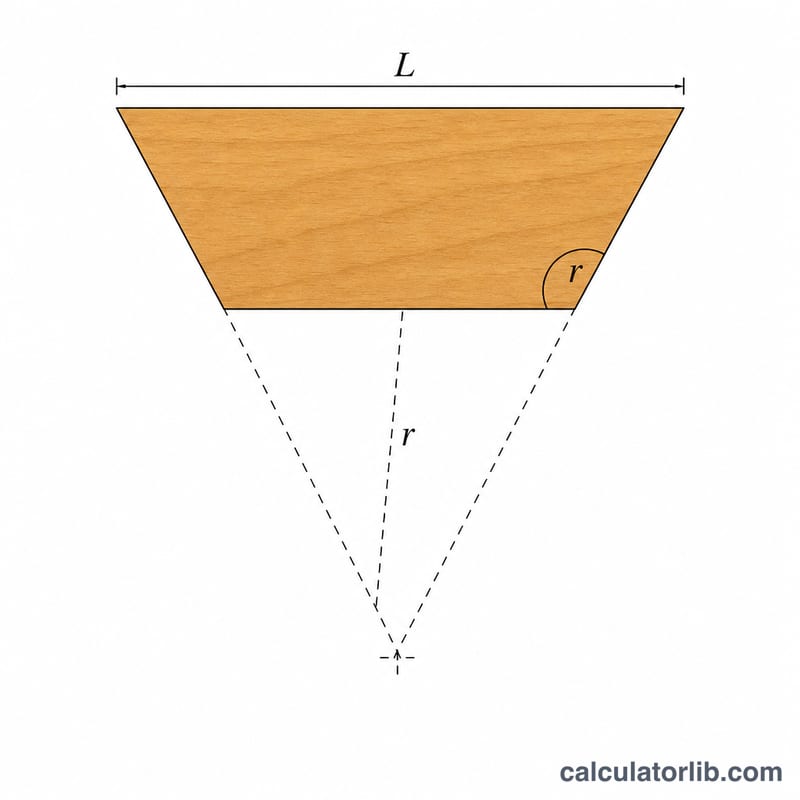
Segmented woodturning builds bowls and vessels from rings, and each ring is made of several wedge-shaped segments glued edge to edge. This calculator gives you the three numbers you need to cut those wedges accurately: the segment angle, the miter (cut) angle you set on your saw, and the segment length along the outer edge of each piece. It works for any segment count and ring size and uses pure geometry, so it applies in any country or unit system.
How to use it
Enter the number of segments in the ring (commonly 8, 12, 16 or 24) and the radius of the ring (the distance from the center to the outer edge). Click calculate and the tool returns the miter angle to set on your miter saw or table saw sled, plus the outer edge length of each segment so you can rough-cut your strips.
The formula explained
A full circle is 360°, so each segment occupies a segment angle of \(360 / n\). Because two segment ends meet at each joint, each end is cut at half that — the miter angle of \(180 / n\). The outer-edge length comes from trigonometry: a segment subtends an angle of \(2\pi/n\) at the center, and the chord-style edge length for a ring of radius \(r\) is
$$L = 2r\cdot\tan\!\left(\frac{\pi}{n}\right)$$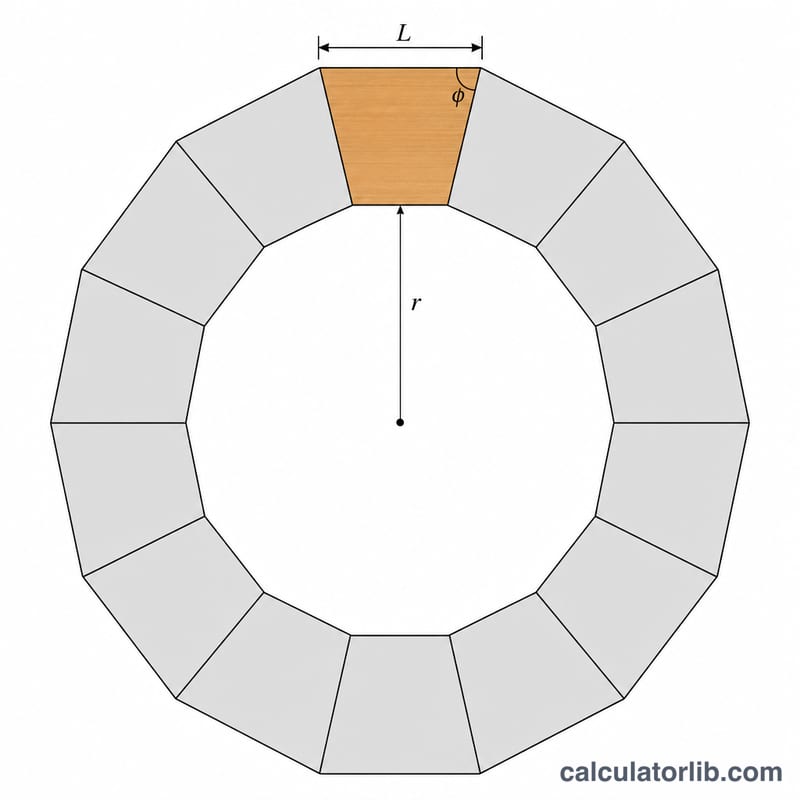
Worked example
For a 12-segment ring with a 5 inch radius: segment angle
$$\theta = \frac{360}{12} = 30^\circ,$$miter angle
$$\phi = \frac{30}{2} = 15^\circ,$$and segment length
$$L = 2 \times 5 \times \tan\!\left(\frac{\pi}{12}\right) = 10 \times 0.2679 \approx 2.679 \text{ inches}.$$You would set your saw to 15° and cut twelve pieces about 2.68 inches long on the outer edge.
Practical Cutting Recommendations
Accurate angles are only half the job — small real-world errors accumulate around a full ring of many segments, so build in margin and verify as you go.
- Cut segments slightly long and sand to fit. Calculated lengths are exact mathematically, but blade deflection and tear-out mean the true fit is best dialed in by leaving each piece a hair long and trimming or sanding on a disc sander until the ring closes with no gaps.
- Add an extra segment or two of stock per ring. Cut one or two spare pieces beyond the count you need for each ring. A single chipped, mis-angled, or short segment otherwise forces you to re-set the saw and re-cut a matched batch.
- Alternate grain direction. Orient adjacent segments so the grain runs consistently around the ring (or deliberately alternate for a chevron look). Consistent orientation keeps wood movement and sanding behavior uniform and the finished bowl stronger.
- Account for saw kerf. Each cut removes material equal to the blade kerf. When ripping segments from a single strip, measure to the cut line — not from the previous segment's edge — or the cumulative kerf loss will leave the final pieces short.
- Dry-fit every ring before gluing. Assemble all segments with a band clamp or hose clamp and no glue first. If the ring closes tight with no visible gaps, glue up; if a gap appears, a tiny error in the miter angle is being multiplied by the segment count, so shave the angle and re-test before committing glue.
A reliable check: with the ring dry-clamped, any total gap means your miter angle is slightly off. Dividing the gap by the number of joints tells you how much to correct each cut. For estimating how much board stock to buy for all the rings in a project, run your finished segment dimensions through a board-foot estimate so you order enough lumber up front.
FAQ
Should I use inner or outer radius? Use the outer radius for the length the formula returns the outer edge; the inner edge is shorter.
Why is my saw angle half the segment angle? Each joint is formed by two cut faces, so each piece supplies half of the total angle at that joint.
Does this account for blade kerf or sanding? No — cut slightly long and sand the joints flush. Always test-fit a dry ring before gluing.