
What Is a Circular Segment?
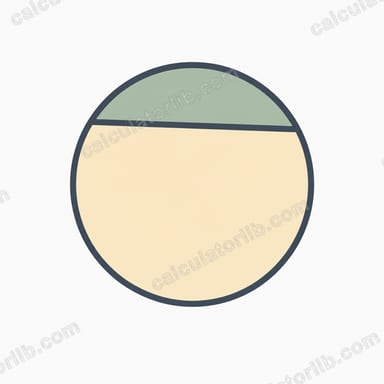
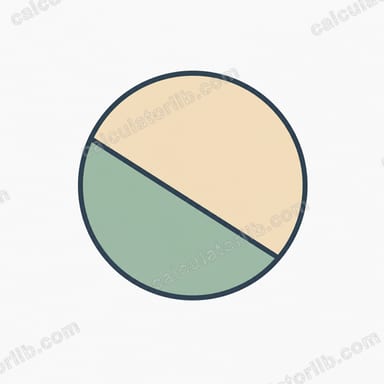
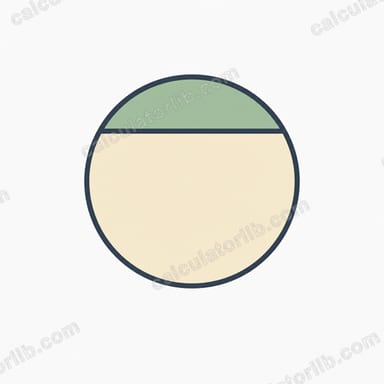
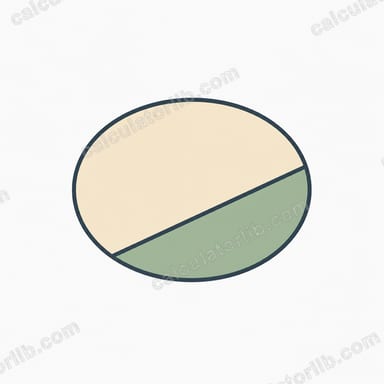
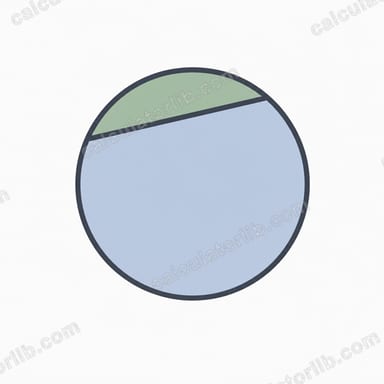
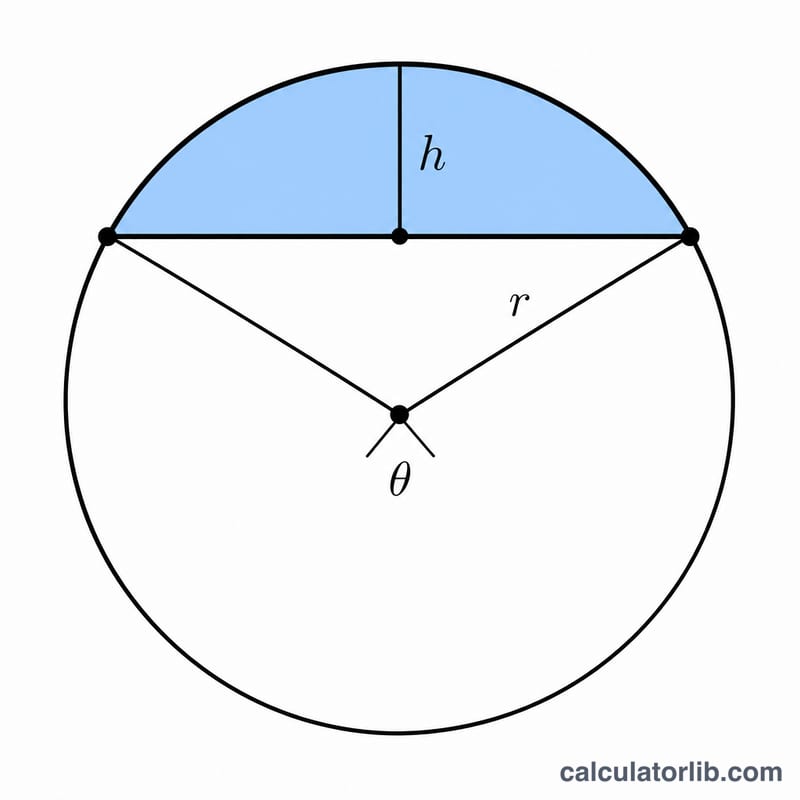
A circular segment is the region of a circle "cut off" by a straight line (a chord). It is the area between the chord and the arc it subtends. This calculator finds that area from the circle's radius and the central angle subtended by the chord, and also reports the arc length, chord length, and sagitta (the maximum height of the segment).
How to Use the Calculator
Enter the radius r of the circle and the central angle θ. Choose whether your angle is in degrees or radians. The calculator converts degrees to radians automatically before applying the formula. Press calculate to see the segment area along with arc length, chord length, and segment height.
The Formula Explained
The segment area is given by:
$$A = \frac{1}{2}\,r^{2}\left(\theta - \sin\theta\right)$$
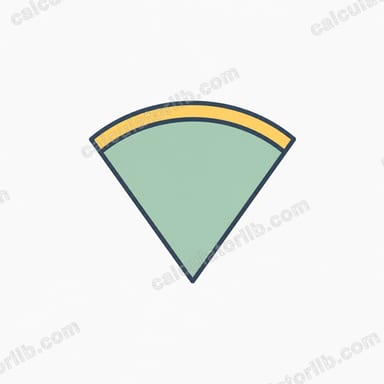
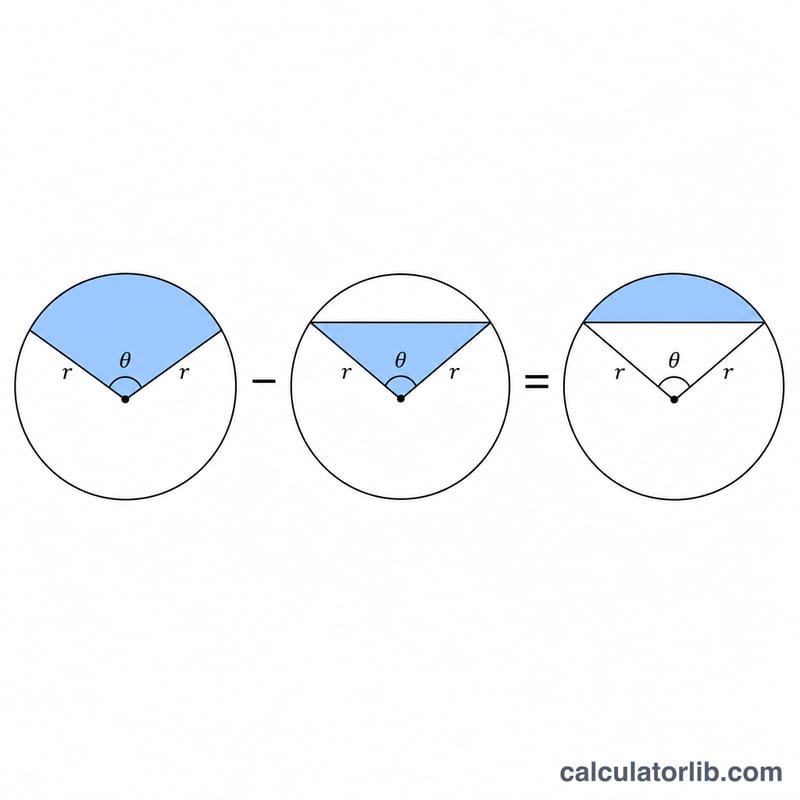
Here \(\theta\) must be in radians. The term \(\frac{1}{2}\,r^{2}\theta\) is the area of the circular sector (the pie slice), and \(\frac{1}{2}\,r^{2}\sin\theta\) is the area of the triangle formed by the two radii and the chord. Subtracting the triangle from the sector leaves just the segment. To convert degrees to radians, multiply by \(\pi/180\).
Worked Example
Suppose \(r = 5\) and \(\theta = 90°\). Convert: $$\theta = 90 \times \frac{\pi}{180} = 1.570796 \text{ rad}.$$ Then \(\sin\theta = \sin(90°) = 1\). So $$A = 0.5 \times 25 \times (1.570796 - 1) = 0.5 \times 25 \times 0.570796 = 7.13495 \text{ square units}.$$ The chord length is \(2 \times 5 \times \sin(45°) \approx 7.0711\), and the sagitta is \(5 \times (1 - \cos 45°) \approx 1.4645\).
FAQ
Is the angle the same as the arc? The central angle \(\theta\) is measured at the center of the circle between the two radii to the chord endpoints. The arc length equals \(r\cdot\theta\) (\(\theta\) in radians).
What if my angle is more than 180°? The formula still works for \(\theta\) up to 360° (\(2\pi\)), giving the larger "major" segment area when \(\theta > 180°\).
What units does the answer use? Area is in square units of whatever unit your radius uses — if r is in cm, area is in cm².