
What is a circular segment?
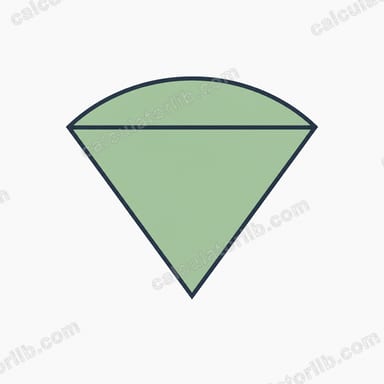
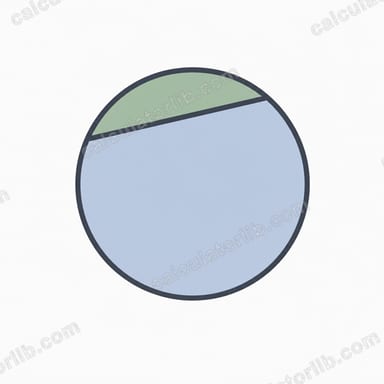
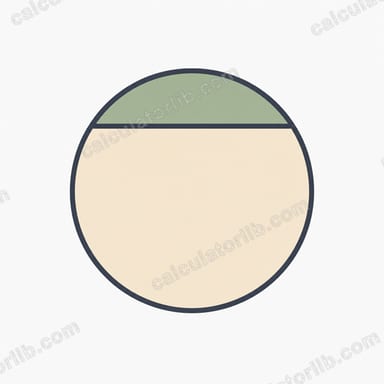
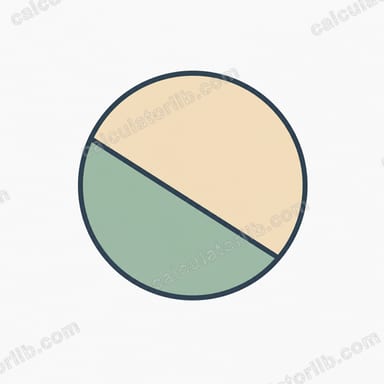
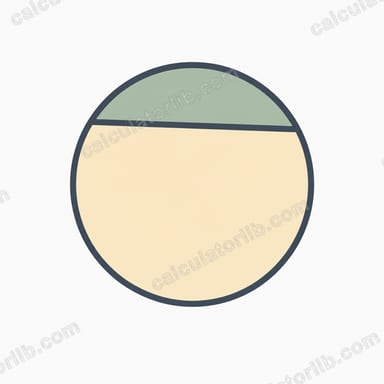
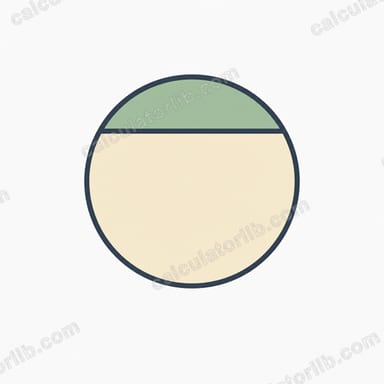
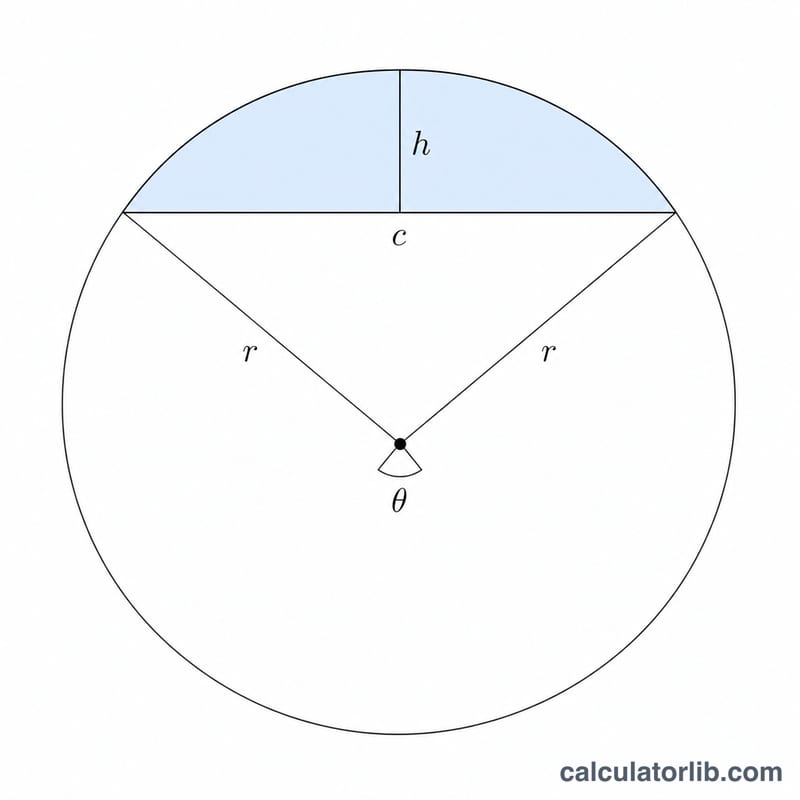
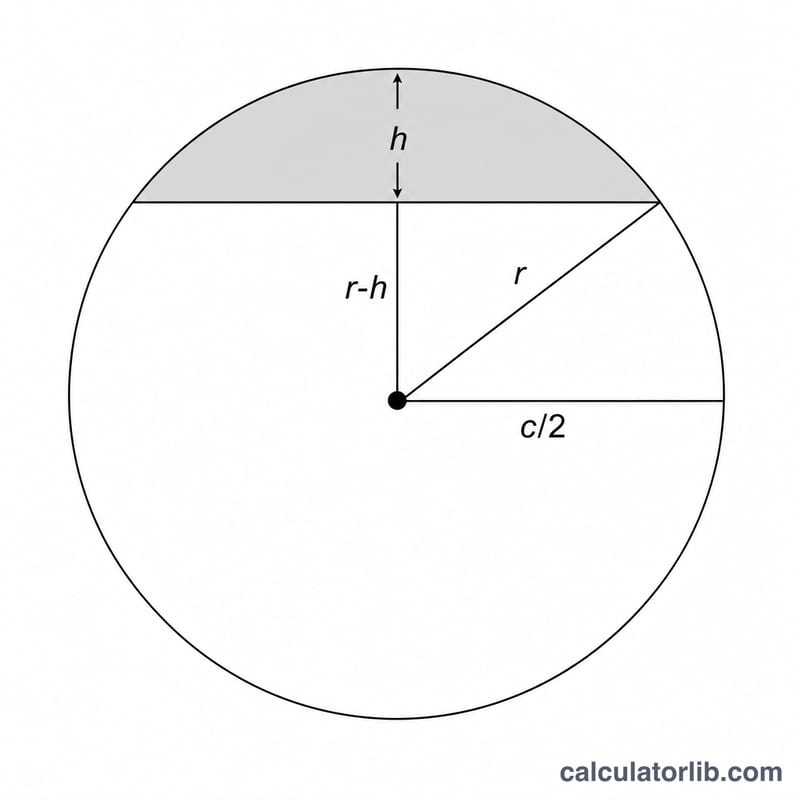
A circular segment is the "bow shape" region of a circle bounded by a straight chord and the arc it cuts off. It is described by two easily measured quantities: the chord length c (the straight base) and the height h, also called the sagitta, which is the greatest distance from the midpoint of the chord up to the arc. This calculator takes c and h and returns the segment area S, the central angle the arc subtends (in both radians and degrees), the arc length L, and the radius r of the parent circle.
How to use it
Enter the chord length and the segment height in any consistent length unit (meters, inches, pixels — whatever you like). All length outputs (L and r) come back in that same unit, the area S in that unit squared, and angles in radians and degrees. The height h must be greater than zero.
The formulas explained
First the radius is recovered from the chord relation \(c = 2\sqrt{h(2r - h)}\), which rearranges to the standard sagitta formula \(r = \dfrac{h}{2} + \dfrac{c^{2}}{8h}\). The central angle is then \(\theta = 2\cos^{-1}\!\left(1 - \dfrac{h}{r}\right)\), the arc length is \(L = r\cdot\theta\), and the segment area is $$S = \frac{\theta}{2}\cdot r^{2} - (r - h)\cdot\sqrt{h(2r - h)}.$$ Because \(\sqrt{h(2r - h)}\) equals \(c/2\), the area can also be written $$S = \frac{\theta}{2}\cdot r^{2} - (r - h)\cdot\frac{c}{2}.$$
Worked example
For \(c = 1.2\) and \(h = 0.5\): $$r = 0.25 + \frac{1.44}{4} = 0.61.$$ Then \(1 - h/r = 0.180328\), so $$\theta = 2\cdot\arccos(0.180328) = 2.778906 \text{ rad} = 159.22^{\circ}.$$ The arc length is $$L = 0.61 \times 2.778906 = 1.695133.$$ Since \(\sqrt{0.5\cdot 0.72} = 0.6\), the area is $$S = 1.389453\cdot 0.3721 - 0.11\cdot 0.6 = 0.516916 - 0.066 = \mathbf{0.450916}.$$
FAQ
What if h equals r? The segment is exactly a semicircle and \(\theta = \pi\) (180°).
Can h exceed r? Yes — the segment is then larger than a semicircle. The formula stays valid as long as \(h \le 2r\); at \(h = 2r\) you get the full circle (\(\theta = 2\pi\)).
What units should I use? Any single consistent length unit. The result simply inherits it (length, length squared, and angle).