
What Is Voltage Regulation?
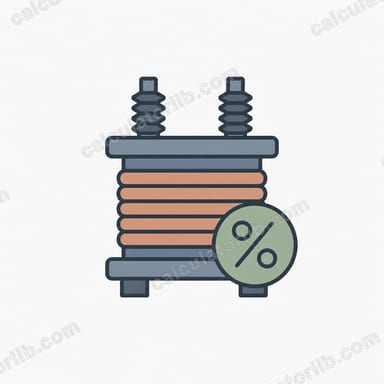
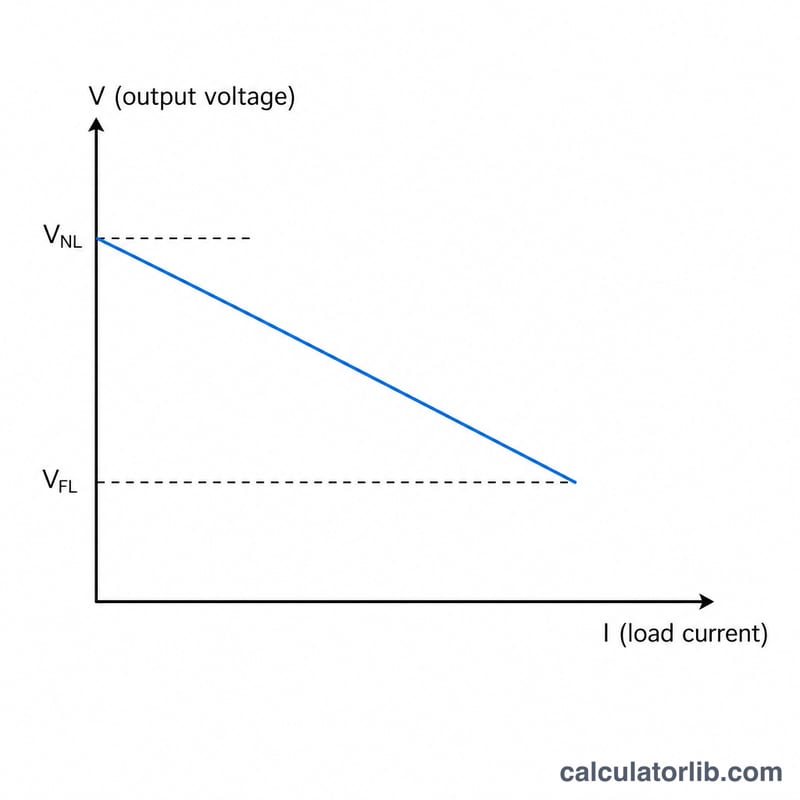
Voltage regulation describes how much the terminal voltage of a transformer, generator, or transmission line changes when load is applied. It is the percentage difference between the no-load voltage and the full-load voltage, expressed relative to the full-load value. A lower percentage means a stiffer, more stable supply; a higher percentage indicates significant voltage sag under load. This is a universal electrical engineering metric and applies anywhere.
How to Use This Calculator
Enter the measured or rated no-load voltage (VNL) — the voltage at the terminals with no current drawn — and the full-load voltage (VFL) — the voltage measured while the device delivers rated load. The calculator returns the percent voltage regulation, the absolute voltage drop, and echoes your inputs. All values use the same voltage unit (volts).
The Formula Explained
The regulation is computed as:
$$\text{VR}\% = \frac{\text{No-Load V} - \text{Full-Load V}}{\text{Full-Load V}} \times 100\%$$
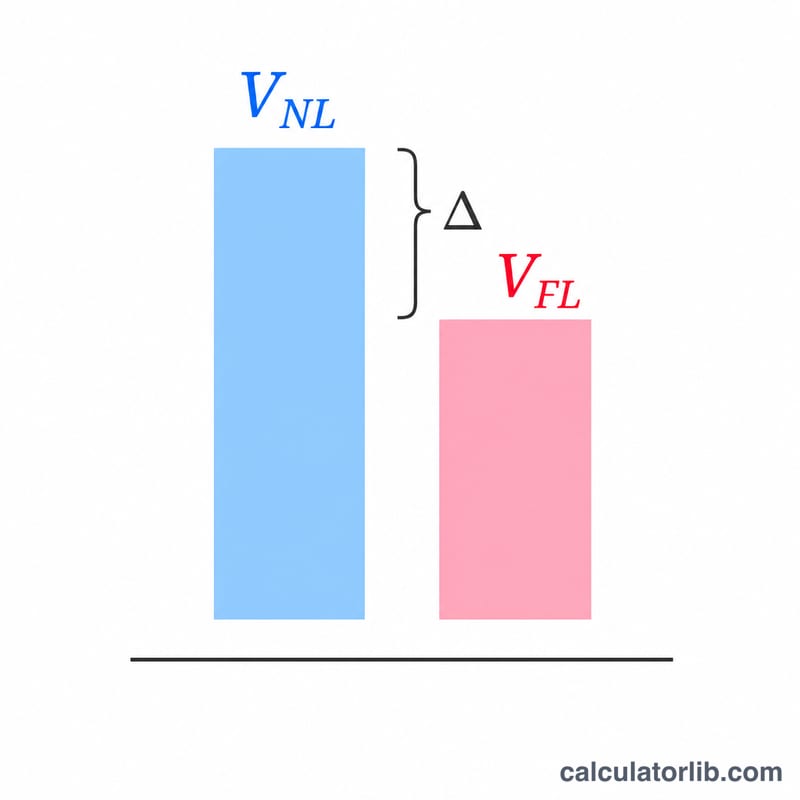
The numerator is the voltage drop caused by internal impedance and load current. Dividing by the full-load voltage normalizes the drop, and multiplying by 100 converts it to a percentage. A negative result indicates the voltage actually rose under load (possible with leading/capacitive loads).
Worked Example
Suppose a transformer reads 240 V at no load and 230 V at full load. Then $$\text{VR}\% = \frac{240 - 230}{230} \times 100 = \frac{10}{230} \times 100 \approx 4.35\%.$$ This means the output sags by about 4.35% from no-load to full-load.
FAQ
What is a good voltage regulation value? Lower is better. Distribution transformers commonly target a few percent; values under 5% are typical for well-designed equipment.
Can voltage regulation be negative? Yes. With leading (capacitive) power factor loads, the full-load voltage can exceed the no-load voltage, giving a negative VR%.
Does the unit matter? No — as long as both voltages use the same unit, the percentage result is unit-independent.