
What Is DC Voltage Drop?
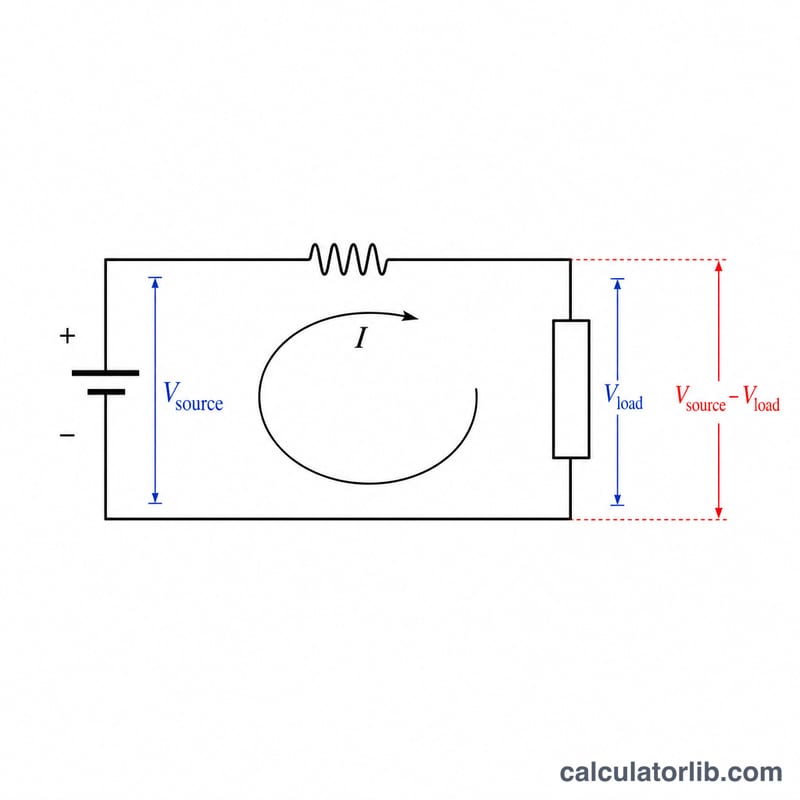
Voltage drop is the loss of electrical potential as current flows through the resistance of a conductor. In a DC circuit, every wire has some resistance, and pushing current through it consumes a small amount of voltage that never reaches the load. Excessive drop can dim lights, slow motors, and trip low-voltage devices, so estimating it before wiring a run is essential for solar arrays, automotive systems, RVs, and battery banks.
How to Use This Calculator
Enter the load current in amps, the one-way wire length in feet, the conductor resistance per 1000 ft (a value you can look up by wire gauge — e.g. ~1.588 Ω/1000 ft for 12 AWG copper), and the source voltage. The tool returns the voltage dropped, the drop as a percentage, the voltage actually delivered to the load, and the total resistance of the round-trip wiring.
The Formula Explained
The drop follows Ohm law:
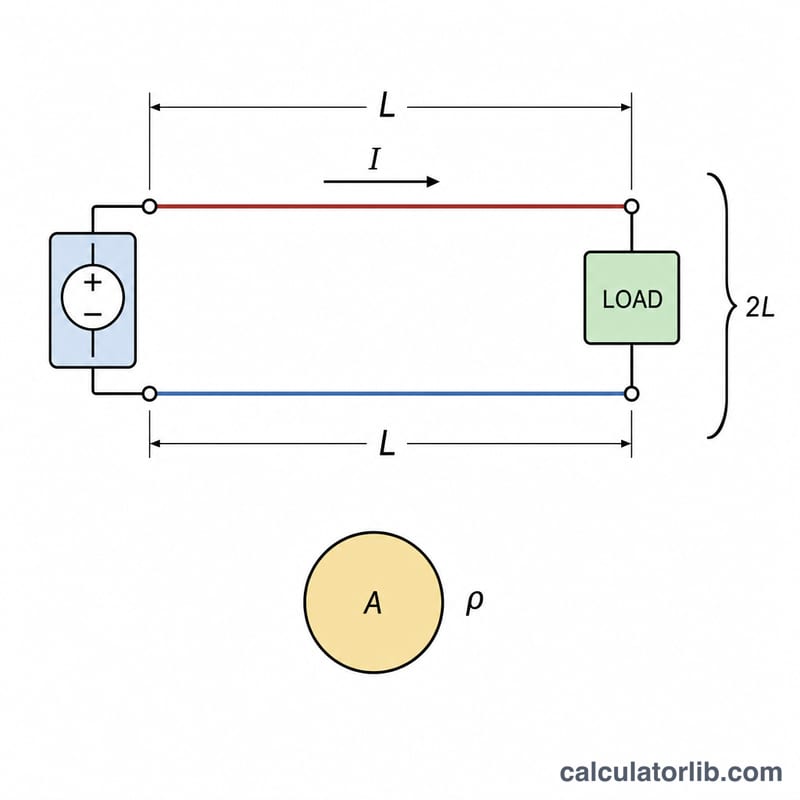
$$V_{drop} = I \times R$$Because current must travel out to the load and back, both conductors count, so the resistance uses twice the one-way length \(L\):
$$R = \frac{2L \times \rho}{1000}$$where \(I\) = current in amps, \(L\) = one-way length in feet, and \(\rho\) = resistance in ohms per 1000 ft. The percentage drop is \(\frac{V_{drop}}{V_{source}} \times 100\).
Worked Example
A 10 A load on a 12 V system runs 50 ft of 12 AWG copper (1.588 Ω/1000 ft):
$$R = \frac{2 \times 50 \times 1.588}{1000} = 0.1588\,\Omega$$$$V_{drop} = 10 \times 0.1588 = 1.588\,\text{V}$$That is about \(13.23\%\) drop, leaving roughly \(10.41\,\text{V}\) at the load — above a typical 3% recommendation, so a heavier gauge is advised.
FAQ
Why multiply length by 2? Current flows in a complete loop, so both the supply and return conductors add resistance.
What is an acceptable voltage drop? A common guideline is 3% or less for critical loads and 5% maximum overall.
Does this work for AC? This tool assumes pure DC resistance. AC circuits may also include reactance, which is not modeled here.