
What is impact velocity?
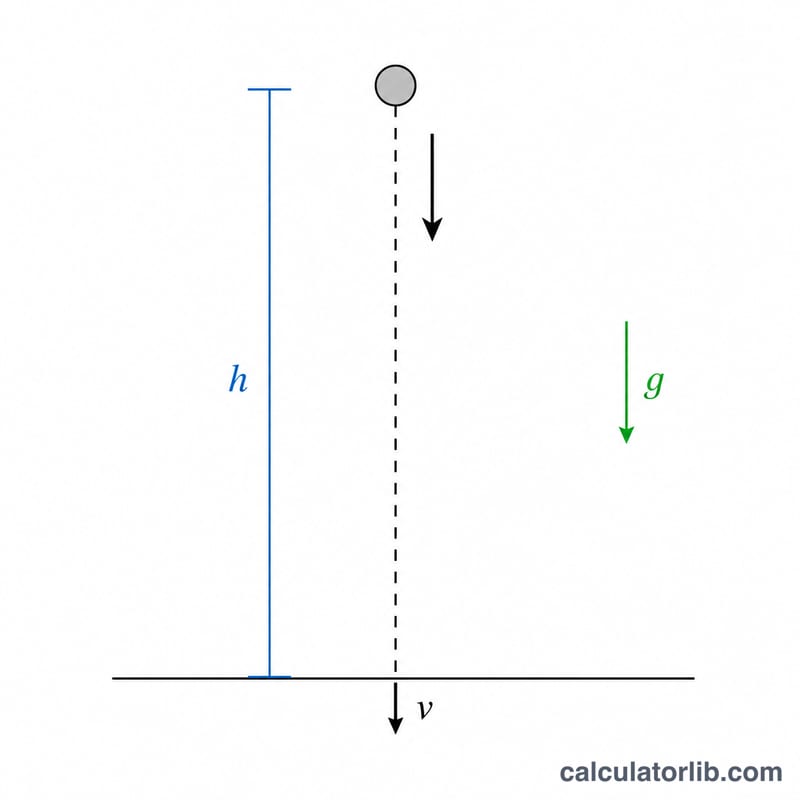
Impact velocity is the speed an object reaches at the moment it strikes the ground after being dropped from rest. Using the principle of energy conservation — where gravitational potential energy is converted into kinetic energy — the speed depends only on the drop height and the acceleration due to gravity, not on the object's mass. This calculator assumes a vacuum (no air resistance), which is a good approximation for short drops and dense objects.
How to use this calculator
Enter the drop height in meters and, if you wish, adjust the gravitational acceleration. The default value of 9.81 m/s² is Earth's standard gravity, but you can change it to model the Moon (1.62), Mars (3.71) or any other body. The calculator returns the impact velocity in meters per second, the equivalent speed in kilometers per hour, and the total time the object spends falling.
The formula explained
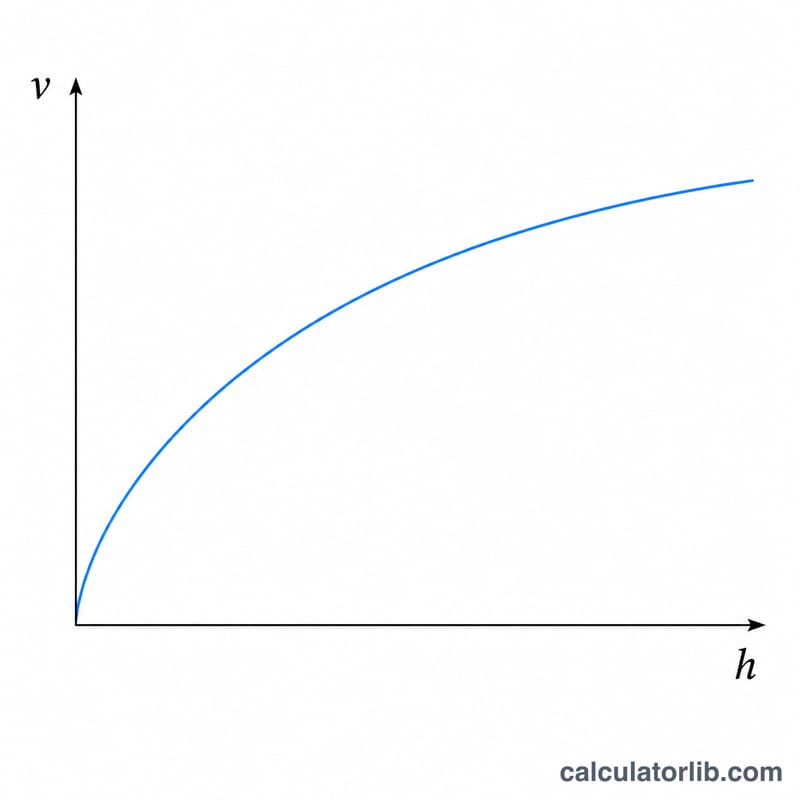
Setting potential energy equal to kinetic energy gives \(mgh = \tfrac{1}{2}mv^2\). The mass m cancels from both sides, leaving \(v^2 = 2gh\), so
$$v = \sqrt{2 \cdot g \cdot h}$$Here g is the gravitational acceleration (m/s²) and h is the drop height (m). The fall time follows from \(h = \tfrac{1}{2}gt^2\), giving \(t = \sqrt{2h/g}\).
Worked example
An object dropped from a height of 10 m on Earth:
$$v = \sqrt{2 \times 9.81 \times 10} = \sqrt{196.2} \approx 14.01 \text{ m/s}$$which is about 50.4 km/h. The fall takes \(t = \sqrt{2 \times 10 / 9.81} \approx 1.428\) seconds.
FAQ
Does mass affect impact velocity? No. In a vacuum all objects accelerate at the same rate, so a feather and a brick dropped from the same height hit at the same speed.
Why is my real-world result lower? Air resistance slows objects down, eventually reaching a terminal velocity. This calculator ignores drag, so it gives the theoretical maximum.
Can I use feet instead of meters? The formula expects consistent units. For feet, use \(g = 32.17\) ft/s² and the result will be in ft/s.