
What Is the Lumens Needed Calculator?
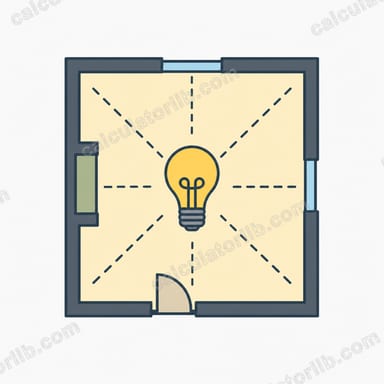
Lumens measure the total amount of visible light a bulb or fixture emits, while lux measures how brightly that light falls on a surface (one lux equals one lumen per square meter). This calculator tells you the total lumens needed to light a room by multiplying its floor area by the recommended illuminance for the activity in that space. It is a quick way to plan LED bulbs, panels, or downlights before you buy.
How to Use It
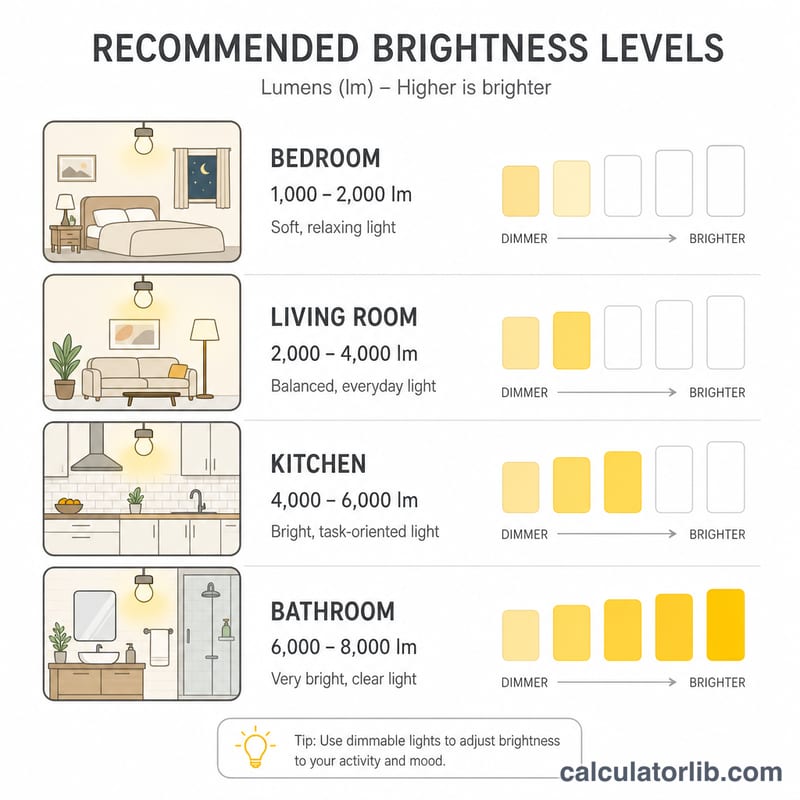
Enter the room length and width in meters and choose the target illuminance level from the dropdown. Common recommendations are around 100–150 lux for hallways and living rooms, 200–300 lux for bedrooms and kitchens, and 500–750 lux for offices and detailed workspaces. The calculator returns the total lumens you should aim for across all fixtures in the room.
The Formula Explained
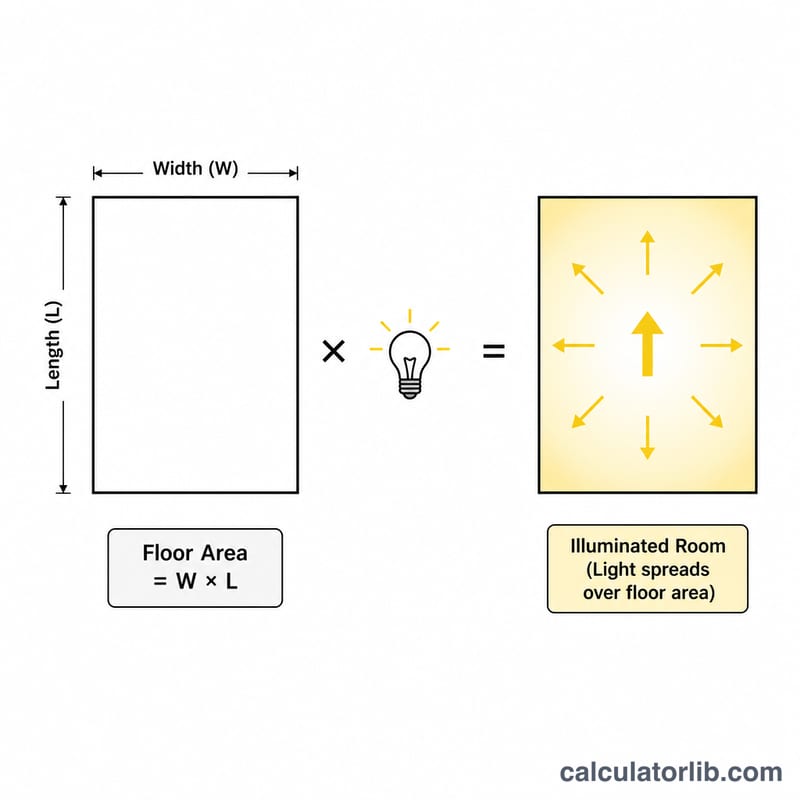
The core equation is $$\text{Lumens} = \text{Area} \times \text{Lux}$$ First, area is found from \(\text{length} \times \text{width}\). Then multiplying area by the desired lux gives the total luminous flux. Because lux is lumens per square meter, the units cancel cleanly to give lumens.
Worked Example
Imagine a 4 m × 5 m kitchen needing 300 lux. The area is 20 m², so the required lumens are $$20 \times 300 = 6{,}000 \text{ lumens}.$$ If each LED bulb produces 800 lumens, you would need roughly eight bulbs to reach that target.
FAQ
Does this account for ceiling height or wall color? No. It gives a baseline. Tall ceilings, dark walls, or fixtures with poor distribution can require 10–30% more lumens.
What if my room is not rectangular? Estimate the floor area and enter equivalent dimensions, or compute area separately and pick length/width that multiply to it.
How many bulbs do I need? Divide the total lumens by the lumen output printed on each bulb's packaging and round up.