
What Is the Lumens to Candela Calculator?
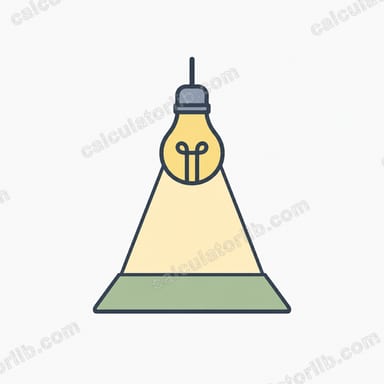
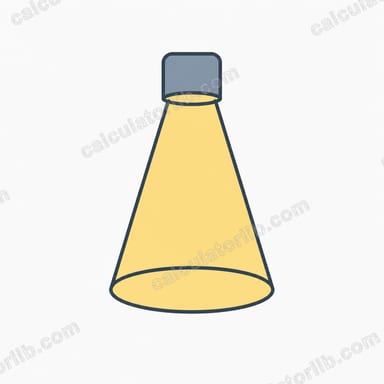
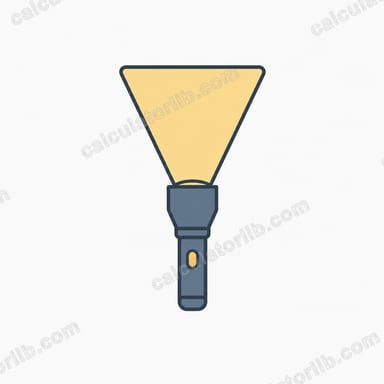
This calculator converts luminous flux (lumens, lm) into luminous intensity (candela, cd) for a light source that emits within a cone of a given apex angle. Lumens measure the total light output, while candela measures how concentrated that light is in a particular direction. A narrow beam packs the same lumens into a smaller solid angle, producing a higher candela value.
How to Use It
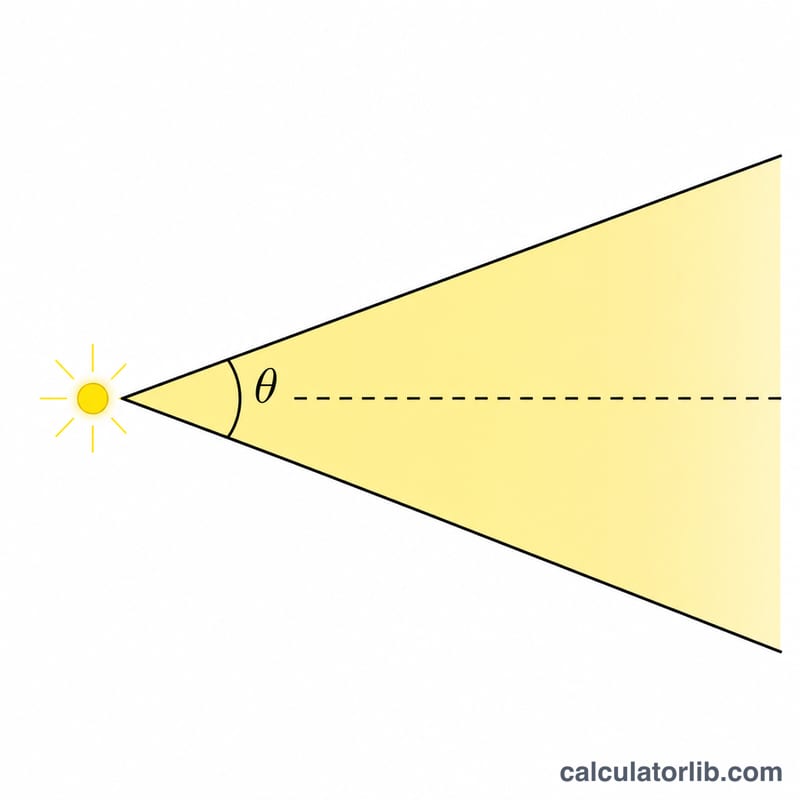
Enter the total luminous flux of your light source in lumens, and the full apex angle of the beam cone in degrees (the angle measured across the entire cone, tip to edge to edge). The calculator returns the luminous intensity in candela along with the solid angle of the beam in steradians.
The Formula Explained
Luminous intensity is flux divided by the solid angle the light fills: candela = lumens / \(\Omega\). For a symmetric cone the solid angle is $$\Omega = 2\pi\left(1 - \cos\!\left(\frac{\theta}{2}\right)\right)$$ where \(\theta\) is the full apex angle. The half-angle \(\theta/2\) is converted to radians before taking the cosine. As \(\theta\) approaches 360°, the light spreads over the full sphere (\(\Omega \to 4\pi\)) and candela drops; as \(\theta\) shrinks, the beam tightens and candela climbs.
Worked Example
Suppose a spotlight emits 1000 lm within a 30° apex angle. The half-angle is 15°, or 0.261799 rad. \(\cos(15°) = 0.965926\), so $$\Omega = 2\pi(1 - 0.965926) = 0.214132 \text{ sr}$$ Then $$\text{candela} = \frac{1000}{0.214132} \approx 4670.84 \text{ cd}$$
FAQ
Is the apex angle the full cone or half? Enter the full apex angle; the calculator halves it internally.
Why does a tighter beam give more candela? Because the same total light is squeezed into a smaller solid angle, raising intensity in the beam direction.
What if I enter 360 degrees? The light spreads over the whole sphere (\(4\pi\) sr \(\approx 12.566\)), giving the minimum candela for that flux.