
What is the Watts to Lumens Calculator?
Watts measure how much electrical power a light source consumes, while lumens measure how much visible light it actually produces. They are not the same thing, but they are linked by a quantity called luminous efficacy, expressed in lumens per watt (lm/W). This calculator converts a wattage into a lumen output once you supply the efficacy of the light source.
How to use it
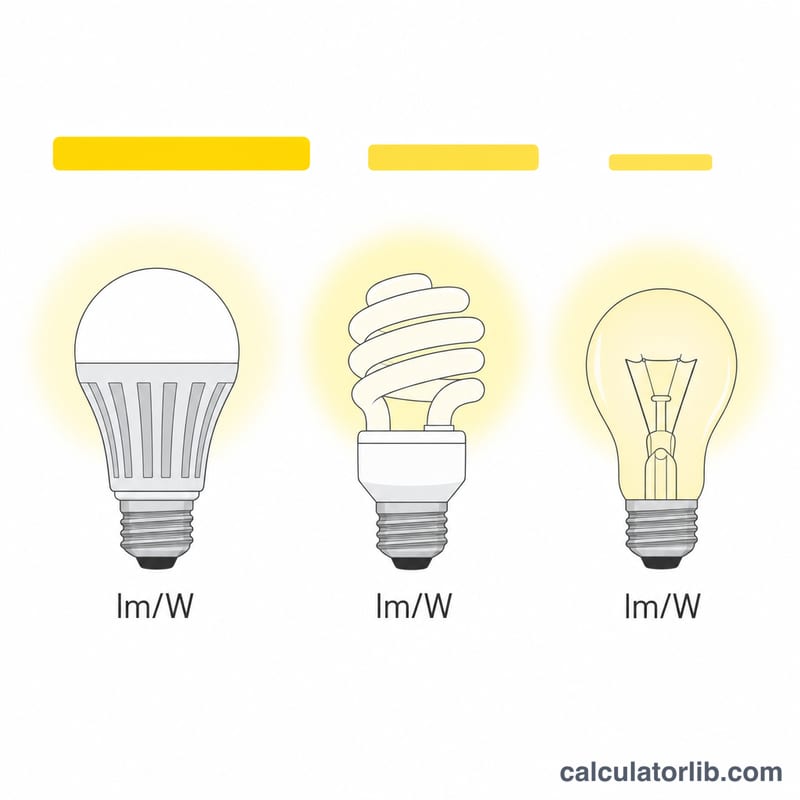
Enter the power of the bulb or fixture in watts, then enter the luminous efficacy in lumens per watt. If you are unsure of the efficacy, pick one of the quick presets: incandescent bulbs are very inefficient (~15 lm/W), halogen and CFL lamps land around 60 lm/W, and modern LEDs reach 90–120 lm/W or more. The calculator immediately shows the resulting luminous flux in lumens.
The formula explained
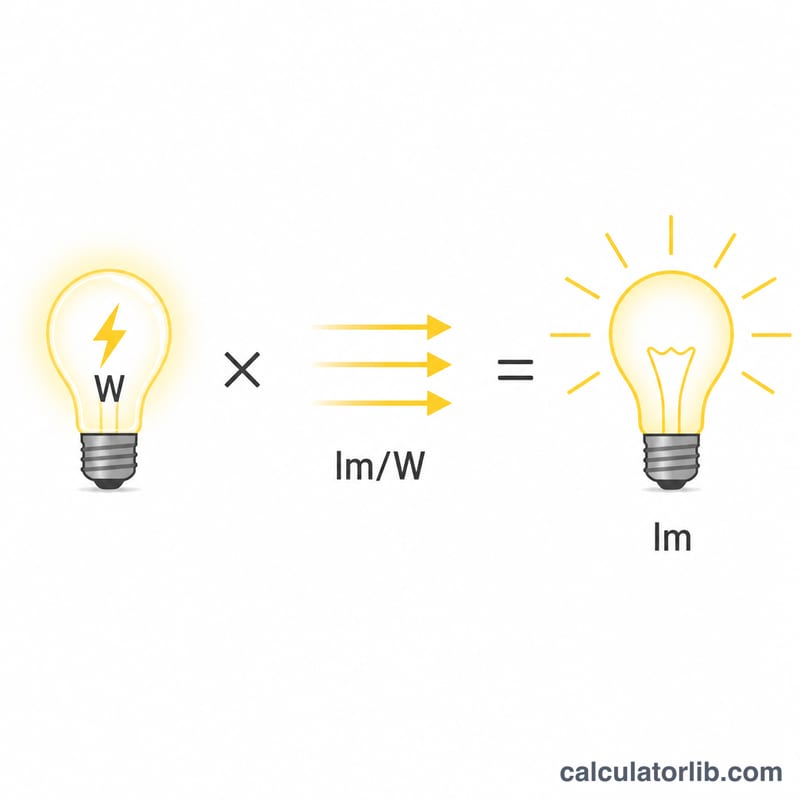
The conversion is a simple multiplication:
$$\text{lumens} = \text{watts} \times \text{efficacy (lm/W)}$$
Because efficacy varies so much between technologies, the same wattage can produce wildly different brightness. A 10 W incandescent bulb might give only 150 lm, whereas a 10 W LED can give 900 lm or more.
Worked example
Suppose you have a 10 W LED with an efficacy of 90 lm/W:
$$\text{lumens} = 10 \times 90 = 900 \text{ lm}$$ That is roughly equivalent to a traditional 60 W incandescent bulb.
FAQ
Why isn't there a fixed watts-to-lumens conversion? Because lumens depend on how efficiently a lamp converts electricity to visible light, and that efficiency differs by technology.
What efficacy should I use? Check the bulb's packaging for its lumen and watt ratings and divide; otherwise use the presets as a guide.
How do I go from lumens back to watts? Divide lumens by efficacy: \(\text{watts} = \text{lumens} \div \text{(lm/W)}\).