
What is the lumen method?
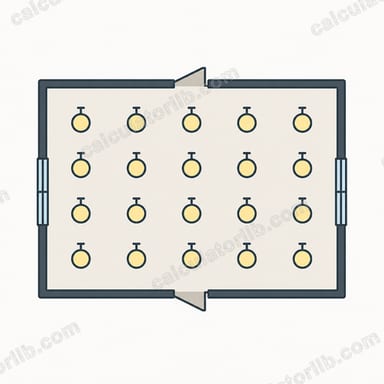
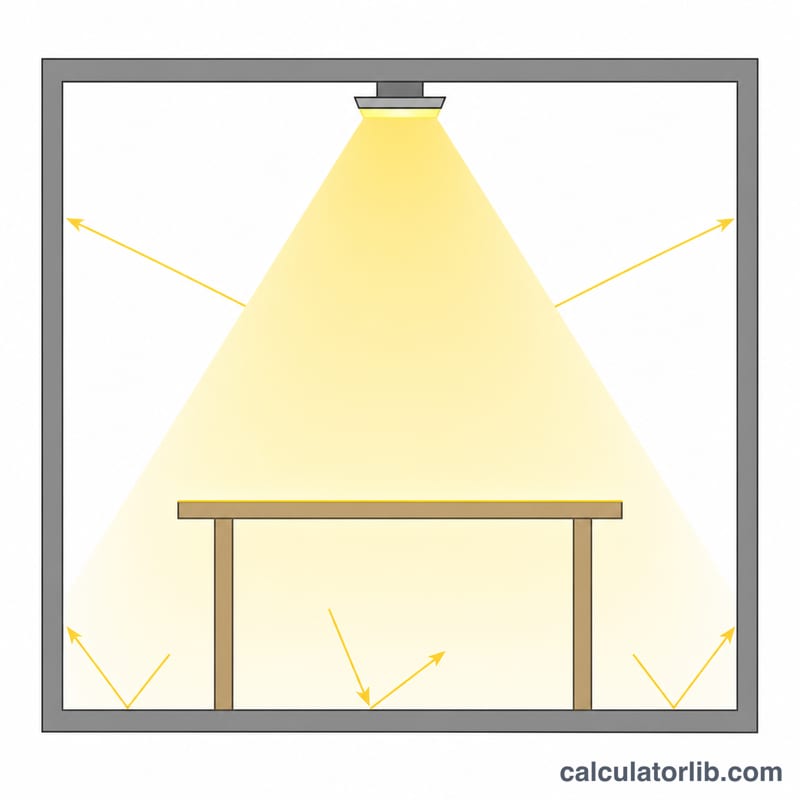
The lumen method (also called the zonal cavity method) is a standard lighting design technique used to estimate the number of luminaires required to achieve a desired average illuminance across a horizontal work plane. It accounts for both how efficiently light reaches the work plane (the coefficient of utilization) and how much light is lost over time due to dirt and lamp depreciation (the light loss factor).
How to use this calculator
Enter the target illuminance in lux, the room area in square metres, the rated lumen output of one fixture, the coefficient of utilization (CU), and the light loss factor (LLF). The calculator divides the total lumens needed by the effective lumens each fixture delivers, then rounds up to a whole number of luminaires. It also reports the actual illuminance you will achieve with that whole-number count.
The formula explained
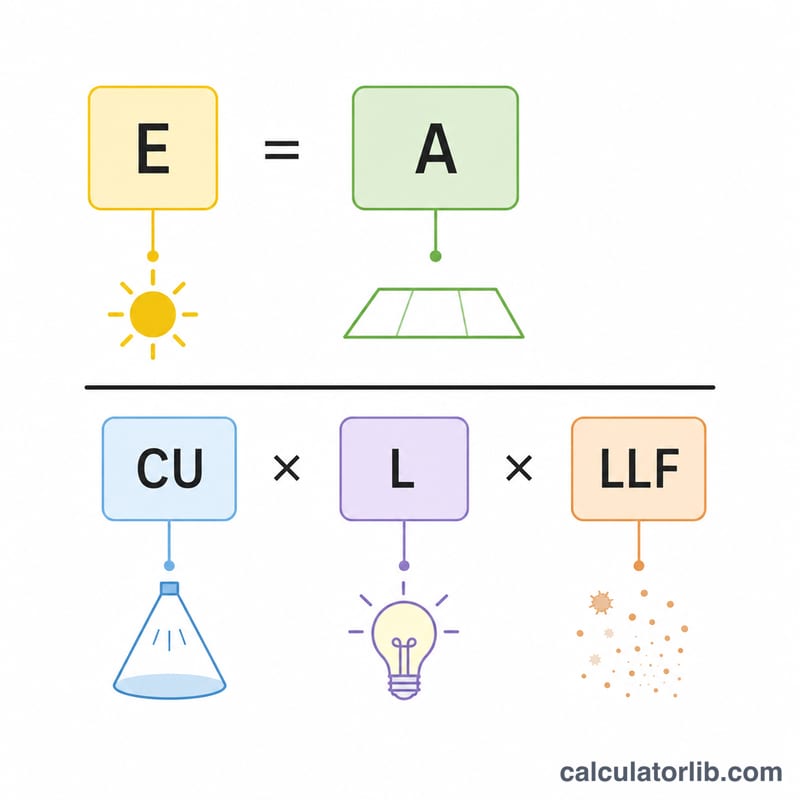
The core equation is $$N = \left\lceil \frac{\text{Target Lux} \times \text{Area (m}^2)}{\text{Lumens/Fixture} \times \text{CU} \times \text{LLF}} \right\rceil$$ The numerator \(E \times A\) is the total lumens that must land on the work plane. The denominator \(\Phi \times \text{CU} \times \text{LLF}\) is the useful lumens one fixture actually contributes after utilization and maintenance losses. CU typically ranges from \(0.4\) to \(0.8\) and LLF from \(0.7\) to \(0.85\).
Worked example
For an office targeting 500 lux over 50 m² with 3500 lm fixtures, CU = 0.6 and LLF = 0.8: effective lumens per fixture = $$3500 \times 0.6 \times 0.8 = 1680$$ Required = $$\frac{500 \times 50}{1680} = \frac{25000}{1680} \approx 14.88$$ rounded up to 15 fixtures. Achieved illuminance = $$\frac{15 \times 1680}{50} \approx 504 \text{ lux}$$
FAQ
What is a good CU value? CU depends on room shape, mounting height and surface reflectances; values of 0.5–0.7 are common for offices.
Why round up? You cannot install a fraction of a fixture, and rounding up ensures the design meets or exceeds the target.
What does LLF account for? Lamp lumen depreciation, luminaire dirt accumulation and ambient temperature effects over the maintenance cycle.