What Is a Cash Advance Fee?
A credit card cash advance lets you withdraw cash against your credit limit, but it is one of the most expensive ways to borrow. Unlike purchases, cash advances usually carry two separate charges: an upfront fee taken the moment you withdraw, and interest that begins accruing immediately with no grace period. This calculator combines both into a single, honest total cost estimate.
How to Use It
Enter the cash advance amount, the fee rate (commonly 3–5%), the minimum flat fee (often $10), your card's cash advance APR (frequently higher than the purchase APR), and the number of days you expect to take before repaying. The calculator returns the upfront fee, the interest accrued, the combined cost, and the total you must repay.
The Formula Explained
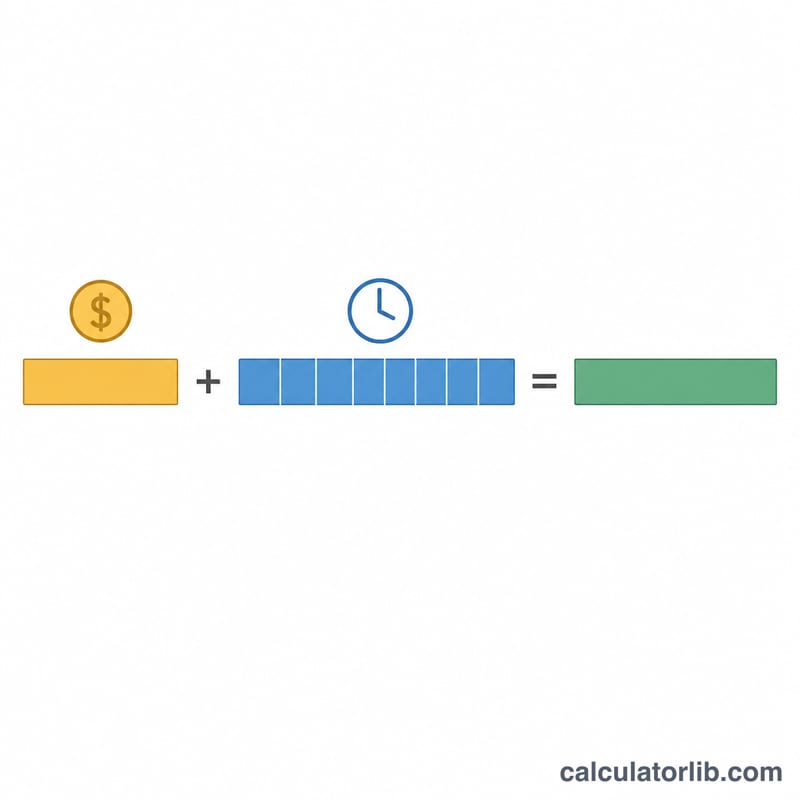
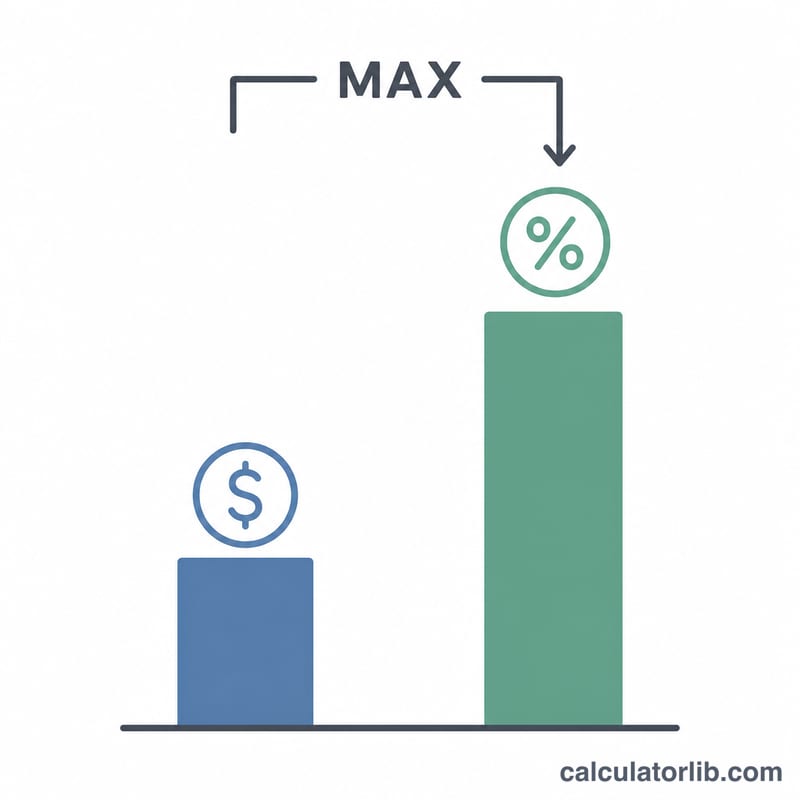
The upfront fee is \( \max(\text{flatFee},\ \text{amount} \times \text{feeRate}) \) — issuers charge whichever is larger, so small advances are dominated by the flat minimum. Interest is computed on a simple daily basis: \( \text{amount} \times \frac{\text{APR}}{365} \times \text{days} \). Because cash advances have no grace period, day-one interest applies. Total cost is the sum of fee and interest.
$$\begin{gathered} \text{Total Cost} = \text{Fee} + \text{Interest} \\[1.5em] \text{where}\quad \left\{ \begin{aligned} \text{Fee} &= \max\!\left( \text{Flat Fee},\; \text{Amount} \times \frac{\text{Fee Rate}}{100} \right) \\[0.4em] \text{Interest} &= \text{Amount} \times \frac{\text{APR}}{100 \times 365} \times \text{Days} \end{aligned} \right. \end{gathered}$$Worked Example
Withdraw $500 at a 5% fee with a $10 minimum, a 29.99% cash advance APR, repaid after 30 days. The percentage fee is \( 500 \times 0.05 = \$25 \), which exceeds the $10 minimum, so the fee is $25. Interest is
$$500 \times 0.2999 \div 365 \times 30 \approx \$12.32$$Total cost ≈ $37.32, and you'd repay about $537.32.
Key Terms Explained
- Cash advance
- A withdrawal of cash against your credit card line, for example at an ATM or bank counter. Some issuers also treat money transfers, convenience checks and similar transactions as cash advances.
- Cash advance fee
- A one-time charge added when you take the advance, usually a percentage of the amount. The rate is set by the issuer.
- Flat/minimum fee
- A fixed dollar amount that serves as a floor. The fee charged is the greater of this amount and the percentage fee, so small advances often pay the minimum.
- Cash advance APR
- The annual percentage rate applied to cash advance balances. It is often different from, and frequently higher than, the purchase APR, and is listed in your card agreement.
- Grace period
- The time during which new purchases do not accrue interest if you pay your statement balance in full by the due date. Cash advances typically do not get a grace period, so interest accrues from day one.
- Daily periodic rate (APR/365)
- The APR divided by 365, which gives the interest rate applied each day. For example, 25% APR gives about 0.0685% per day. Some issuers use 360 days instead of 365.
- Cash advance limit
- The maximum amount of cash you can withdraw on the card. It is usually a portion of your total credit limit and is set by the issuer.
FAQ
Why is there no grace period? Card issuers begin charging interest on cash advances from the transaction date, unlike purchases which often have a billing-cycle grace period.
Is the cash advance APR different? Yes — it is typically several points higher than your standard purchase APR. Check your cardholder agreement.
Are ATM or bank fees included? No. Some ATMs add their own surcharge on top of the issuer's cash advance fee; add those separately for a complete picture.