What Is the Minimum Credit Card Payment Calculator?
This calculator estimates the smallest amount you must pay on your credit card this billing cycle to keep the account in good standing. Most issuers compute the minimum as a small percentage of your balance plus the interest that accrued during the month, but never less than a fixed floor amount (commonly $25–$35). This tool models that common formula. Exact rules vary by issuer and card agreement, so treat the result as an estimate.
How to Use It
Enter your current statement balance, your card's minimum payment percent (often 1%–3%), your APR, and the minimum floor amount your issuer charges. The calculator returns the estimated minimum payment along with a breakdown of the interest charge and the percent-of-balance portion.
The Formula Explained
First, monthly interest is computed as \(\text{Balance} \times (\text{APR} \div 12)\). Then the percent portion is \(\text{Balance} \times \text{percent rate}\). These are added together, and the calculator takes the larger of that sum or the fixed floor amount. If the result exceeds your full balance, the payment is capped at the balance.
$$\text{Min Payment} = \min\!\left(\text{Balance},\ \max\!\left(\text{Floor},\ P\right)\right)$$ $$P = \text{Balance}\cdot\dfrac{\text{Percent}}{100} + \text{Balance}\cdot\dfrac{\text{APR}}{1200}$$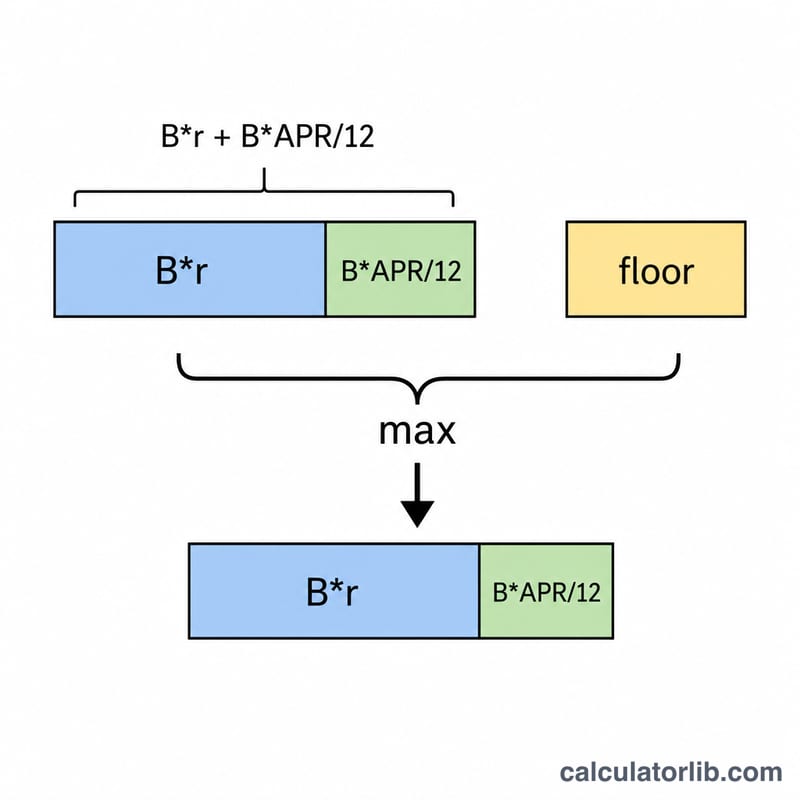
Worked Example
Suppose you owe $2,000 at a 19.99% APR, with a 1% minimum percent and a $25 floor. Monthly interest = \(2000 \times (0.1999 \div 12) \approx \$33.32\). Percent portion = \(2000 \times 0.01 = \$20\). Sum = $53.32. Since $53.32 is greater than the $25 floor, your estimated minimum payment is $53.32.
$$2000 \times \frac{0.1999}{12} + 2000 \times 0.01 \approx 33.32 + 20 = 53.32$$
Minimum Payment Across Different Balances and Rates
The table applies the calculator's formula with a 1% minimum percent rate and a $25 floor. The calculated sum is \(P = \text{Balance} \times \frac{\text{Percent}}{100} + \text{Balance} \times \frac{\text{APR}}{100 \times 12}\), meaning the percent portion plus one month of interest. The final minimum is \(\min(\text{Balance},\ \max(\text{Floor},\ P))\). Figures are rounded to the cent.
| Balance | APR | Monthly interest | Percent portion (1%) | Calculated sum | Final minimum payment | Floor or formula? |
|---|---|---|---|---|---|---|
| $300 | 15.99% | $4.00 | $3.00 | $7.00 | $25.00 | Floor applied |
| $1,000 | 19.99% | $16.66 | $10.00 | $26.66 | $26.66 | Formula applied |
| $2,000 | 24.99% | $41.65 | $20.00 | $61.65 | $61.65 | Formula applied |
| $5,000 | 19.99% | $83.29 | $50.00 | $133.29 | $133.29 | Formula applied |
| $10,000 | 24.99% | $208.25 | $100.00 | $308.25 | $308.25 | Formula applied |
Example of the arithmetic for the $1,000 row: monthly interest is \(1000 \times \frac{19.99}{100 \times 12} = 16.658\ldots \approx 16.66\), the percent portion is \(1000 \times 0.01 = 10.00\), and the sum is \(16.66 + 10.00 = 26.66\). That exceeds the $25 floor and is far below the $1,000 balance, so $26.66 is the result.
Key Terms Defined
- Statement balance
- The total amount owed on your card as of the closing date of the billing cycle. The minimum payment is generally calculated from this figure.
- APR (annual percentage rate)
- The yearly cost of borrowing on the card, expressed as a percentage. It is the starting point for the interest charged each month.
- Periodic (monthly) interest rate
- The APR divided by 12, for example \(\frac{19.99\%}{12} \approx 1.666\%\) per month. Some issuers instead apply a daily periodic rate (commonly APR divided by 365 or 360) to each day's balance, so their actual interest charge can differ slightly from the APR/12 estimate used here.
- Minimum percent rate
- The share of the balance, such as 1%, that the issuer requires toward the balance each month. In this calculator it is added to the month's interest.
- Minimum payment floor
- A fixed lowest dollar amount, such as $25, used when the calculated sum would be smaller.
- Cap at full balance
- The minimum payment can never exceed what you owe. If the balance is below the floor, the minimum equals the whole balance.
Minimum payment terms are set by each card issuer and card agreement, and they vary by issuer and country.
Interpreting Your Estimated Minimum Payment
Interest versus principal. In this calculator's formula, only the percent portion reduces the balance, while the interest portion is the cost of borrowing for the month. For the $1,000 balance at 19.99% APR, $16.66 of the $26.66 payment is interest and $10.00 reduces the balance, so only about 37.5% of the payment reduces the amount owed. For $10,000 at 24.99%, $208.25 of the $308.25 payment is interest, about 68%. Because the principal share is small, the balance falls slowly, and the higher the APR, the slower it falls.
Floor versus formula. When the result equals the floor (as in the $300 row), the percent-plus-interest sum was smaller than the floor, so the fixed minimum sets the payment. When the formula applies, the payment scales with the balance and APR, so it changes from month to month as the balance changes. If the balance is below the floor, the payment is capped at the balance.
What the minimum means. The minimum is the least the card agreement requires in order to avoid a late fee and having the account reported as delinquent to credit bureaus. It is not the amount that pays off the debt in any particular timeframe, and interest continues to accrue on the remaining balance.
Issuers differ. Some issuers use 1% of the balance plus interest and fees, others use a flat percentage of the balance such as 2% to 3%, and many apply a dollar floor. Some use daily interest calculations. Treat the result as an estimate and check your statement or card agreement for the exact figure.
Central bank policy rates today
The latest official policy rates of major central banks, updated automatically — the benchmark that bank deposit and loan rates follow.
- Federal Reserve · United States
- 3.75–4.00%
- As of
- 2026-11-12
- Change in 1 year
- 0 pp
Latest change Up +25 bp Federal Reserve changed its rate on 2026-09-17: from 3.50–3.75% to 3.75–4.00%.
| Central bank | Policy rate | As of | Change in 1 year |
|---|---|---|---|
| Banco Central do Brasil (Selic) · Brazil | 13.75% | 2026-11-15 | −1.25 pp |
| Banco de México · Mexico | 6.25% | 2026-11-10 | −1.00 pp |
| Federal Reserve · United States | 3.75–4.00% | 2026-11-12 | 0 pp |
| ECB | 2.50% | 2026-11-15 | +0.50 pp |
| Sveriges Riksbank · Sweden | 2.00% | 2026-11-13 | +0.25 pp |
| Saudi Central Bank (SAMA) · Saudi Arabia | 4.50% | 2026-10-29 | 0 pp |
| Reserve Bank of Australia · Australia | 4.60% | 2026-10-31 | +1.00 pp |
| Central Bank of the Republic of Türkiye · Türkiye | 36.00% | 2026-11-06 | −3.50 pp |
| Bank of Russia · Russia | 14.00% | 2026-11-10 | −2.50 pp |
| People’s Bank of China · China | 3.00% | 2026-11-10 | 0 pp |
| Bank of Canada · Canada | 2.50% | 2026-11-12 | +0.25 pp |
| Reserve Bank of India · India | 5.50% | 2026-10-19 | 0 pp |
| Bank of England · United Kingdom | 4.00% | 2026-11-15 | 0 pp |
| Bank of Japan · Japan | 1.25% | 2026-11-10 | +0.75 pp |
| Bank of Korea · South Korea | 3.00% | 2026-11-02 | +0.50 pp |
Federal Reserve: key rates and overnight market rates
The rates that frame monetary policy and the overnight market rate they steer, each with the date of its latest published value.
| Rate | Level | As of | Change in 1 year |
|---|---|---|---|
| Federal funds target range | 3.75–4.00% | 2026-11-12 | 0 pp |
| Effective federal funds rate (EFFR) | 3.88% | 2026-11-12 | +0.01 pp |
| Secured Overnight Financing Rate (SOFR) | 3.90% | 2026-11-12 | −0.08 pp |
Each rate keeps the date of its own latest published value; overnight market rates are published on the next business day.
Latest figure: 2026-11-12 Data last updated 2026-11-15 · current
Source: Banco Central do Brasil ODbL; Bank for International Settlements (BIS) Terms of permitted use of BIS statistics; Federal Reserve Bank of New York New York Fed Terms of Use; Board of Governors of the Federal Reserve System Public domain (U.S. government work); European Central Bank ECB reuse policy; Sveriges Riksbank Riksbank open data terms; The World Bank Group CC BY 4.0; Reserve Bank of Australia 2026 RBA copyright terms (Cash Rate); Bank of Canada Bank of Canada terms of use; Bank of England Open Government Licence v3.0
The one-year change is computed by CalculatorLib from these data. The EFFR and SOFR are subject to the Terms of Use posted at newyorkfed.org. The New York Fed is not responsible for publication of the EFFR and SOFR by CalculatorLib, does not sanction or endorse any particular republication, and has no liability for your use.
Source details and methodology
- Banco Central do Brasil
- Bank for International Settlements (BIS) — Central bank policy rates
- Federal Reserve Bank of New York — Reference rates (EFFR, SOFR)
- Board of Governors of the Federal Reserve System
- European Central Bank
- Sveriges Riksbank
- The World Bank Group — World Development Indicators (FR.INR.LEND, FR.INR.RINR)
- Reserve Bank of Australia 2026
- Bank of Canada
- Bank of England
FAQ
Why is paying only the minimum costly? Most of a minimum payment goes toward interest, so the balance shrinks slowly and you pay far more over time. Paying extra each month dramatically reduces total interest.
Is the floor amount always $25? No. It depends on your card agreement; many issuers use $25–$35, or the full balance if it is smaller.
Does this match my exact bill? It approximates a common issuer formula. Your statement may use a slightly different percent, interest method, or include past-due fees.