What is a Credit Card Interest Calculator?
A credit card interest calculator is a financial tool that helps you determine how much interest you'll pay on your credit card balance over time. It provides insights into your repayment timeline based on different payment strategies and shows the total cost of carrying credit card debt.
When to Use a Credit Card Interest Calculator
This calculator is particularly useful in the following scenarios:
- When planning to pay off your credit card balance and wanting to know how long it will take
- When deciding between making minimum payments or larger monthly payments
- When comparing different payment strategies to minimize interest costs
Examples
Example 1: Paying a Fixed Monthly Amount
How long will it take to pay off a credit card balance of $5,000 with an APR of 18% if you make monthly payments of $200?
| Balance | APR | Monthly Payment | Result |
|---|---|---|---|
| $5,000 | 18% | $200 | Total Interest: $1,313.96 Months to Payoff: 32 |
Example 2: Setting a Target Timeframe
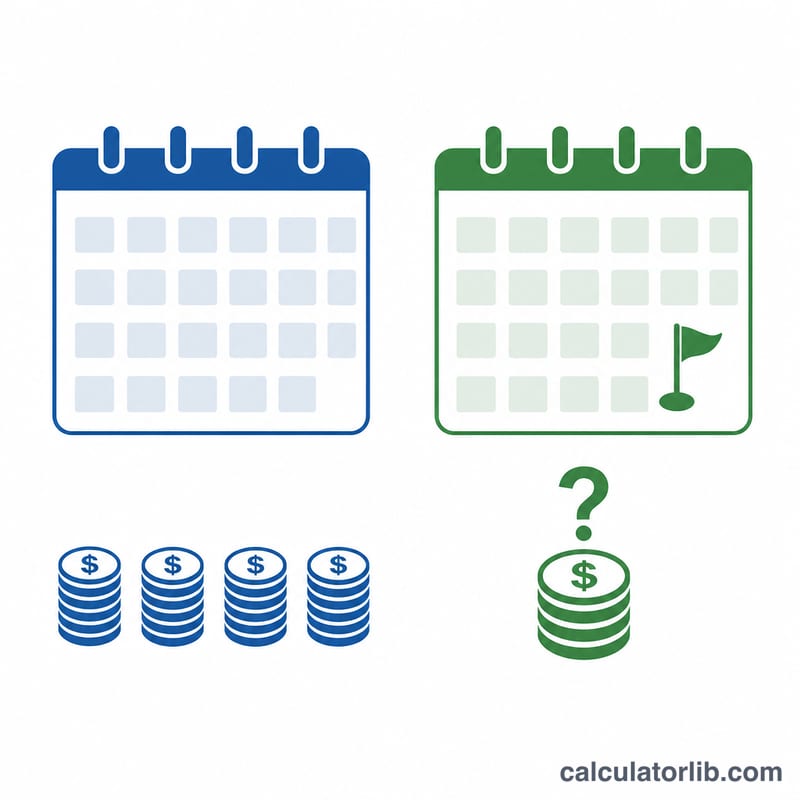
How much should you pay monthly to clear a credit card balance of $3,500 with an APR of 22% in 18 months?
| Balance | APR | Target Months | Result |
|---|---|---|---|
| $3,500 | 22% | 18 months | Required Monthly Payment: $230.05 Total Interest: $640.91 |
Example 3: Payment Too Low to Cover Interest
What happens if you attempt to pay off a $10,000 balance with an APR of 24% by making only $150 monthly payments?
| Balance | APR | Monthly Payment | Result |
|---|---|---|---|
| $10,000 | 24% | $150 | Monthly Interest: $200 Result: Payment too low to cover interest |
Important Considerations
When using this calculator, keep in mind:
- The calculation assumes a fixed APR and no new purchases; monthly fees are included only when you enter them
- Your monthly payment must be greater than the monthly interest to make progress on paying down the principal
- Making larger payments reduces both the total interest paid and the time needed to pay off the balance
- Some credit cards compound interest daily rather than monthly, which may result in slightly higher interest costs
How the payoff plans are calculated
This calculator is built for US credit cards and follows the repayment model behind the minimum payment warning on US card statements (Regulation Z, 12 CFR §1026.7(b)(12), and Appendix M1 to Part 1026): the APR does not change, you make no new purchases, interest is charged each month at APR ÷ 12, and the last payment is whatever balance is left. Real statements can differ slightly, because many issuers charge interest daily and round to the cent.
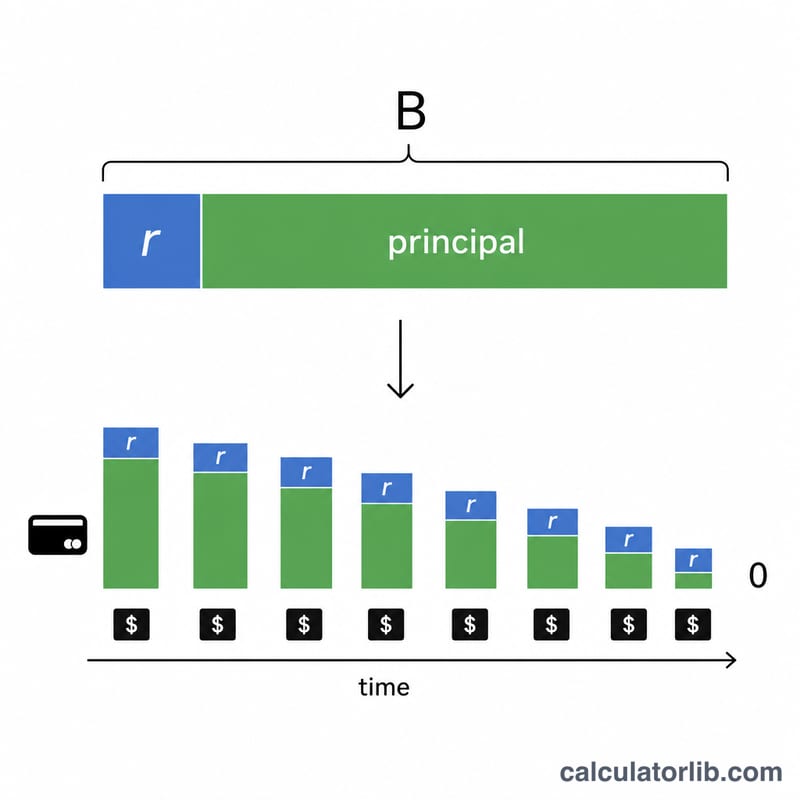
- Fixed monthly payment: each month the interest (balance × APR ÷ 1200) and any monthly fee you enter are added, then your payment is subtracted, until the balance reaches zero. The result shows the number of months, the total interest, the smaller final payment and a yearly schedule.
- Target timeframe: to pay the balance \(B\) off in \(n\) months at the monthly rate \(r\) (APR ÷ 1200), the required payment is $$P = \frac{B \cdot r}{1-(1+r)^{-n} } + \text{fee}$$ With a 0% APR it is simply \(B \div n\) plus the fee.
- Extra payment: the same plan is run again with the extra amount added to every payment, and the interest and months it saves are shown.
- Paying only the minimum: the card minimum is recalculated every month as the interest and fees plus a percentage of the balance (or as a percentage of the balance alone), never less than the minimum payment floor you enter. This is the structure Appendix M1 uses for the minimum payment estimate. The calculator runs that path to zero and compares it with your plan.
If your payment is not larger than the first month's interest plus fees, the balance never goes down, so the calculator says the payment is too low instead of showing a payoff time. A plan that would take more than 600 months (50 years) is reported in the same way.
Worked example: a fixed payment against the minimum
A $5,000 balance at 18.99% APR, paid with a fixed $200 a month, is cleared in 33 months. The last payment is $14.44, the interest comes to $1,414.44 and the total paid is $6,414.44.
If you paid only a card minimum of interest plus 1% of the balance with a $25 floor, the first minimum would be $129.92, the payoff would take 222 months and the interest would be $6,823.55. The $200 plan therefore saves $5,409.11 in interest and 189 months.
With the Target timeframe mode, clearing the same $5,000 in 24 months takes $252.02 a month and $1,048.45 of interest. Adding an extra $50 a month (so $302.02) clears it in 20 months and saves another $204.28 in interest.
US card statements must show how long paying only the minimum would take and what it would cost, together with the monthly payment that clears the balance in 36 months (12 CFR §1026.7(b)(12)). This calculator lets you run the same comparison with your own numbers. This is general information, not financial advice; your card agreement sets your actual minimum payment and interest charges.
Payment Scenario Comparison
The table shows a $5,000 balance at 18% APR (monthly rate 1.5%) paid off with four different fixed payments. Each month the interest is added and the payment subtracted; the final payment is the remaining balance.
| Monthly payment | Months to payoff | Total interest | Total cost |
|---|---|---|---|
| $150 | 47 | $1,983.60 | $6,983.60 |
| $200 | 32 | $1,313.96 | $6,313.96 |
| $300 | 20 | $797.17 | $5,797.17 |
| $500 | 11 | $458.11 | $5,458.11 |
The first month's interest is \(5{,}000 \times 0.015 = \$75\). The $150 payment is only just above that, so it cuts the principal by about $75 in month 1. Payoff therefore takes almost four years and the interest is large. Doubling the payment from $150 to $300 cuts the payoff time by more than half and saves about $1,186 in interest. Totals may differ by a few cents depending on rounding.
Key Terms
- APR (annual percentage rate)
- The yearly interest rate quoted on the card. This calculator takes APR as the annual rate and applies APR ÷ 12 each month.
- Monthly periodic rate
- APR divided by 12. An 18% APR gives a 1.5% monthly rate.
- Principal / balance
- The amount you currently owe, before future interest. Each payment first covers that month's interest, and the rest reduces the principal.
- Minimum payment
- The smallest amount the issuer requires each month. Issuers often set it as a percentage of the balance plus interest, or a floor amount, so rules vary by issuer and country. Paying only the minimum usually lengthens payoff considerably.
- Amortization
- Paying off a balance through regular payments over time. Each payment contains an interest portion and a principal portion, and the interest share falls as the balance falls.
- Total cost of credit
- Everything you pay back on the debt: the original balance plus all interest (total payments = balance + total interest). Any monthly fee you enter is added on top.
- Compounding (daily vs. monthly)
- Compounding means interest is charged on previously accrued interest. Many issuers calculate interest daily (APR ÷ 365 on the daily balance) and add it monthly. This calculator uses simple monthly compounding at APR ÷ 12, so real statements may differ slightly.
This is general information, not financial advice. Your card agreement determines your actual charges.
Central bank policy rates today
The latest official policy rates of major central banks, updated automatically — the benchmark that bank deposit and loan rates follow.
- Federal Reserve · United States
- 3.75–4.00%
- As of
- 2026-11-13
- Change in 1 year
- 0 pp
Latest change Up +25 bp Federal Reserve changed its rate on 2026-09-17: from 3.50–3.75% to 3.75–4.00%.
| Central bank | Policy rate | As of | Change in 1 year |
|---|---|---|---|
| Banco Central do Brasil (Selic) · Brazil | 13.75% | 2026-11-16 | −1.25 pp |
| Banco de México · Mexico | 6.25% | 2026-11-10 | −1.00 pp |
| Federal Reserve · United States | 3.75–4.00% | 2026-11-13 | 0 pp |
| ECB | 2.50% | 2026-11-16 | +0.50 pp |
| Sveriges Riksbank · Sweden | 2.00% | 2026-11-16 | +0.25 pp |
| Saudi Central Bank (SAMA) · Saudi Arabia | 4.50% | 2026-10-29 | 0 pp |
| Reserve Bank of Australia · Australia | 4.60% | 2026-10-31 | +1.00 pp |
| Central Bank of the Republic of Türkiye · Türkiye | 36.00% | 2026-11-06 | −3.50 pp |
| Bank of Russia · Russia | 14.00% | 2026-11-10 | −2.50 pp |
| People’s Bank of China · China | 3.00% | 2026-11-10 | 0 pp |
| Bank of Canada · Canada | 2.50% | 2026-11-13 | +0.25 pp |
| Reserve Bank of India · India | 5.50% | 2026-10-19 | 0 pp |
| Bank of England · United Kingdom | 4.00% | 2026-11-16 | 0 pp |
| Bank of Japan · Japan | 1.25% | 2026-11-10 | +0.75 pp |
| Bank of Korea · South Korea | 3.00% | 2026-11-02 | +0.50 pp |
Federal Reserve: key rates and overnight market rates
The rates that frame monetary policy and the overnight market rate they steer, each with the date of its latest published value.
| Rate | Level | As of | Change in 1 year |
|---|---|---|---|
| Federal funds target range | 3.75–4.00% | 2026-11-13 | 0 pp |
| Effective federal funds rate (EFFR) | 3.88% | 2026-11-13 | 0 pp |
| Secured Overnight Financing Rate (SOFR) | 3.90% | 2026-11-13 | −0.10 pp |
Each rate keeps the date of its own latest published value; overnight market rates are published on the next business day.
Latest figure: 2026-11-13 Data last updated 2026-11-16 · current
Source: Banco Central do Brasil ODbL; Bank for International Settlements (BIS) Terms of permitted use of BIS statistics; Federal Reserve Bank of New York New York Fed Terms of Use; Board of Governors of the Federal Reserve System Public domain (U.S. government work); European Central Bank ECB reuse policy; Sveriges Riksbank Riksbank open data terms; The World Bank Group CC BY 4.0; Reserve Bank of Australia 2026 RBA copyright terms (Cash Rate); Bank of Canada Bank of Canada terms of use; Bank of England Open Government Licence v3.0
The one-year change is computed by CalculatorLib from these data. The EFFR and SOFR are subject to the Terms of Use posted at newyorkfed.org. The New York Fed is not responsible for publication of the EFFR and SOFR by CalculatorLib, does not sanction or endorse any particular republication, and has no liability for your use.
Source details and methodology
- Banco Central do Brasil
- Bank for International Settlements (BIS) — Central bank policy rates
- Federal Reserve Bank of New York — Reference rates (EFFR, SOFR)
- Board of Governors of the Federal Reserve System
- European Central Bank
- Sveriges Riksbank
- The World Bank Group — World Development Indicators (FR.INR.LEND, FR.INR.RINR)
- Reserve Bank of Australia 2026
- Bank of Canada
- Bank of England