
What This Calculator Does
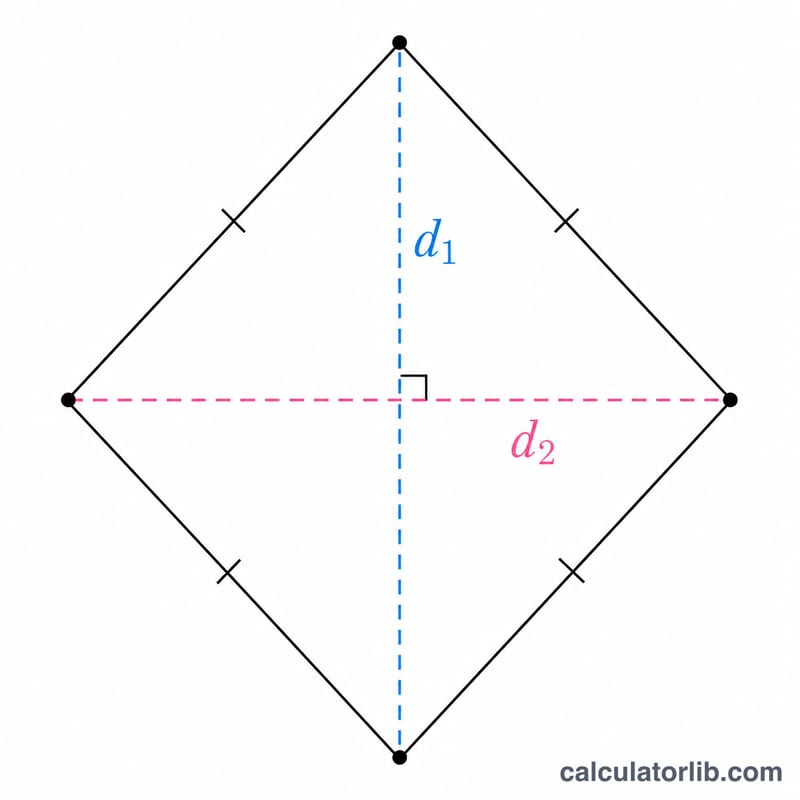
The Rhombus Area Calculator finds the area of a rhombus using the lengths of its two diagonals. A rhombus is a four-sided shape (quadrilateral) where all four sides are equal in length, and its two diagonals always cross each other at right angles. Because of this property, you only need the diagonals — not the angles or side length — to work out the area.
Behind the scenes, the tool also calculates the side length and the perimeter from the same two diagonals, so a single input gives you a complete picture of the shape.
Inputs You Provide
- Diagonal 1 (d₁): the length of the first diagonal, measured corner to opposite corner.
- Diagonal 2 (d₂): the length of the second diagonal, which crosses the first at 90°.
Both values should use the same unit (cm, m, inches, etc.). The area result is in those units squared.
The Formula Explained
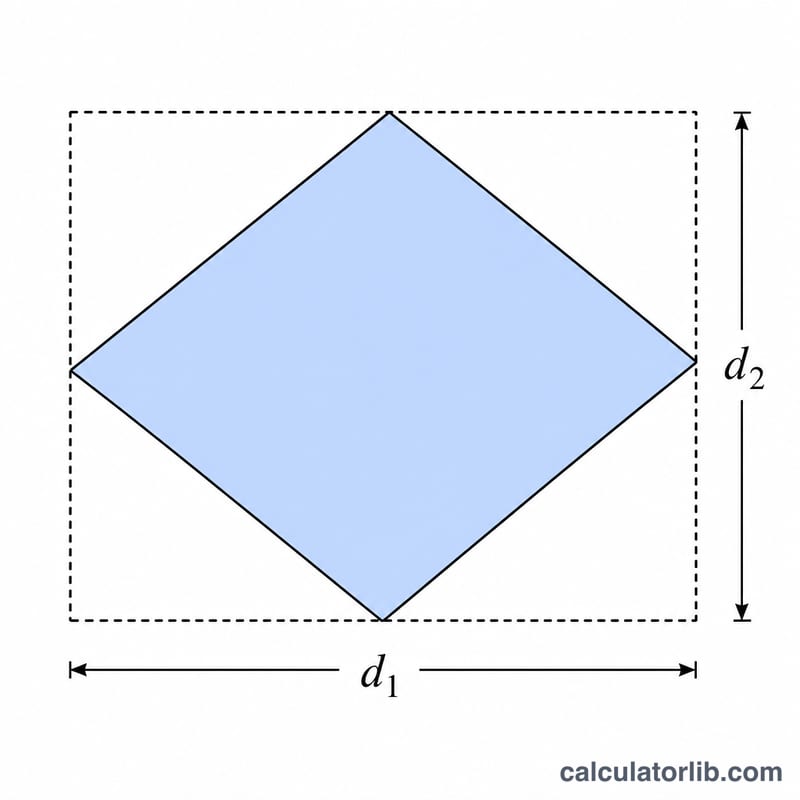
The area of a rhombus is half the product of its diagonals:
Area = (d₁ × d₂) ÷ 2
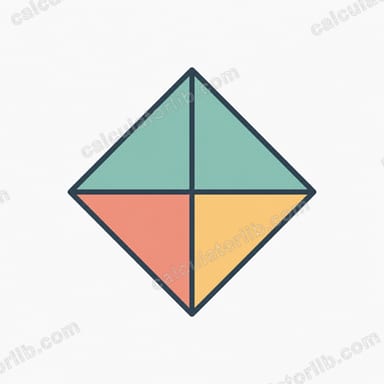
This works because the diagonals split the rhombus into four right triangles. Each half-diagonal acts as the base and height of those triangles, and combining them gives this clean formula.
The calculator also derives the side and perimeter. Since the diagonals bisect each other at right angles, each side is the hypotenuse of a right triangle with legs d₁/2 and d₂/2:
- Side = √((d₁/2)² + (d₂/2)²)
- Perimeter = 4 × side (equivalently 2 × √((d₁/2)² + (d₂/2)²) per the tool's pairing)
Worked Example
Suppose d₁ = 10 and d₂ = 8.
- Area = (10 × 8) ÷ 2 = 40 square units
- Side = √((10/2)² + (8/2)²) = √(25 + 16) = √41 ≈ 6.40 units
- Perimeter = 4 × 6.40 ≈ 25.61 units
Frequently Asked Questions
Can I find the area without the diagonals? This calculator specifically uses the two diagonals. If you only know the side and an angle, you would use Area = side² × sin(angle) instead.
Do the diagonals have to be equal? No. If both diagonals are equal, the rhombus becomes a square, but the formula still applies.
What units does the answer use? Whatever unit you enter the diagonals in — the area comes out in that unit squared, and the side and perimeter in the same linear unit.