
What the Kite Area Calculator Does
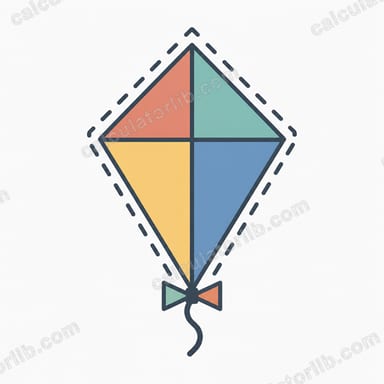
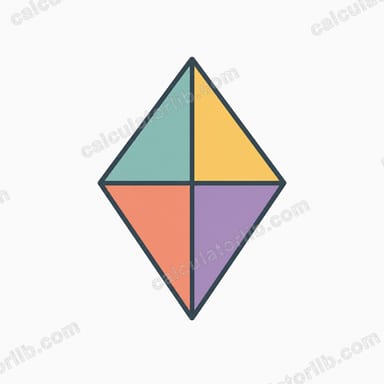
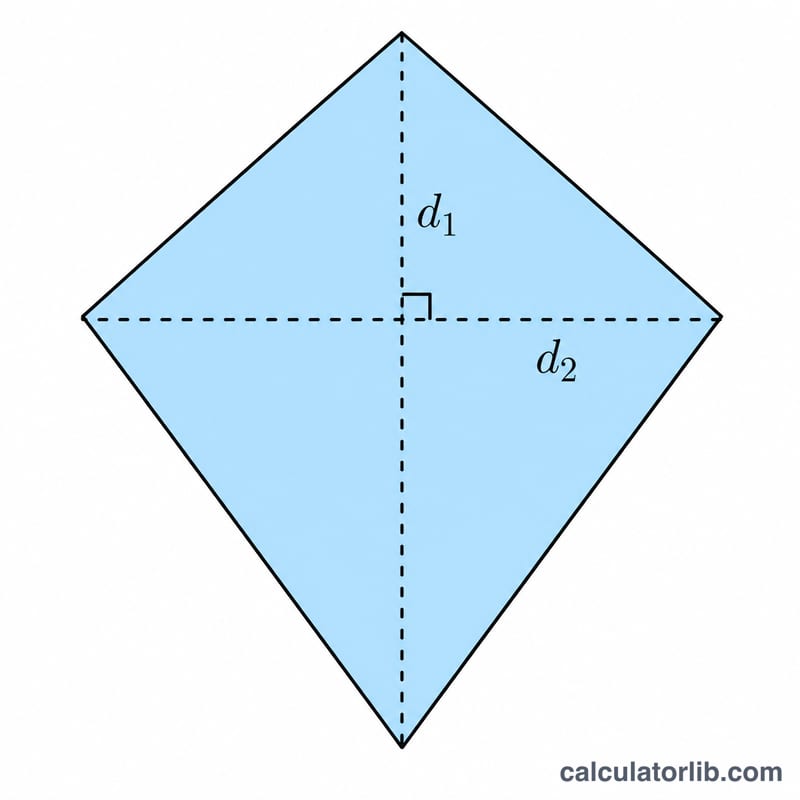
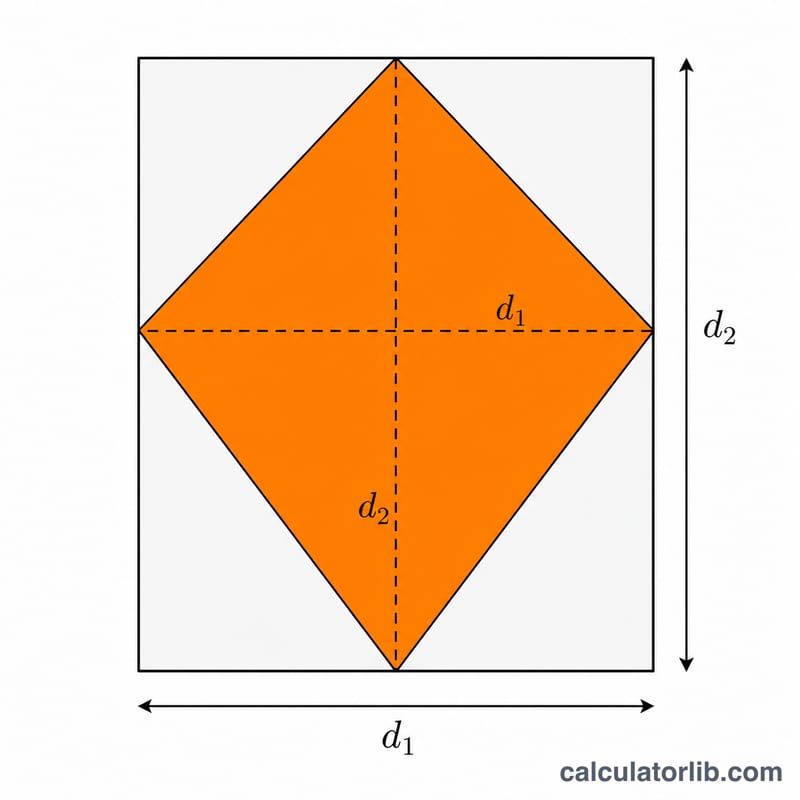
A kite is a four-sided shape (quadrilateral) with two pairs of adjacent sides that are equal in length. One handy feature of a kite is that its two diagonals cross at right angles, which makes finding its area very simple. This calculator takes the lengths of those two diagonals and instantly returns the area of the kite. It also computes an estimate of the perimeter behind the scenes, based on the diagonal lengths.
The Inputs You Enter
- Diagonal 1 (d₁): the length of the first diagonal — typically the longer line connecting the two vertices between the unequal sides.
- Diagonal 2 (d₂): the length of the second diagonal, which crosses the first at 90°.
Enter both values in the same unit (for example, centimetres or inches), and the area will be returned in that unit squared.
The Formula Explained
The calculator uses the standard kite area formula:
$$A = \frac{d_1 \times d_2}{2}$$
You multiply the two diagonals together and divide by two. This works because the perpendicular diagonals split the kite into four right triangles, and their combined area equals exactly half the product of the diagonals — the same logic used for a rhombus.
The tool also estimates the perimeter using each half-diagonal as the legs of a right triangle: $$P = 2 \times \sqrt{\left(\frac{d_1}{2}\right)^2 + \left(\frac{d_2}{2}\right)^2}$$ Note this perimeter assumes the diagonals bisect each other equally, which is exact for a rhombus but only an approximation for a general kite.
Worked Example
Suppose a kite has a diagonal 1 of 10 cm and a diagonal 2 of 6 cm.
- $$\text{Area} = \frac{10 \times 6}{2} = \frac{60}{2} = \mathbf{30 \text{ cm}^2}$$
- $$\text{Perimeter} \approx 2 \times \sqrt{(5)^2 + (3)^2} = 2 \times \sqrt{34} \approx \mathbf{11.66 \text{ cm}}$$
Frequently Asked Questions
Do both diagonals need to be in the same unit? Yes. Use matching units for both inputs so the area comes out correctly (in square units).
Can I use this for a rhombus or square? Absolutely. A rhombus and a square are special kites, so the same formula \(A = \frac{d_1 \times d_2}{2}\) applies.
Why is the perimeter only an estimate? The diagonals of a general kite do not bisect each other equally, so the perimeter formula here is exact only when they do (as in a rhombus). For precise kite perimeters you would need the actual side lengths.