
What This Calculator Does
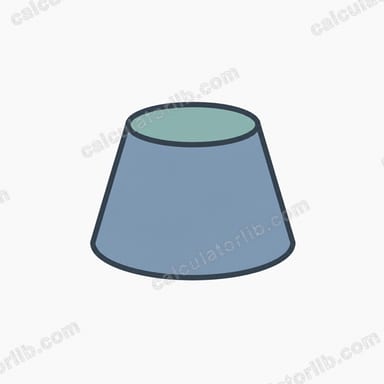
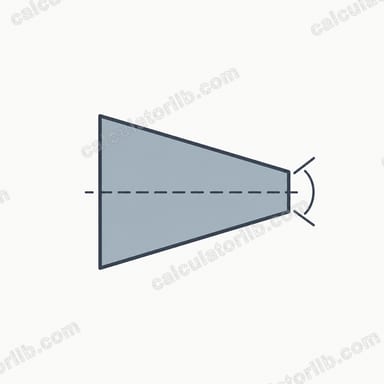
A frustum of a cone is the shape you get when you slice the top off a cone with a cut parallel to the base — think of a bucket, a lampshade, or a paper coffee cup. This calculator finds the total surface area of that shape, including the curved side and both circular ends. You supply three measurements and it returns the full area instantly, along with the slant height it computes along the way.
The Inputs
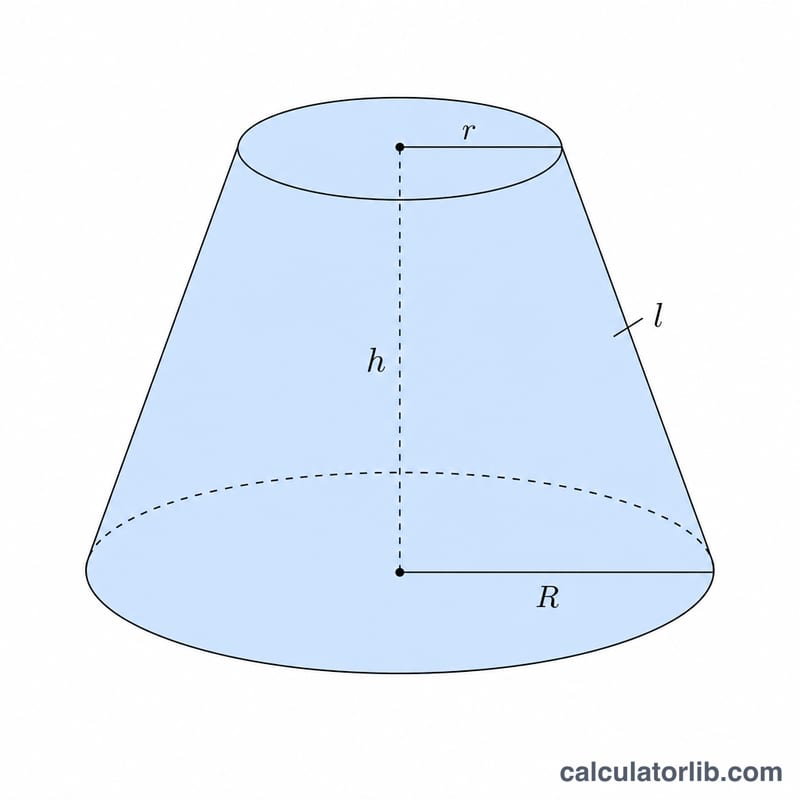
- Top Radius (\(r\)): the radius of the smaller circular face at the top.
- Bottom Radius (\(R\)): the radius of the larger circular face at the bottom.
- Height (\(h\)): the straight vertical distance between the two faces (not the slanted edge).
All three should be entered in the same unit (cm, m, inches, etc.), and the result will be in those units squared.
The Formula
The calculator uses:
$$A = \pi(R + r)s + \pi R^{2} + \pi r^{2}$$
Here \(s\) is the slant height, which is not entered directly — it is derived from the height and the difference in radii using the Pythagorean theorem:
$$s = \sqrt{h^{2} + (R - r)^{2}}$$
The first term, \(\pi(R + r)s\), is the curved lateral surface area. The two remaining terms, \(\pi R^{2}\) and \(\pi r^{2}\), are the areas of the bottom and top circles. Adding all three gives the total surface area.
Worked Example
Suppose a bucket has a top radius of 3, a bottom radius of 5, and a height of 8.
- Slant height: \(s = \sqrt{8^{2} + (5 - 3)^{2}} = \sqrt{64 + 4} = \sqrt{68} \approx 8.246\)
- Lateral area: \(\pi(5 + 3)(8.246) \approx 207.3\)
- Bottom area: \(\pi(5^{2}) \approx 78.54\)
- Top area: \(\pi(3^{2}) \approx 28.27\)
- Total area \(\approx 314.1\) square units
FAQ
Do I need to enter the slant height? No. The calculator computes the slant height for you from the height and the two radii, so you only provide the three vertical and radial measurements.
What if both radii are the same? If the top and bottom radii are equal, the shape becomes a cylinder. The slant height then equals the height, and the formula still gives the correct total surface area.
Does this include the open top or bottom? This calculation includes both circular caps. If your object is open (like an open bucket), subtract the area of the open face — for example, subtract \(\pi r^{2}\) to exclude an open top.