TDEE Calculator
TDEE (Total Daily Energy Expenditure) is the total amount of calories your body burns in a day, including physical activity. Understanding your TDEE helps in managing your weight, planning your diet, and optimizing athletic performance.
When to Use a TDEE Calculator
A TDEE calculator can be particularly useful in the following situations:
- When starting a weight loss or muscle gain program to determine your caloric targets
- When adjusting your fitness routine to account for changes in activity level
- When planning a nutrition strategy for athletic performance or specific fitness goals
How to Calculate TDEE
TDEE is calculated by first determining your Basal Metabolic Rate (BMR) and then multiplying it by an activity factor:
$$\text{TDEE} = \text{BMR} \times \text{Activity Multiplier}$$
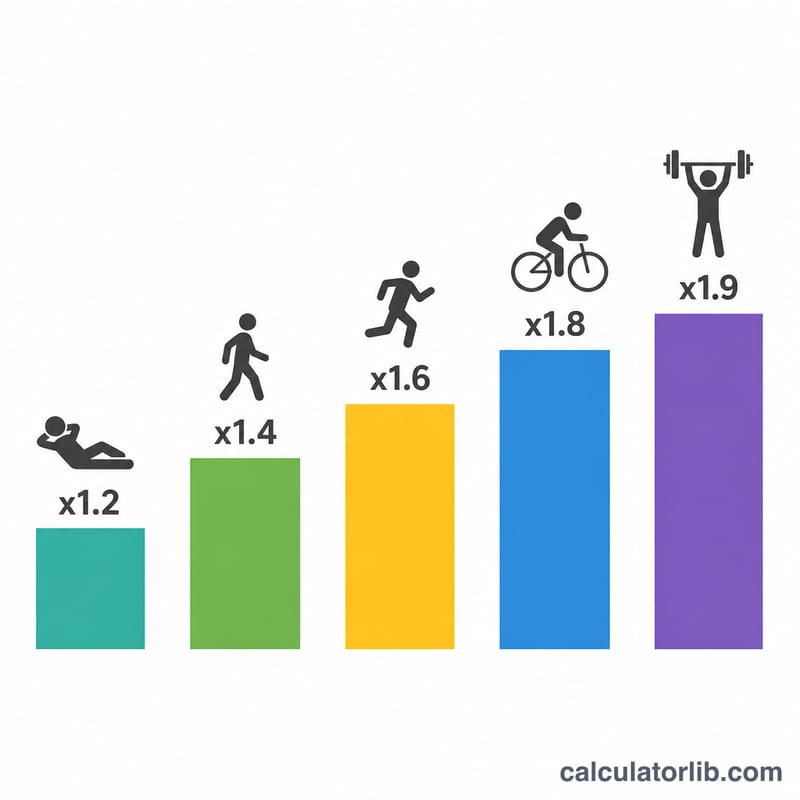
Activity Multipliers
| Activity Level | Multiplier | Description |
|---|---|---|
| Sedentary | 1.2 | Little or no exercise |
| Lightly Active | 1.375 | Light exercise/sports 1-3 days/week |
| Moderately Active | 1.55 | Moderate exercise/sports 3-5 days/week |
| Very Active | 1.725 | Hard exercise/sports 6-7 days/week |
| Extra Active | 1.9 | Very hard exercise/physical job/training twice a day |
Examples
Example 1: Harris-Benedict Formula
Calculate the TDEE for a 30-year-old man who weighs 80 kg, is 180 cm tall, and has a moderately active lifestyle.
| Parameter | Value |
|---|---|
| Gender | Male |
| Age | 30 years |
| Weight | 80 kg |
| Height | 180 cm |
| Activity Level | Moderately Active (1.55) |
| BMR Calculation | \(88.362 + (13.397 \times 80) + (4.799 \times 180) - (5.677 \times 30)\) |
| BMR | 1,854 calories |
| TDEE (BMR × 1.55) | 2,873 calories |
Example 2: Mifflin-St Jeor Formula
Calculate the TDEE for a 25-year-old woman who weighs 65 kg, is 165 cm tall, and has a lightly active lifestyle.
| Parameter | Value |
|---|---|
| Gender | Female |
| Age | 25 years |
| Weight | 65 kg |
| Height | 165 cm |
| Activity Level | Lightly Active (1.375) |
| BMR Calculation | \(10 \times 65 + 6.25 \times 165 - 5 \times 25 - 161\) |
| BMR | 1,395 calories |
| TDEE (BMR × 1.375) | 1,918 calories |
Example 3: Katch-McArdle Formula
Calculate the TDEE for a person with 60 kg of lean body mass who has a very active lifestyle.
| Parameter | Value |
|---|---|
| Lean Body Mass | 60 kg |
| Activity Level | Very Active (1.725) |
| BMR Calculation | \(370 + (21.6 \times 60)\) |
| BMR | 1,666 calories |
| TDEE (BMR × 1.725) | 2,874 calories |
Using Your TDEE
Once you know your TDEE:
- For weight maintenance: consume calories equal to your TDEE
- For weight loss: consume fewer calories than your TDEE (typically 300-500 calories less)
- For weight gain: consume more calories than your TDEE (typically 300-500 calories more)
Remember that TDEE is an estimate and may need adjustment based on your individual response and goals.
Interpreting Your TDEE Result
Total Daily Energy Expenditure (TDEE) is an estimate of how many kilocalories your body uses over a full 24-hour day. It is conventionally broken into four components:
- BMR — basal metabolic rate, the energy needed to keep you alive at complete rest. It is usually the largest share, roughly 60–70% of TDEE in a typical sedentary adult.
- TEF — the thermic effect of food, the energy spent digesting, absorbing and storing nutrients. It averages about 10% of energy intake on a mixed diet (higher for protein-rich meals, lower for fat-rich ones).
- NEAT — non-exercise activity thermogenesis: fidgeting, standing, walking to the shop, occupational movement. This is the most variable component between individuals.
- EAT — exercise activity thermogenesis, the energy cost of deliberate training.
So, conceptually:
$$\text{TDEE} = \text{BMR} + \text{TEF} + \text{NEAT} + \text{EAT}$$
This calculator does not measure those four parts separately. It estimates BMR from a predictive equation and then multiplies by a single activity factor (PAL) that bundles TEF, NEAT and EAT together:
$$\text{TDEE} = \text{BMR} \times \text{PAL}$$
How accurate is the number?
Predictive equations are regression models fitted to groups of people. They describe the average person with your sex, age, height and weight — not you specifically. Compared with measured energy expenditure (indirect calorimetry for resting metabolic rate, or doubly labelled water for free-living total expenditure), individual results typically differ by about ±10–15%, and occasionally more. On a 2,500 kcal/day estimate that is a spread of roughly 250–375 kcal/day. Treat the output as a starting point to be adjusted from real-world feedback (body-weight trend over 2–4 weeks), not as a measured fact.
Choosing between the equations
- Mifflin-St Jeor (1990) — the equation recommended by the Academy of Nutrition and Dietetics (a United States professional body) for estimating resting metabolic rate in both non-obese and obese adults, as it was the most reliably accurate in their evidence review. It is the sensible default for most people.
- Harris-Benedict (1919, revised by Roza & Shizgal in 1984) — derived from a lean, early-20th-century sample; the original version tends to overestimate resting needs by roughly 5% in modern populations.
- Katch-McArdle — based on fat-free mass rather than total body weight. It is only meaningful when body-fat percentage has actually been measured (DXA, air displacement plethysmography, skinfolds), not guessed. With a guessed body-fat figure it is no better than the others and can be considerably worse.
The "3,500 kcal per pound" rule
You will often see that a cumulative deficit of about 3,500 kcal corresponds to roughly 0.45 kg (1 lb) of body fat, i.e. about 7,700 kcal per kilogram. This is a rough approximation based on the energy density of adipose tissue, and it systematically over-predicts long-term loss. Real weight change on the scale also reflects water and glycogen shifts (glycogen binds several grams of water per gram), gut contents, hormonal fluctuations, and metabolic adaptation — as body mass falls, BMR, NEAT and the cost of movement all fall too, so the same deficit yields progressively less change.
This section is general information about how the estimate is produced, not medical or nutritional advice, and it is not a personal recommendation. Energy needs are altered by pregnancy and lactation, growth, illness, injury, thyroid and other endocrine conditions, and many medications. If you are managing a health condition or planning a substantial change in intake, consult a qualified physician or registered dietitian.
Key Terms and Variables Explained
| Term | Unit | Definition |
|---|---|---|
| TDEE (total daily energy expenditure) | kcal/day | All energy used over 24 hours: BMR + TEF + NEAT + EAT. The figure this calculator estimates. |
| BMR (basal metabolic rate) | kcal/day | Energy used by the body at complete rest. Measured under strict conditions: awake but lying still, fully rested, 12+ hours fasted, in a thermoneutral room, free of recent exercise or stimulants. |
| RMR (resting metabolic rate) | kcal/day | The same concept measured under less strict conditions (no overnight stay, shorter fast). Because those conditions are more relaxed, RMR typically comes out about 10% higher than true BMR. Most "BMR" equations, including Mifflin-St Jeor, were actually fitted to RMR data, and the two terms are used interchangeably in practice. |
| TEF (thermic effect of food) | kcal/day, or % of intake | Energy spent digesting, absorbing, transporting and storing nutrients. About 10% of total intake on a mixed diet; roughly 20–30% of the energy in protein, 5–10% for carbohydrate, 0–3% for fat. |
| NEAT (non-exercise activity thermogenesis) | kcal/day | All movement that is not deliberate exercise — posture, walking, household and occupational activity, fidgeting. It can differ by many hundreds of kcal/day between two people of identical size. |
| EAT (exercise activity thermogenesis) | kcal/day | Energy cost of planned training sessions, over and above what resting would have cost. |
| PAL (physical activity level) | dimensionless | The ratio of total expenditure to basal expenditure: \( \text{PAL} = \text{TDEE} / \text{BMR} \). Typical free-living adults fall between about 1.4 and 2.0; values above ~2.4 are sustained only by athletes and heavy manual workers. |
| Activity multiplier | dimensionless | The PAL factor selected in this calculator. Common values: sedentary 1.2, lightly active 1.375, moderately active 1.55, very active 1.725, extra active 1.9. These are conventional round numbers, not measured constants. |
| Lean body mass / fat-free mass (FFM) | kg | Body mass excluding fat: muscle, bone, organs, water. Strictly, lean body mass includes essential lipids while fat-free mass excludes all fat, but the terms are often used interchangeably. FFM is the main driver of resting metabolism. |
| Body-fat percentage | % | Fat mass as a share of total body mass: \( \text{BF\%} = 100 \times \text{fat mass} / \text{total mass} \). Required input for the Katch-McArdle equation. |
| Age | years | In this tool, derived from your birth year: \( A = \text{CurrentYear} - \text{BirthYear} \). Estimated BMR falls with age in all of these equations. |
The equations, in one line each
- Harris-Benedict (1919; revised by Roza & Shizgal, 1984) — the original sex-specific regression on weight, height and age; the 1919 version tends to run about 5% high for modern populations, and the 1984 revision was fitted to updated data.
- Mifflin-St Jeor (1990) — a simpler regression on the same variables, fitted to a more representative modern sample: \( \text{RMR} = 10W + 6.25H - 5A + s \), with \(W\) in kg, \(H\) in cm, \(A\) in years, and \(s = +5\) for males, \(-161\) for females.
- Katch-McArdle — ignores sex and predicts from fat-free mass alone: \( \text{BMR} = 370 + 21.6 \times \text{FFM} \) (FFM in kg); accurate only when body-fat percentage has been genuinely measured.