What this calculator does
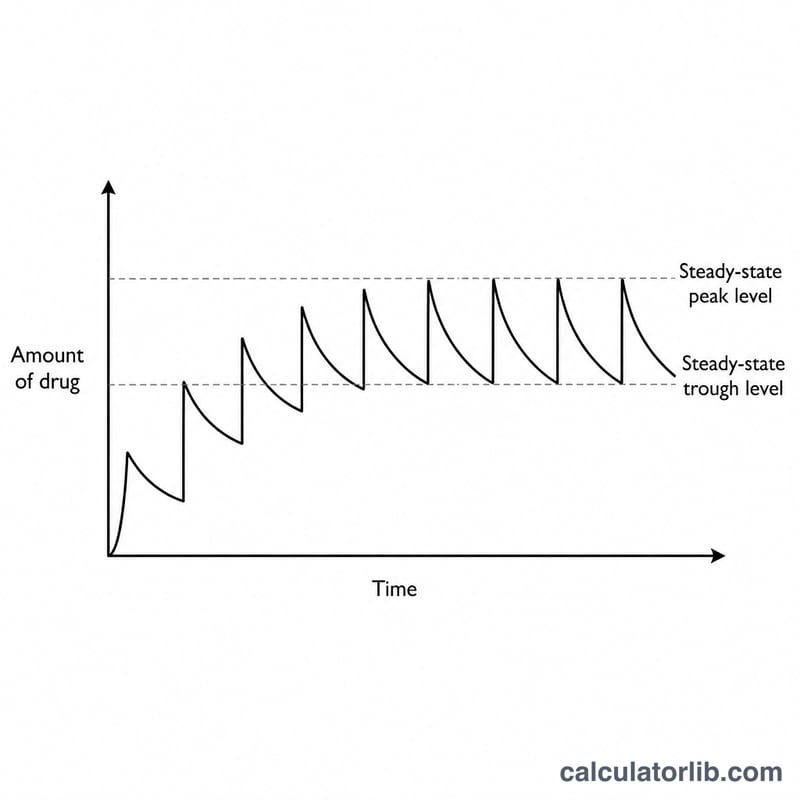
The Multiple-Dose Drug Half-Life Calculator estimates how a drug accumulates in the body when the same dose is given repeatedly at a fixed interval. It reports the steady-state peak and trough amounts, the accumulation factor, and how much of steady state has been reached after a chosen number of doses. This is a first-order, one-compartment model widely used to reason about repeated dosing.
How to use it
Enter the dose amount, the drug half-life \(t_{1/2}\) in hours, the dosing interval \(\tau\) in hours, and the number of doses \(n\). The calculator converts half-life to an elimination rate constant and returns the accumulation behavior across doses.
The formula explained
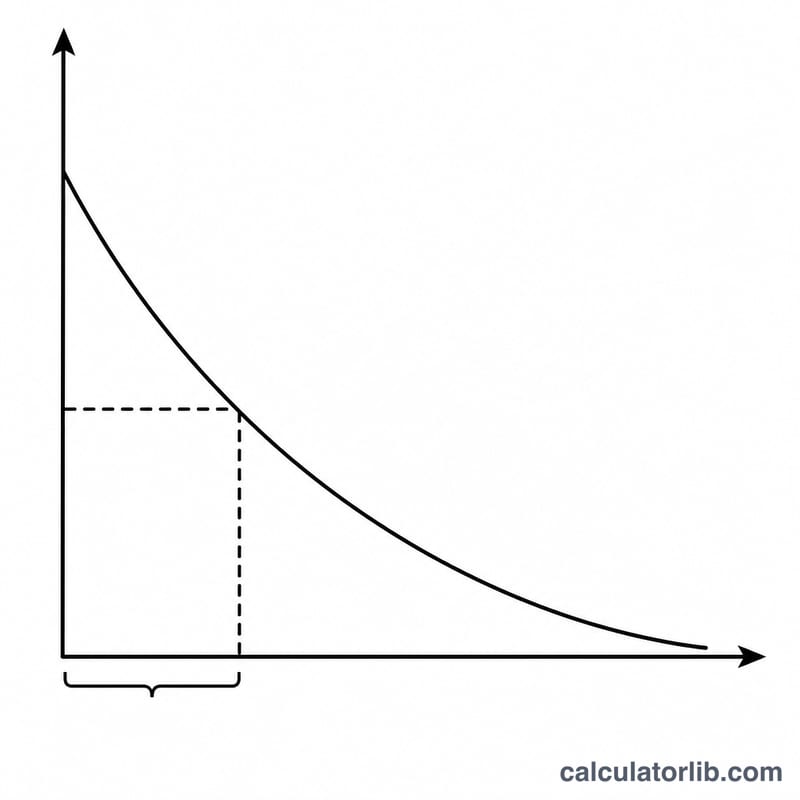
The elimination rate constant is \(k = \tfrac{\ln 2}{t_{1/2}}\). The fraction of drug remaining over one interval is \(e^{-k\tau}\), so the steady-state accumulation factor is:
$$R = \frac{1}{1 - e^{-k\tau}}$$The peak amount immediately after the \(n\)th dose is:
$$A_n = D\,\frac{1 - e^{-nk\tau}}{1 - e^{-k\tau}}$$where \(D\) is the dose. The steady-state peak is \(D\times R\) and the trough is \(D\times R\times e^{-k\tau}\).
Worked example
Take \(D = 500\) mg, \(t_{1/2} = 12\) h, \(\tau = 12\) h, and \(n = 5\) doses. Then \(k = \tfrac{\ln 2}{12} \approx 0.0578\,\text{/h}\) and \(e^{-k\tau} = 0.5\). The accumulation factor is:
$$R = \frac{1}{1 - 0.5} = 2$$The steady-state peak is \(500 \times 2 = 1000\) mg, and the peak after five doses is:
$$A_5 = 500\,\frac{1 - 0.5^5}{1 - 0.5} = 968.75\ \text{mg}$$That is \(96.875\%\) of the steady-state peak.
Interpreting Your Result
Accumulation factor (R). R tells you how many times the amount from one dose builds up in the body once steady state is reached. With R = 2, the steady-state peak is twice a single dose. This happens because half of each dose is still present when the next dose is given. R depends only on how the dosing interval compares with the half-life, not on dose size.
Time to reach steady state. How fast you approach steady state depends only on the half-life, not on how often you dose. After \(n\) half-lives the fraction of steady state reached is \(1 - 0.5^{n}\):
| Half-lives elapsed | Fraction of steady state reached |
|---|---|
| 1 | \(1 - 0.5 = 50\%\) |
| 2 | \(1 - 0.25 = 75\%\) |
| 3 | \(1 - 0.125 = 87.5\%\) |
| 4 | \(1 - 0.0625 = 93.75\%\) |
| 5 | \(1 - 0.03125 \approx 96.9\%\) |
This is why steady state is often described, as a rule of thumb, as being reached after about 4–5 half-lives.
Peak versus trough. The peak is the amount right after a dose. The trough is the amount just before the next dose, equal to peak × \(e^{-k\tau}\). The peak-to-trough ratio \(1/e^{-k\tau}\) measures how much the amount swings within each interval. A ratio close to 1 means fairly even exposure. A large ratio means high peaks and low troughs.
Amounts, not concentrations. The calculator reports drug amounts in mg. To turn these into plasma concentrations, you need the drug's volume of distribution (\(C = \text{amount} / V_d\)), and for oral drugs also its bioavailability. Neither is included here.
Model limits. The results assume:
- a single-compartment body, where the drug mixes instantly and evenly;
- instant input, like an IV bolus, with no absorption phase. Real oral doses peak later and lower than shown;
- linear, first-order elimination with a constant half-life. Drugs with saturable (non-linear) metabolism, or patients whose kidney or liver function changes, will not follow these numbers;
- identical doses taken exactly on schedule.
Important: this is general educational information, not medical advice. The calculator shows textbook pharmacokinetic behaviour. It is not a dosing guide and must not be used to start, change or time any medication. Always follow the guidance of your prescriber or pharmacist.
FAQ
When is steady state reached? Practically after about 4 to 5 half-lives; each half-life closes roughly half the remaining gap to steady state.
Does this account for absorption? No. It assumes rapid input and first-order elimination, so it is an approximation for oral drugs with slow absorption.
What units are the results? Amounts are in the same unit as the dose (for example mg); \(k\) is per hour.