
What is the Vitamin D Dose Calculator?
This calculator estimates the cumulative vitamin D₃ (cholecalciferol) loading dose, in International Units (IU), needed to raise your blood 25-hydroxyvitamin D — written 25(OH)D — to a sufficiency target of 75 nmol/L. It uses your current serum level and body weight, since heavier individuals generally require more vitamin D to correct a deficiency. This tool is for general education only and is not medical advice; dosing and monitoring should always be supervised by a healthcare professional.
How to use it
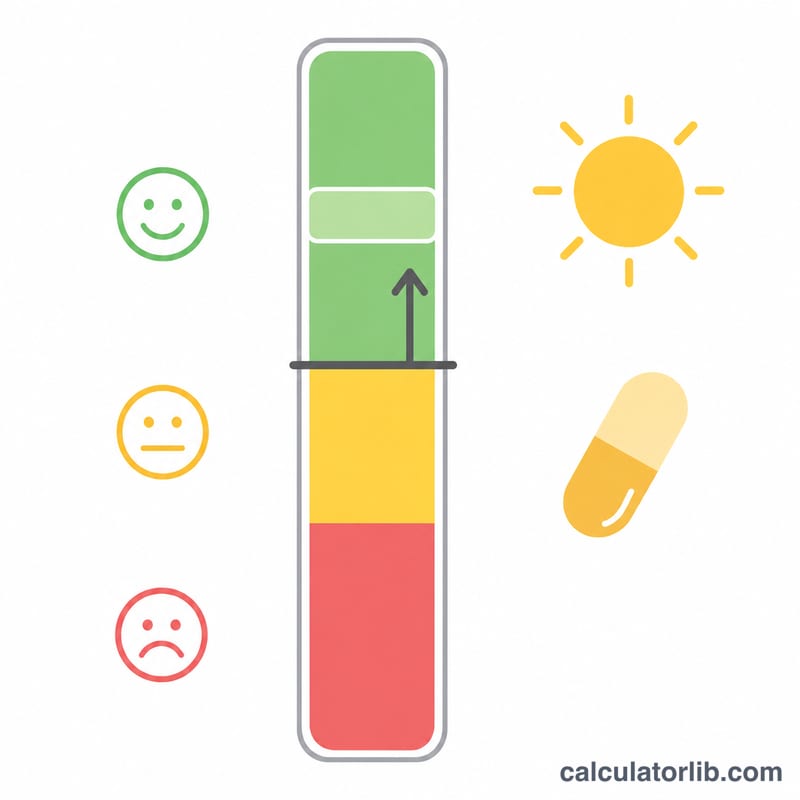
Enter your most recent serum 25(OH)D result in nmol/L (if your lab reports ng/mL, multiply by 2.5 to convert). Then enter your body weight in kilograms. The calculator returns the estimated total loading dose and also shows what that would look like spread evenly over an 8-week course.
The formula explained
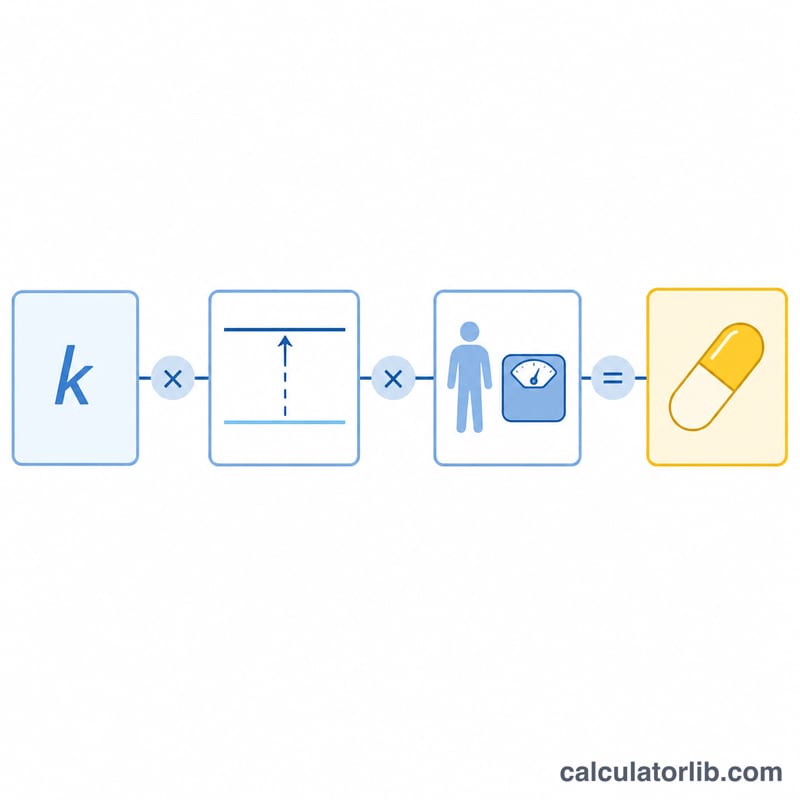
The model is $$\text{Loading Dose (IU)} = 40 \times (75 - \text{serum 25(OH)D}) \times \text{weight (kg)}$$ The term \((75 - \text{serum})\) is your deficit below the 75 nmol/L target. Each nmol/L of deficit is assumed to need roughly 40 IU per kilogram of body weight to correct, reflecting vitamin D's distribution in body tissues. If your serum level already meets or exceeds 75 nmol/L, the deficit is zero and no loading dose is indicated.
Worked example
Suppose your serum 25(OH)D is 30 nmol/L and you weigh 70 kg. The deficit is \(75 - 30 = 45\) nmol/L. Loading dose = $$40 \times 45 \times 70 = 126{,}000 \text{ IU}$$ Spread over 8 weeks (56 days), that is about 2,250 IU per day.
FAQ
Is 75 nmol/L the right target? Many guidelines treat 50 nmol/L as adequate and 75 nmol/L as optimal; this tool uses 75 nmol/L. Your clinician may choose a different target.
Can I take the whole loading dose at once? No. Loading doses are normally divided over several weeks; very high single doses can be harmful. Always follow professional guidance.
How do I convert ng/mL to nmol/L? Multiply the ng/mL value by 2.5 (e.g. 20 ng/mL = 50 nmol/L).