
What Is the Air Force PT Calculator?
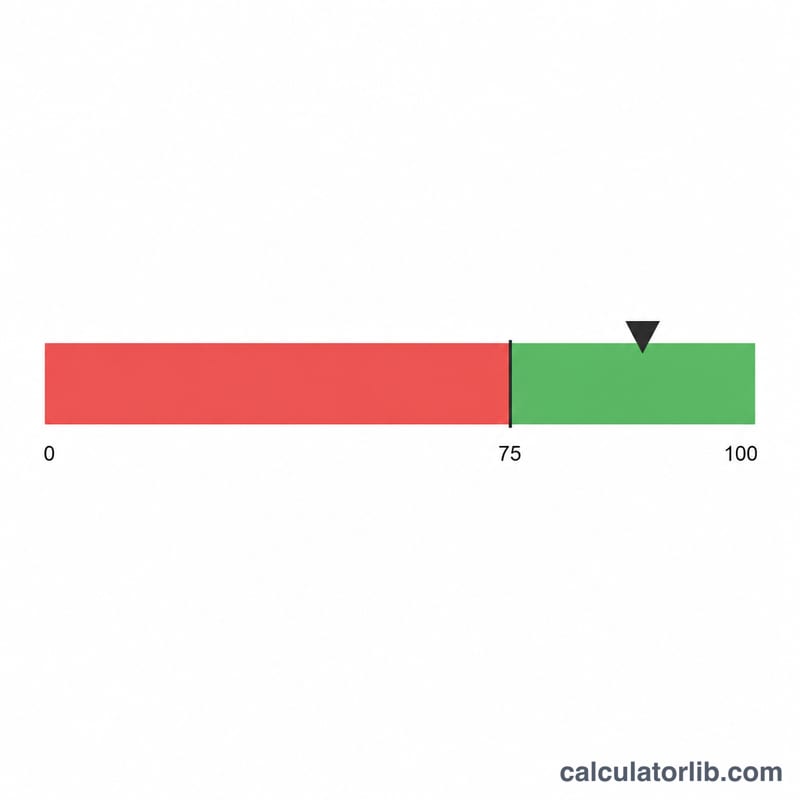
This tool estimates your United States Air Force (USAF) Physical Fitness Test score. The USAF assessment is scored out of 100 points and combines three components: 1-minute push-ups (20 points), 1-minute sit-ups (20 points), and a timed 1.5-mile run (60 points). A passing composite score is 75 or higher, and you must also meet the minimum standard in every individual component. This is an unofficial estimator using a simplified, age- and gender-scaled model and should not replace official scoring charts.
How to Use It
Select your gender, enter your age, then input your raw performance: push-up reps, sit-up reps, and your 1.5-mile run time in decimal minutes (for example, 11 minutes 30 seconds is entered as 11.5). The calculator scales each component against age-adjusted thresholds, awards points, sums them into a total, and tells you whether you pass.
The Formula Explained
Each strength component earns points proportional to the maximum-point target: points = (your reps ÷ target) × 20, capped at 20. The run uses linear interpolation between a fast time worth the full 60 points and a slow cutoff worth 0. Age eases the thresholds slightly in each decade band. The total is the sum of all three. You pass only when the total reaches 75 and no single component falls below its minimum (10/10/30 points).
$$\text{Total} = \text{Push-up}_{pts} + \text{Sit-up}_{pts} + \text{Run}_{pts}$$$$P_{run} = 60 \cdot \frac{t_{slow} - t}{t_{slow} - t_{fast}}$$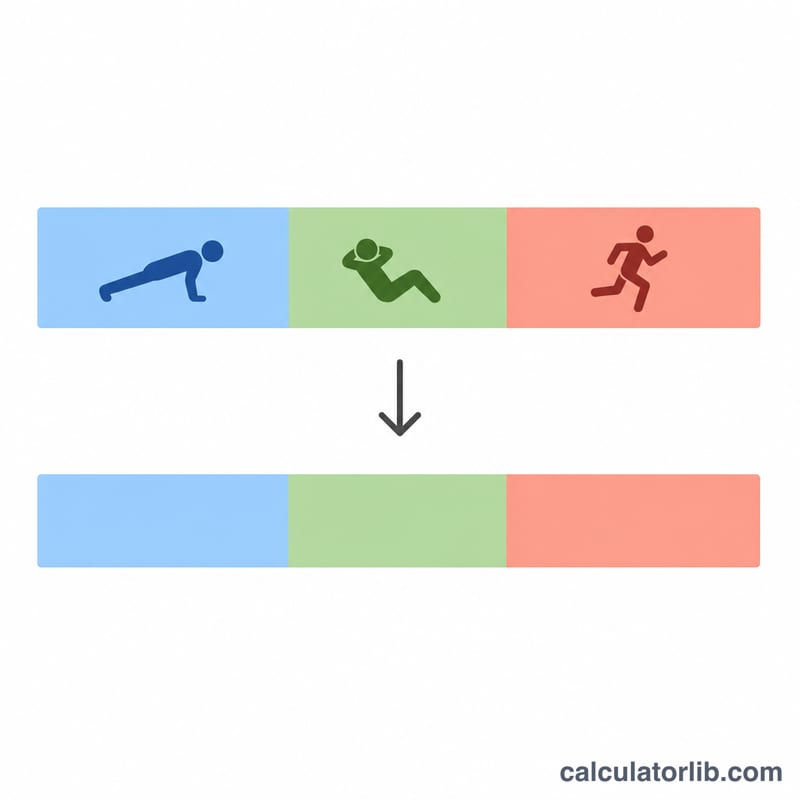
Worked Example
A 25-year-old male does 67 push-ups (20 pts), 58 sit-ups (20 pts), and runs in 9.2 minutes (60 pts). His total is \(20 + 20 + 60 = 100\) — a clear pass. A slower run of 13.6 minutes scores 0 on that component, dropping the total to \(20 + 20 + 0 = 40\) and failing the run minimum.
Key Terms Explained
- Composite score
- The single total, out of 100 points, formed by adding your push-up, sit-up, and 1.5-mile run component points. A composite of 75 or higher (with all component minimums met) is a passing result.
- Component minimum
- The lowest acceptable performance on a single event. Scoring below the minimum on any one component (push-ups, sit-ups, or run) causes the whole assessment to fail, even if the composite is otherwise 75+.
- Age band
- A grouping of ages (for example, under 30, 30–39, 40–49) that determines which scoring chart applies. Older bands generally require fewer reps and slower run times for the same number of points, accounting for changes in fitness with age.
- 1.5-mile run
- The timed cardiorespiratory event, run over 1.5 miles, recorded as minutes and seconds. A faster time earns more points; it is the most heavily weighted component of the test.
- Decimal minutes
- A way of expressing run time as a decimal number rather than minutes and seconds. To convert, divide the seconds by 60 and add them to the minutes — for example, 11 minutes 30 seconds becomes \(11 + \tfrac{30}{60} = 11.5\) minutes. Enter run time in this decimal form when the field expects a single number.
- Push-up rep standard
- A correctly counted push-up requires a straight body line, lowering until the upper arms are at least parallel to the floor, and returning to full arm extension. Reps performed with improper form are not counted. The total counts within the allotted time window.
- Sit-up rep standard
- A correctly counted sit-up (or the cross-leg reverse crunch alternative) requires the prescribed starting and finishing positions with proper range of motion. Only reps meeting the standard within the time limit are counted toward your component score.
FAQ
Is this the official scoring chart? No. It is a simplified estimate; always confirm with current Air Force fitness charts.
What is a passing score? A composite of 75 points or more, with each component above its minimum.
How do I enter my run time? Convert to decimal minutes — seconds ÷ 60. So 10:45 becomes \(10.75\).