
What is the STOP-BANG questionnaire?
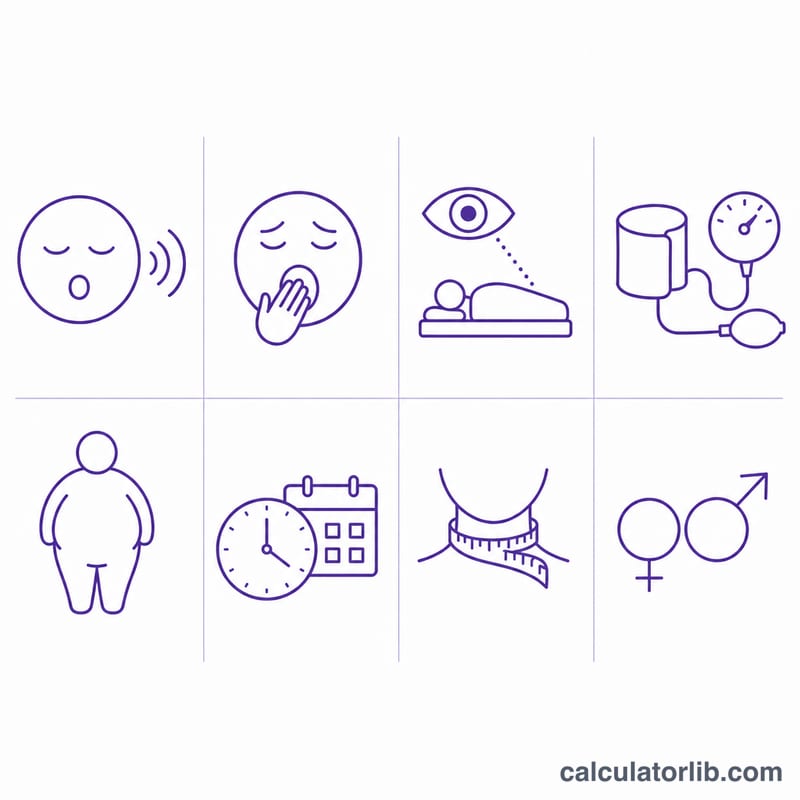
STOP-BANG is a widely used screening tool for obstructive sleep apnea (OSA). It is a simple eight-item yes/no questionnaire, where each "yes" answer scores one point. The total score ranges from 0 to 8 and places a person into a low, intermediate, or high risk category. The acronym stands for Snore, Tired, Observed apnea, Pressure (high blood pressure), BMI over 35, Age over 50, Neck circumference over 40 cm, and Gender (male).
How to use this calculator
Answer each of the eight questions with Yes or No. The calculator adds up the "yes" responses and instantly shows your total score and risk band. This is an awareness and screening tool only — it does not diagnose sleep apnea. If your score is intermediate or high, talk to a healthcare professional about a formal sleep evaluation.
The formula explained
Each affirmative answer contributes exactly one point. The score is the plain sum of all eight items:
$$\text{Score} = \text{S} + \text{T} + \text{O} + \text{P} + \text{B} + \text{A} + \text{N} + \text{G}$$Equivalently, the score is the count of affirmative answers:
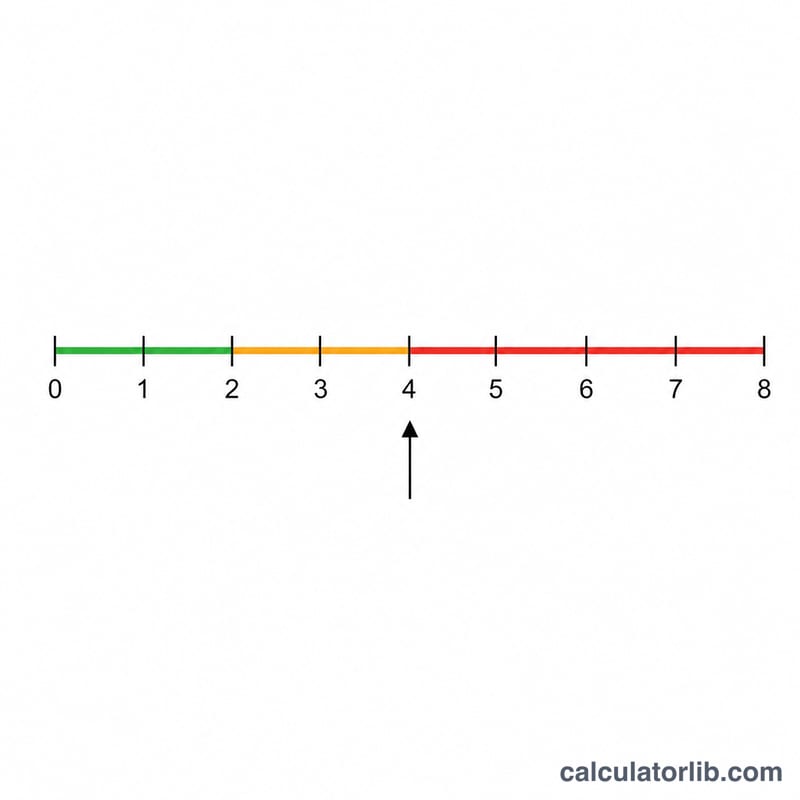
$$\text{Score} = \sum_{i=1}^{8} \text{yes}_i,\quad 0 \le \text{Score} \le 8$$Interpretation follows the commonly cited cut-offs: a score of 0–2 indicates low risk, 3–4 indicates intermediate risk, and 5–8 indicates high risk of moderate-to-severe OSA.
Worked example
Suppose someone snores loudly (1), feels tired during the day (1), has been observed to stop breathing (1), is being treated for high blood pressure (1), has a BMI under 35 (0), is over 50 (1), has a neck over 40 cm (0), and is male (1). The total is $$1+1+1+1+0+1+0+1 = 6$$ which falls in the high-risk band.
FAQ
Is a high STOP-BANG score a diagnosis? No. It only signals elevated risk and suggests further testing, typically a sleep study (polysomnography).
Why does gender count as a point? Epidemiologically, men have a higher prevalence of OSA, so male sex adds one point in the validated scoring.
What if I'm unsure about my BMI or neck size? \(\text{BMI} = \text{weight(kg)} \div \text{height(m)}^2\). Measure neck circumference around the Adam's apple. If unsure, answer "No" to avoid overstating risk and confirm the measurement later.