
What is the HAS-BLED Score?
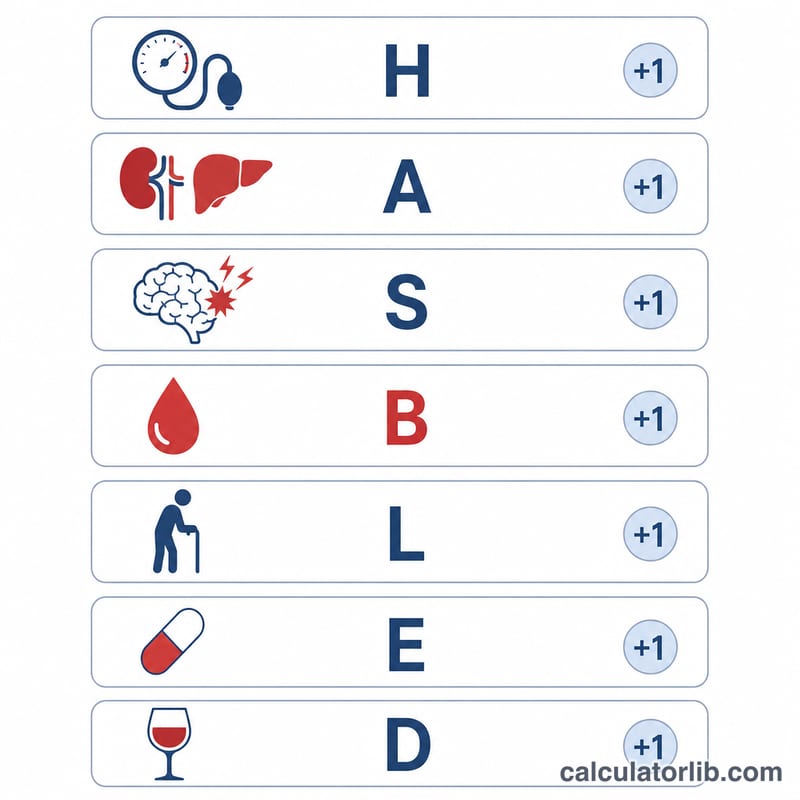
The HAS-BLED score is a clinical tool used to estimate the 1-year risk of major bleeding in patients with atrial fibrillation (AF) who are being considered for, or are already taking, oral anticoagulation. It was derived from the Euro Heart Survey and is widely recommended in European and international cardiology guidelines. The acronym stands for Hypertension, Abnormal renal/liver function, Stroke, Bleeding history or predisposition, Labile INR, Elderly (>65), and Drugs/alcohol use.
How to use this calculator
Tick each clinical factor that applies to your patient. Most factors score 1 point. Two categories are split into separate items: abnormal renal function and abnormal liver function each score 1 point (so a patient with both scores 2), and the drugs and alcohol items each score 1 point. The calculator adds the ticked items to give a total from 0 to 9 and assigns a risk category.
The formula explained
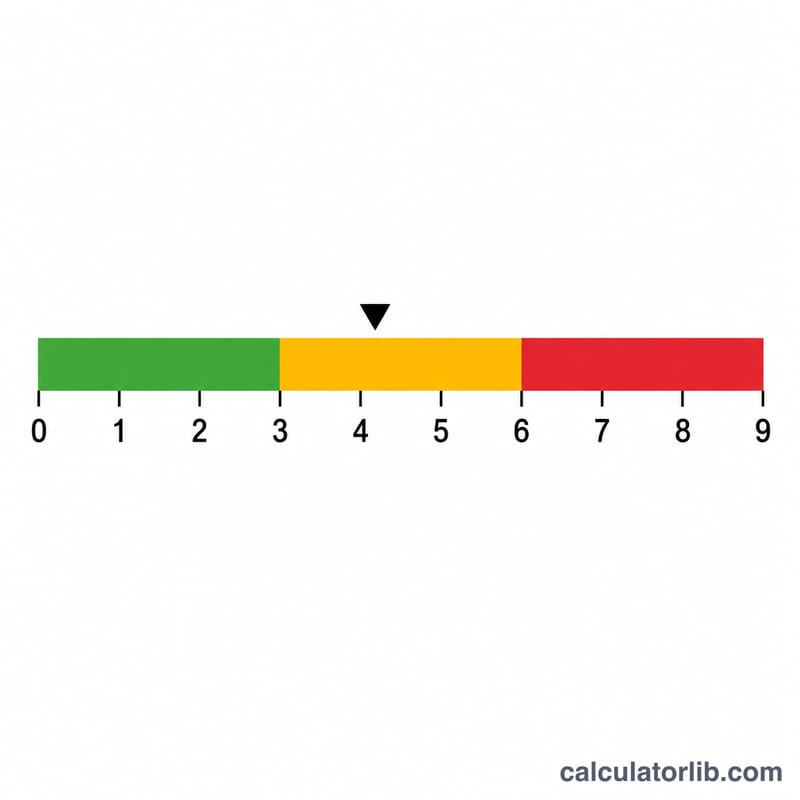
$$\text{Score} = H + A_{renal} + A_{liver} + S + B + L + E + D_{drugs} + D_{alcohol}$$ Each component contributes 0 or 1 point: $$\text{Score} = \sum_{i=1}^{9} x_i, \quad x_i \in \{0,1\}$$ A score of 0–1 is considered low risk, 2 is moderate, and 3 or more indicates high bleeding risk where extra caution and regular review are advised — though a high score is not by itself a reason to withhold anticoagulation.
Worked example
A 72-year-old man with uncontrolled hypertension, a previous major bleed, and regular NSAID use scores: $$\text{Hypertension}\,(1) + \text{Elderly} > 65\,(1) + \text{Bleeding}\,(1) + \text{Drugs}\,(1) = 4 \text{ points}$$ 4 points, placing him in the high-risk category.
FAQ
Does a high HAS-BLED score mean I should stop anticoagulation? No. It flags patients who need closer monitoring and modification of correctable risk factors (e.g. blood pressure, alcohol, NSAIDs), not automatic withdrawal of therapy.
What is the maximum score? The maximum is 9 points because abnormal renal/liver and drugs/alcohol are each counted as two separate 1-point items.
Is this a diagnosis? No. It is a risk-stratification aid for clinicians and does not replace individual clinical judgement.