
What is apparent temperature?
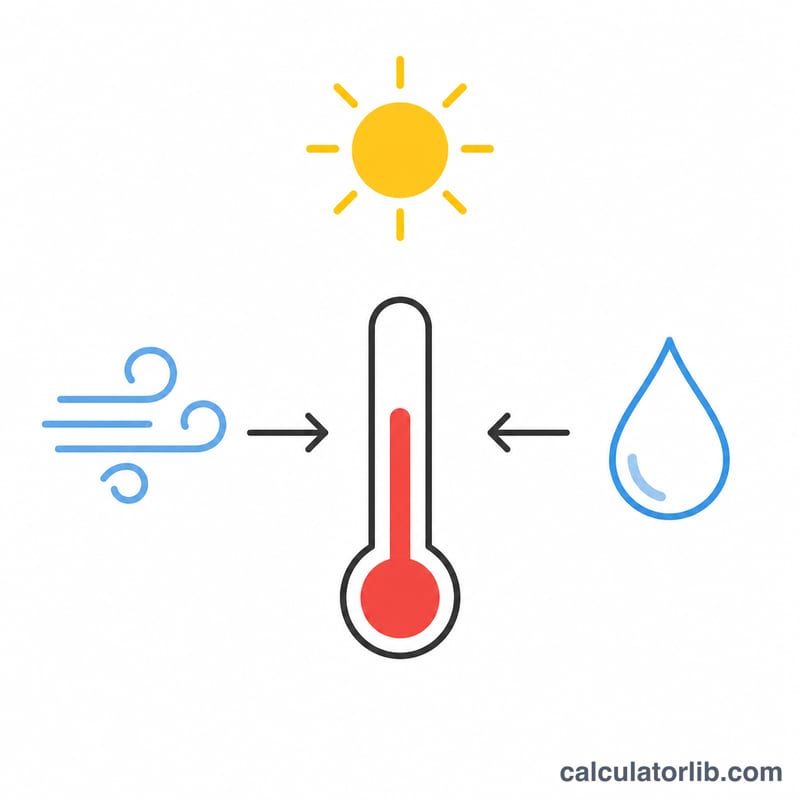
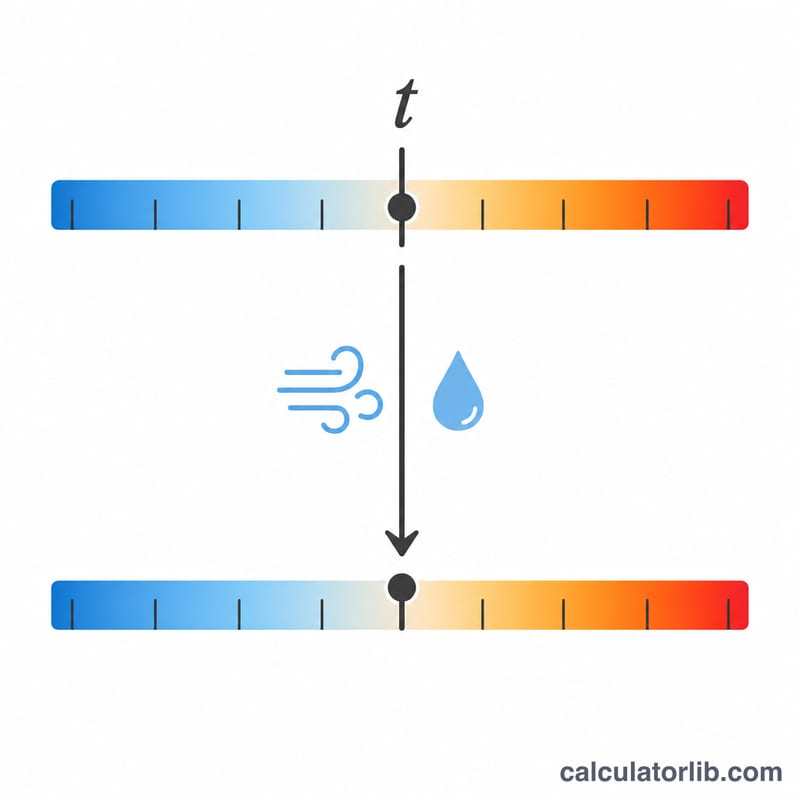
Apparent temperature, often called the "feels-like" temperature, estimates how hot or cold the air feels to a person once humidity and wind are taken into account. High humidity makes warm air feel hotter because sweat evaporates more slowly, while wind makes air feel cooler by carrying heat away from the skin. This calculator uses the improved Missenard formula, a universal meteorological equation (popularized by the Hong Kong Observatory, Reprint r444) that combines air temperature, relative humidity and wind speed into a single number. It is not specific to any country and works the same everywhere on Earth.
How to use it
Enter three values: the air temperature in degrees Celsius, the relative humidity as a percentage from 0 to 100, and the wind speed in metres per second. Press calculate to get the apparent temperature in degrees Celsius. If your data is in other units, convert first: km/h to m/s multiply by 0.27778, mph by 0.44704, knots by 0.51444; Fahrenheit to Celsius use \((F-32)\times 5/9\).
The formula explained
First an intermediate wind term is computed:
$$A = 1.76 + 1.4 \times v^{0.75}$$Then the apparent temperature is
$$T_m = 37 - \frac{37 - t}{0.68 - 0.0014h + \frac{1}{A}} - 0.29t\left(1 - \frac{h}{100}\right)$$Note that humidity \(h\) appears twice: once raw as \(0.0014h\) and once divided by 100 in the final term. Because \(v\) is never negative, \(A\) is always at least 1.76, so \(\frac{1}{A}\) is finite and there is no divide-by-zero.
Worked example
With \(t = 20\,^\circ\text{C}\), \(h = 30\%\), \(v = 10\ \text{m/s}\):
$$A = 1.76 + 1.4 \times 10^{0.75} = 1.76 + 7.8728 = 9.6328$$so \(\frac{1}{A} = 0.10381\). The denominator is
$$0.68 - 0.042 + 0.10381 = 0.74181$$Then \(\frac{37 - 20}{0.74181} = 22.917\), and the last term is \(0.29 \times 20 \times 0.7 = 4.06\). So
$$T_m = 37 - 22.917 - 4.06 \approx 10.0\,^\circ\text{C}$$FAQ
Why is the result lower than it feels on a sunny day? This is a "shade" apparent temperature; it ignores direct solar radiation, so in bright sun the real felt temperature can be higher.
What if wind speed is zero? That is valid. With \(v = 0\), \(A = 1.76\) and the formula still gives a finite answer.
Does it work in any country? Yes. The improved Missenard formula is a universal physical relationship and is not tied to any jurisdiction.