
What is the Temperature at Altitude Calculator?
Air temperature generally decreases as you climb. This calculator estimates the temperature at any altitude using the environmental lapse rate, the rate at which temperature falls with height in the troposphere. Starting from a known sea-level (or reference) temperature, it predicts how cold it will be higher up — useful for hiking, aviation, ballooning, drone flights and weather curiosity.
How to use it
Enter the sea-level temperature in °C, the altitude in metres, and (optionally) adjust the lapse rate. The default 6.5 °C per 1000 m is the ICAO International Standard Atmosphere value. The result shows the estimated temperature in °C, °F and Kelvin, plus the total drop from the reference level.
The formula explained
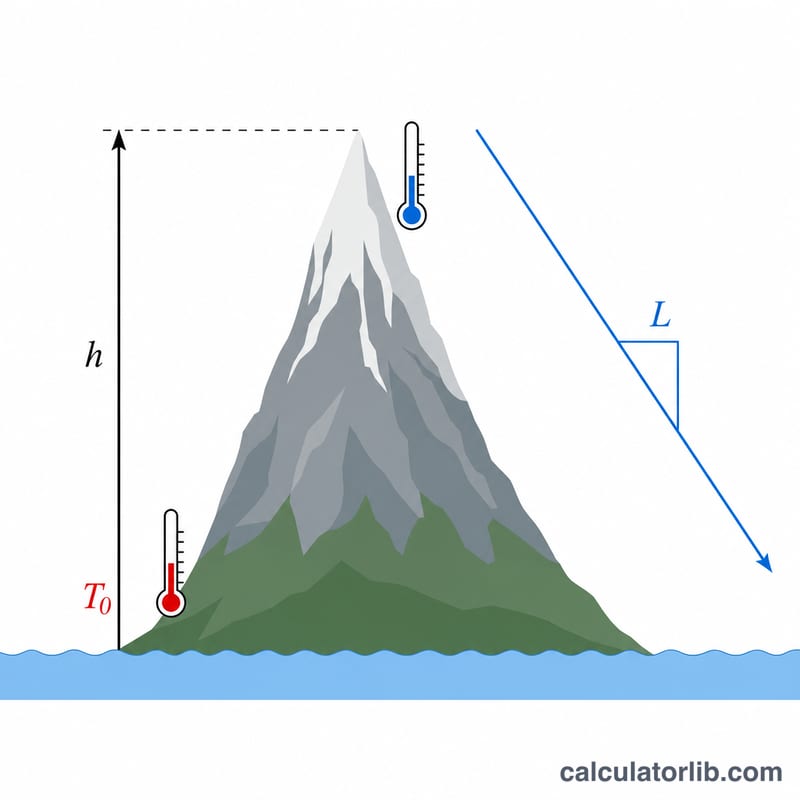
The core relationship is $$T = T_0 - L \cdot h$$ where \(T_0\) is the reference temperature, \(L\) is the lapse rate per metre, and \(h\) is altitude in metres. With \(L\) given per 1000 m, we convert it to per-metre by dividing by 1000. For example, a 6.5 °C/1000 m rate becomes 0.0065 °C/m. The total temperature drop is simply \(L \cdot h\).
Worked example
Suppose sea level is 15 °C and you climb to 2000 m with the standard lapse rate of 6.5 °C/1000 m. The drop is $$0.0065 \times 2000 = 13\ \text{°C}$$ so the temperature at altitude is $$15 - 13 = 2\ \text{°C}$$ (35.6 °F, 275.15 K).
FAQ
Is the lapse rate always 6.5 °C/1000 m? No. It varies with humidity and weather. Dry air can cool near 9.8 °C/1000 m, while saturated air may cool around 5 °C/1000 m. The standard value is a good general estimate.
Does this account for inversions? No. Temperature inversions (where it gets warmer with height) are local weather effects not captured by a fixed lapse rate.
Can I go negative on altitude? Yes — a negative altitude (below the reference) gives a warmer temperature, consistent with the formula.