
What is True Airspeed?
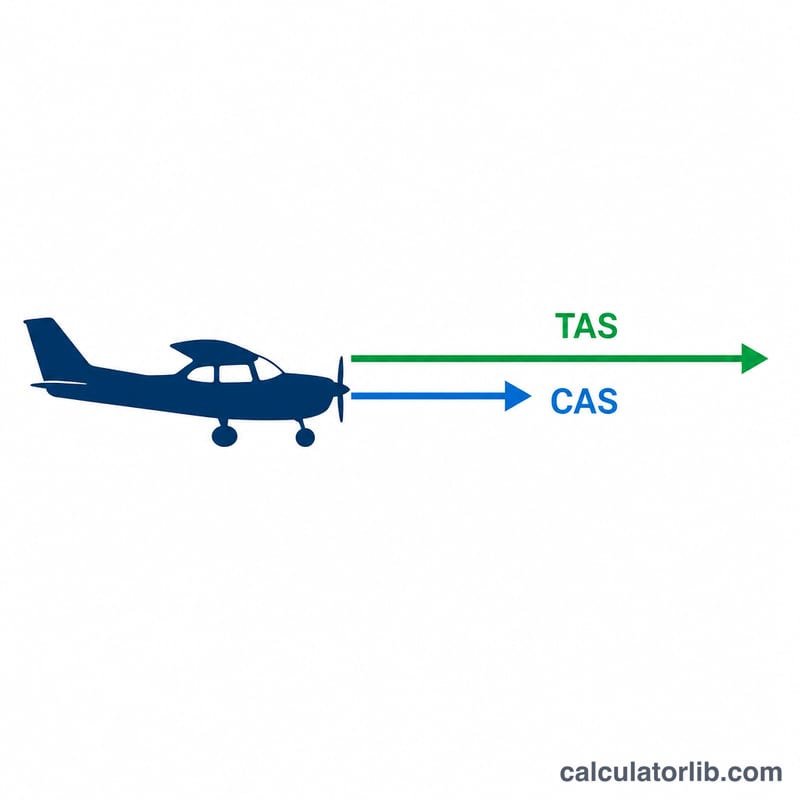
True airspeed (TAS) is the actual speed of an aircraft relative to the air mass it is flying through. As an aircraft climbs, air density decreases, so the same calibrated airspeed (CAS) shown on the airspeed indicator corresponds to a higher true speed through the air. This calculator estimates TAS from CAS and pressure altitude using the popular pilot rule of thumb of about 2% per 1,000 feet.
How to use this calculator
Enter your calibrated airspeed in knots and your pressure altitude in feet. The calculator returns your estimated true airspeed, the increase over CAS, and a summary table. This quick estimate is ideal for flight planning, mental math cross-checks, and understanding how altitude affects groundspeed potential.
The formula explained
The exact physics relate TAS to CAS through air density: \( \text{TAS} = \text{CAS} \times \sqrt{\rho_0 / \rho} \), where \( \rho_0 \) is sea-level standard density and \( \rho \) is the density at altitude. Because density falls predictably in the standard atmosphere, pilots use the handy approximation
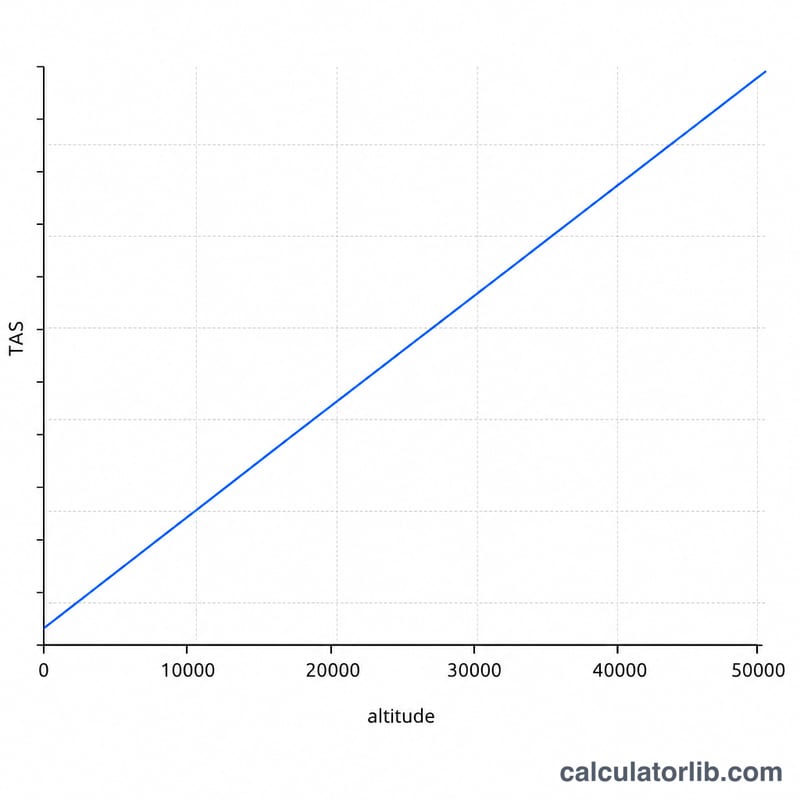
$$\text{TAS} \approx \text{CAS} \times \left(1 + 0.02 \times \frac{\text{Altitude}}{1000}\right)$$This adds roughly 2% to CAS for each 1,000 feet of altitude.
Worked example
Suppose you are cruising at a calibrated airspeed of 120 knots at a pressure altitude of 10,000 feet. Altitude in thousands is 10, so the multiplier is \( 1 + 0.02 \times 10 = 1.20 \).
$$\text{TAS} = 120 \times 1.20 = 144 \text{ knots}$$That is 24 knots faster than your indicated/calibrated value — a meaningful difference when computing time en route.
FAQ
Is this exact? No. The 2% per 1,000 ft rule is an approximation accurate to within a few knots at typical light-aircraft altitudes (below ~20,000 ft and standard temperatures). For precise figures use a flight computer accounting for actual temperature and pressure.
What is the difference between CAS and IAS? Indicated airspeed (IAS) is the raw gauge reading; calibrated airspeed (CAS) corrects IAS for instrument and position error. This tool assumes you have CAS.
Does temperature matter? Yes — warmer-than-standard air is less dense and raises TAS further. This simplified estimate assumes standard atmospheric conditions.