
What is the Biot Number?
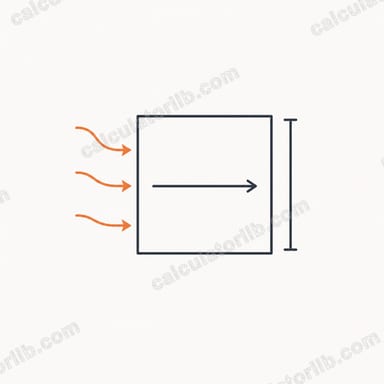
The Biot number (Bi) is a dimensionless quantity used in transient heat conduction analysis. It compares the resistance to heat transfer inside a body (conduction) to the resistance at its surface (convection). A small Biot number means the body conducts heat internally far faster than it loses it to the surroundings, so its temperature stays nearly uniform during heating or cooling.
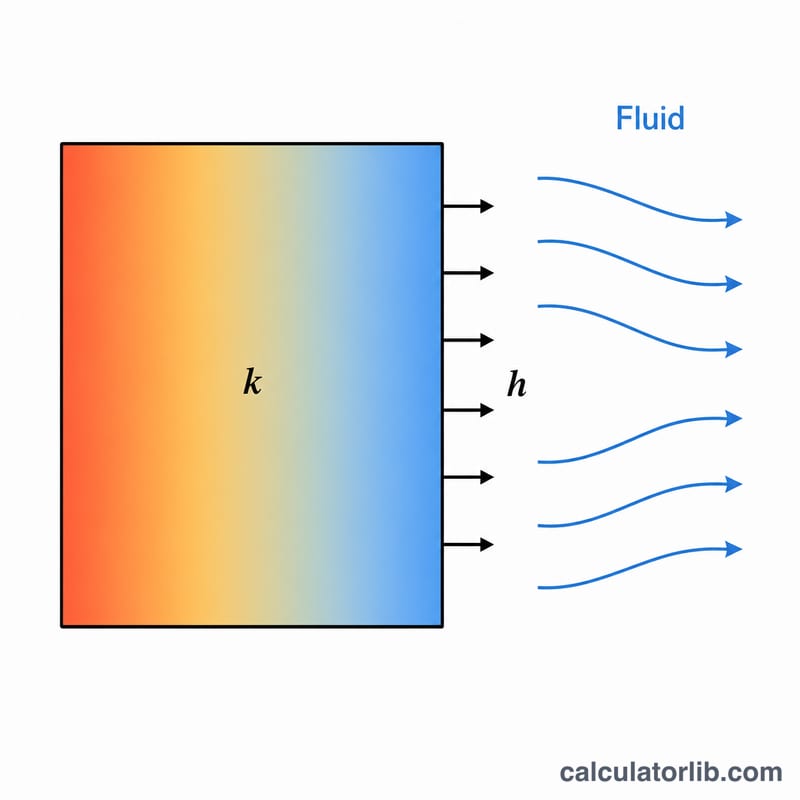
How to use this calculator
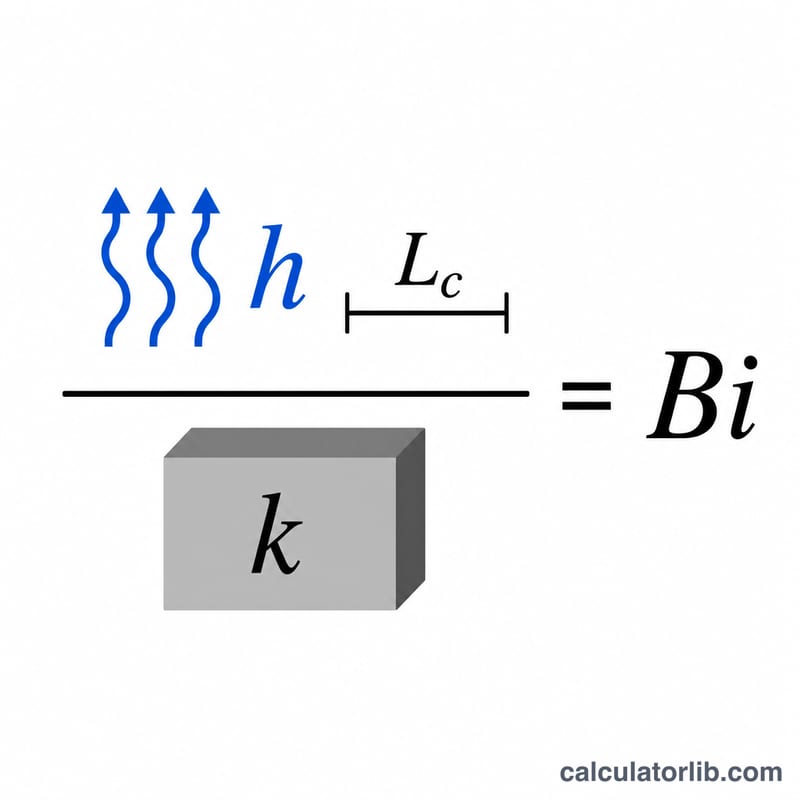
Enter three values: the convective heat transfer coefficient h (W/m²·K), the characteristic length Lc (m), and the thermal conductivity k (W/m·K) of the solid. The calculator returns \(\text{Bi} = \frac{\text{h} \cdot \text{L}_c}{\text{k}}\) and tells you whether the popular lumped-capacitance approximation applies.
The formula explained
The governing equation is $$\text{Bi} = \frac{\text{h} \cdot \text{L}_c}{\text{k}}$$ The characteristic length Lc is usually taken as the volume divided by the surface area (V/A): for a slab of thickness L cooled on one side it is L; for a sphere of radius r it is r/3; for a long cylinder, r/2. When \(\text{Bi} < 0.1\), internal temperature gradients are negligible and you can treat the object as a single lumped node.
Worked example
A metal part with h = 10 W/m²·K, Lc = 0.05 m and k = 200 W/m·K gives $$\text{Bi} = \frac{10 \times 0.05}{200} = \frac{0.5}{200} = 0.0025$$ Because \(0.0025 < 0.1\), the lumped capacitance method is valid.
Characteristic Length (Lc) by Geometry
For lumped-capacitance analysis the characteristic length is defined as the ratio of the solid's volume to its surface area exposed to convection, \(L_c = V/A_s\). Using this consistent definition keeps the Biot-number criterion (\(\text{Bi}<0.1\)) directly comparable across shapes. Some textbooks instead use the full radius or half-thickness for one-term series and Heisler-chart solutions; both conventions are shown below.
| Geometry | Defining dimension | \(L_c = V/A_s\) | Conduction-length convention |
|---|---|---|---|
| Plane wall, both faces cooled | Thickness \(2L\) | \(L\) | Half-thickness \(L\) |
| Plane wall / slab, one face insulated | Thickness \(L\) | \(L\) | Thickness \(L\) |
| Long cylinder (radius \(r\)) | Radius \(r\) | \(r/2\) | Radius \(r\) |
| Sphere (radius \(r\)) | Radius \(r\) | \(r/3\) | Radius \(r\) |
| Cube (side \(a\)) | Side \(a\) | \(a/6\) | Half-side \(a/2\) |
Worked check: for a sphere of radius \(r=0.02\text{ m}\), \(L_c = r/3 = 0.02/3 \approx 0.00667\text{ m}\). For a long cylinder of the same radius, \(L_c = r/2 = 0.01\text{ m}\).
Interpreting Your Biot Number
The Biot number compares internal conduction resistance \((L_c/k)\) to external convection resistance \((1/h)\). It tells you whether a solid heats or cools with a nearly uniform internal temperature or with significant internal gradients.
| Biot range | Physical meaning | Recommended analysis |
|---|---|---|
| \(\text{Bi}<0.1\) | Internal conduction resistance is negligible; the body's temperature is essentially uniform at any instant. | Lumped-capacitance model valid; use exponential decay \(\theta/\theta_0 = e^{-t/\tau}\) with \(\tau = \rho V c_p / (h A_s)\). |
| \(0.1<\text{Bi}<\sim 10\) | Finite internal temperature gradients exist; neither resistance dominates. | Use one-term approximation or Heisler/transient-conduction chart solutions for the appropriate geometry. |
| \(\text{Bi}>\sim 10\) | Convection resistance is negligible; the surface temperature is essentially pinned at the fluid temperature. | Conduction-controlled; treat surface as isothermal boundary condition (\(T_s \approx T_\infty\)). |
The widely used engineering threshold of \(\text{Bi}=0.1\) keeps the lumped-capacitance error in temperature below roughly 5%. Below this value the simple single-node model is both convenient and accurate.
Key Terms & Variables
- Convective heat transfer coefficient, \(h\) (W/m²·K)
- Rate of heat exchange between the solid surface and surrounding fluid per unit area per degree of temperature difference. Larger for forced convection and for liquids than for still air.
- Characteristic length, \(L_c\) (m)
- Geometric scale of the solid, defined as \(L_c = V/A_s\) for lumped analysis. It represents the typical distance heat must conduct internally.
- Thermal conductivity of the solid, \(k\) (W/m·K)
- The solid's intrinsic ability to conduct heat. Note that \(k\) in the Biot number is that of the solid body, not of the surrounding fluid.
- Biot number, \(\text{Bi}\) (dimensionless)
- \(\text{Bi}=hL_c/k\); the ratio of internal conduction resistance to surface convection resistance.
- Lumped capacitance
- An idealization treating the entire body as a single uniform temperature node, valid when \(\text{Bi}<0.1\).
Biot vs. Nusselt: The two share the form \(hL/k\) but use different \(k\). The Biot number uses the solid's conductivity and gauges internal vs. surface resistance. The Nusselt number uses the fluid's conductivity and gauges convective vs. conductive heat transfer in the fluid, so the same \(h\) and \(L\) give very different values.
FAQ
Why is \(\text{Bi} < 0.1\) the rule of thumb? Below this threshold the temperature variation inside the solid is under about 5%, small enough to ignore for most engineering work.
What is the difference between the Biot and Nusselt numbers? Both use \(\frac{\text{h} \cdot \text{L}}{\text{k}}\), but the Biot number uses the conductivity of the solid, while the Nusselt number uses the conductivity of the fluid.
What if k is zero? Conductivity cannot be zero for a real material; the calculator guards against division by zero and returns 0 in that case.