
What is the Boltzmann Factor?
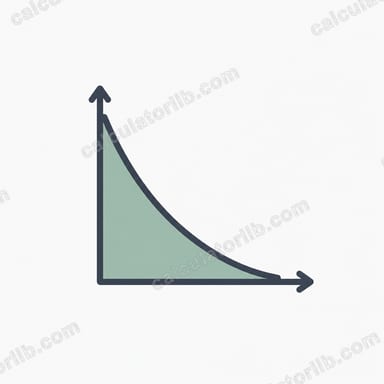
The Boltzmann factor is a fundamental quantity in statistical mechanics and thermodynamics. It gives the relative probability that a system in thermal equilibrium occupies a state with energy E at absolute temperature T. Defined as f = exp(−E / k_B·T), it appears throughout physics and chemistry — from the Maxwell–Boltzmann distribution of molecular speeds to reaction-rate theory (the Arrhenius equation) and semiconductor carrier statistics.
How to Use This Calculator
Enter the energy E of the state in joules and the absolute temperature T in kelvin. The calculator divides E by the product of the Boltzmann constant (k_B = 1.380649 × 10⁻²³ J/K) and T, negates it, and exponentiates the result. A larger energy or lower temperature drives the factor toward zero, meaning high-energy states are increasingly unlikely.
The Formula Explained
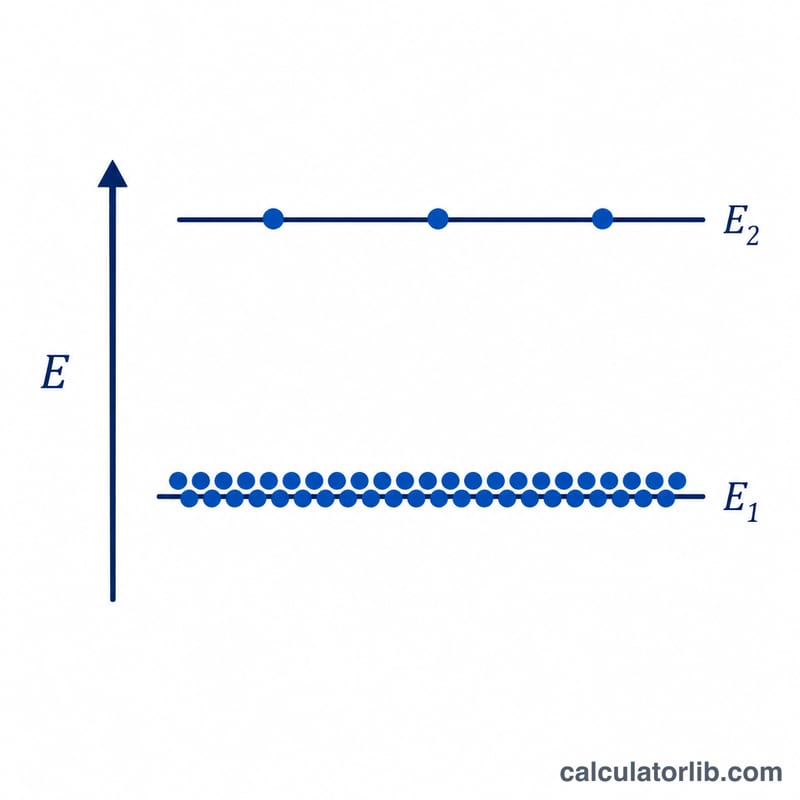
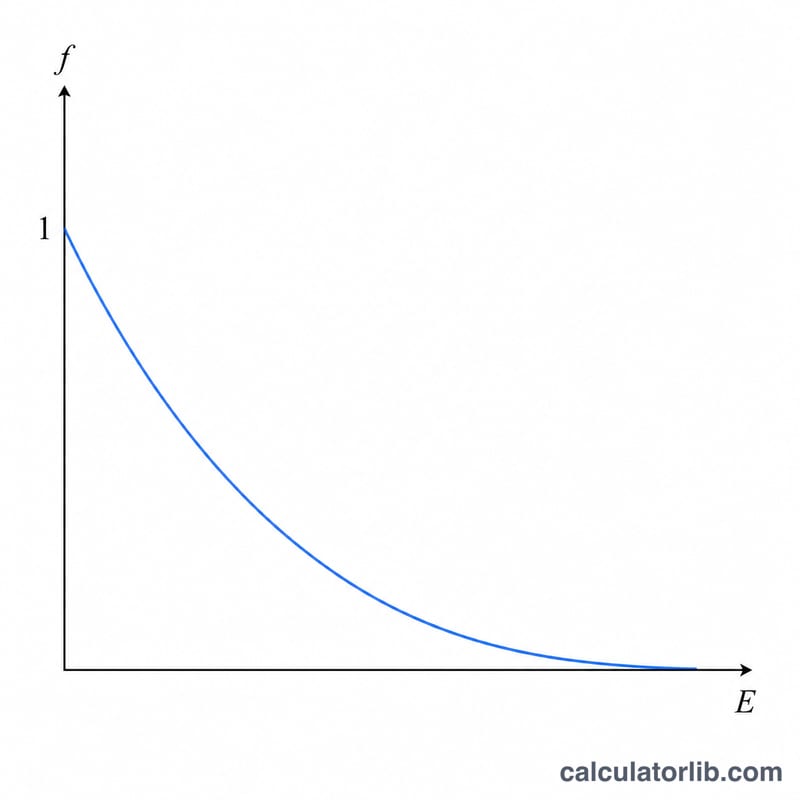
The exponent −E / (k_B·T) is dimensionless: energy in the numerator divided by the thermal energy scale k_B·T. When E equals k_B·T, the factor is e⁻¹ ≈ 0.368. When E is much smaller than k_B·T, f approaches 1; when E is much larger, f approaches 0. The ratio of two Boltzmann factors gives the relative population of two energy levels.
Worked Example
Suppose E = 4.14195 × 10⁻²¹ J at T = 300 K. The thermal energy is k_B·T = 1.380649 × 10⁻²³ × 300 = 4.141947 × 10⁻²¹ J. The exponent is −E / (k_B·T) ≈ −1.0000, so f = e⁻¹ ≈ 0.3679. The state is occupied with about 37% of the weight relative to the ground state.
Key Terms & Variables
- Boltzmann factor \(f\)
- The dimensionless weight \(f = \exp(-E/k_BT)\) giving the relative likelihood that a system occupies a state of energy \(E\) at thermal equilibrium. It ranges from 1 (when \(E=0\)) down toward 0 as \(E\) grows large compared with \(k_BT\).
- Energy \(E\)
- The energy of the state of interest, measured relative to a chosen reference (often the ground state, where \(E=0\)). Only energy differences matter, so the reference choice rescales all factors by a common constant. Expressed in joules for use with SI \(k_B\).
- Absolute temperature \(T\)
- The thermodynamic temperature in kelvin (K). It must be absolute (never Celsius or Fahrenheit), since \(T\) appears in the denominator and \(T=0\) would make the exponent diverge. Higher \(T\) flattens the distribution, making high-energy states more accessible.
- Boltzmann constant \(k_B\)
- The fundamental constant linking temperature to energy, \(k_B = 1.380649\times10^{-23}\ \text{J/K}\) (exact in the SI). The product \(k_BT\) converts a temperature into a characteristic energy.
- Thermal energy \(k_B T\)
- The characteristic energy scale of thermal fluctuations at temperature \(T\). States separated by much less than \(k_BT\) are nearly equally populated; states separated by much more are strongly suppressed. At room temperature \(k_BT \approx 0.0259\ \text{eV}\).
- Partition function \(Z\)
- The normalizing sum (or integral) of Boltzmann factors over all states, \(Z = \sum_i \exp(-E_i/k_BT)\). Dividing a single factor by \(Z\) converts the relative weight into an absolute probability.
- Relative population / occupation probability
- The ratio of populations of two states is \(N_2/N_1 = (g_2/g_1)\exp(-(E_2-E_1)/k_BT)\), where \(g_i\) are degeneracies. The absolute probability of a single state is \(P_i = \exp(-E_i/k_BT)/Z\). These describe how molecules or particles distribute themselves among available energy levels at equilibrium.
FAQ
What units should I use? Energy must be in joules and temperature in kelvin so the exponent is dimensionless. To convert eV to joules, multiply by 1.602176634 × 10⁻¹⁹.
Why is my result greater than 1? If you enter a negative energy (a state below the reference), the factor exceeds 1. For positive energies it is always between 0 and 1.
What happens at T = 0? Division by zero is undefined, so the calculator returns 0 for non-positive temperatures.