
What Is the Calorimetry Calculator?
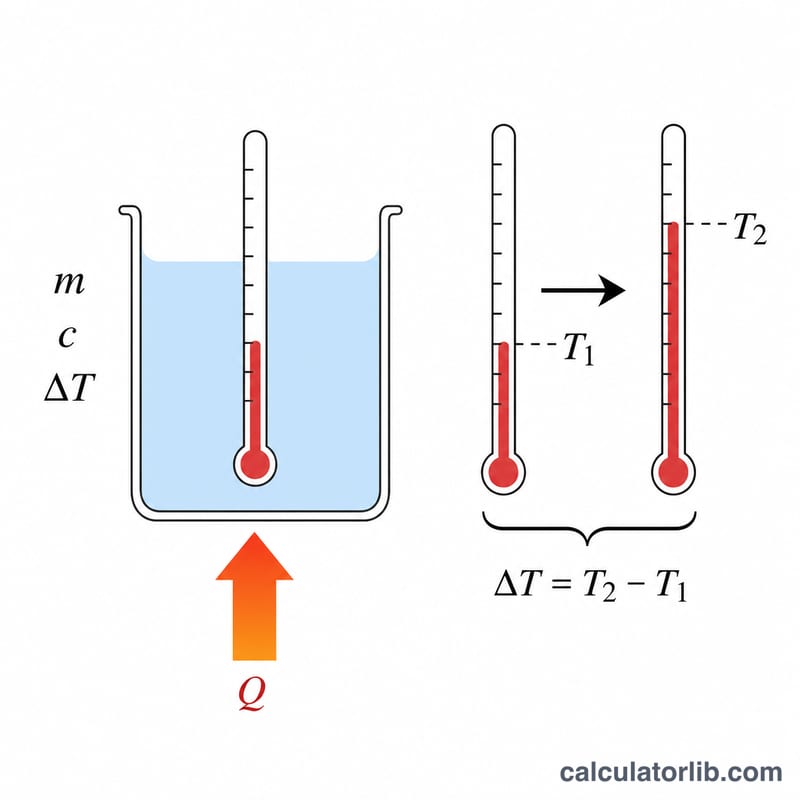
Calorimetry is the science of measuring the heat exchanged during physical and chemical processes. This calculator applies the fundamental heat equation, \(Q = m \cdot c \cdot \Delta T\), to find how much thermal energy (Q) a substance absorbs or releases when its temperature changes. It works for any substance as long as you know its specific heat capacity, making it useful for physics, chemistry, and engineering coursework.
How to Use It
Enter four values: the mass of the substance in grams, its specific heat capacity (c) in joules per gram per degree Celsius, the initial temperature, and the final temperature. The calculator computes the temperature change automatically and returns the heat energy in both joules and kilojoules. A positive Q means heat was absorbed (the substance warmed up); a negative Q means heat was released (it cooled down).
The Formula Explained
The equation $$Q = m \cdot c \cdot \Delta T$$ links four quantities. Mass (m) tells us how much material is being heated. Specific heat (c) is the energy needed to raise one gram by one degree Celsius — water's is high at about 4.186 J/g·°C, which is why water resists temperature changes. \(\Delta T\) is simply the final temperature minus the initial temperature. Multiply all three together and you get the total heat exchanged.
Worked Example
Suppose you heat 100 g of water from 20 °C to 80 °C. The specific heat of water is 4.186 J/g·°C. \(\Delta T = 80 - 20 = 60\) °C. Then $$Q = 100 \times 4.186 \times 60 = 25{,}116 \text{ J}$$ or about 25.12 kJ of heat absorbed.
FAQ
What units should I use? Use grams for mass, J/g·°C for specific heat, and °C for temperature so the result comes out in joules. The calculator also shows kilojoules.
What does a negative answer mean? A negative Q indicates the substance lost heat (cooled), since the final temperature was below the initial.
Can I use it for substances other than water? Yes — just supply the correct specific heat (e.g., ~0.385 J/g·°C for copper, ~0.897 for aluminum).