

What Is Specific Heat Capacity?
Specific heat capacity (\(c\)) is the amount of heat energy required to raise the temperature of one unit mass of a substance by one degree. It is a fundamental thermal property that explains why some materials heat up quickly while others, like water, resist temperature change. This calculator solves for \(c\) using the experimentally measured heat energy, mass, and temperature change.
How to Use the Calculator
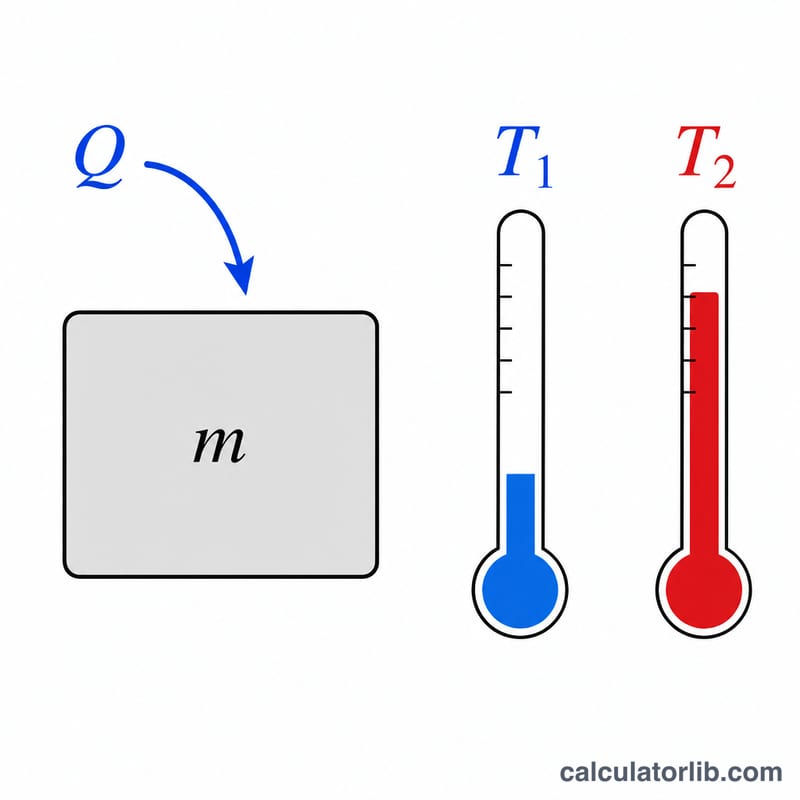
Enter the heat energy Q in joules, the mass m in grams, and both the initial (T1) and final (T2) temperatures in degrees Celsius. The tool computes the temperature change \(\Delta T = T_2 - T_1\) and divides Q by the product of mass and \(\Delta T\) to return the specific heat capacity in joules per gram per degree Celsius, \(\text{J/(g}\cdot\text{\textdegree C)}\).
The Formula Explained
The governing equation is $$c = \frac{\text{Heat Energy }Q}{\text{Mass }m \cdot \left(\text{Final }T_2 - \text{Initial }T_1\right)}$$ rearranged from the classic heat equation \(Q = m \cdot c \cdot \Delta T\). Q is the heat added (joules), m is mass, and \(\Delta T\) is the temperature change. Because a degree change in Celsius equals a degree change in Kelvin, the result is identical whether you think in °C or K.
Worked Example
Suppose 4180 J of heat raises 100 g of water from 20 °C to 30 °C. The temperature change is \(\Delta T = 30 - 20 = 10\) °C. Then $$c = \frac{4180}{100 \times 10} = \frac{4180}{1000} = \mathbf{4.18 \ \text{J/(g}\cdot\text{\textdegree C)}}$$ — the well-known specific heat of liquid water.
FAQ
What units does this use? Q in joules, mass in grams, temperature in °C, giving c in \(\text{J/(g}\cdot\text{\textdegree C)}\). To convert to \(\text{J/(kg}\cdot\text{\textdegree C)}\), multiply the result by 1000.
Why must temperatures differ? If T1 equals T2, \(\Delta T\) is zero and the formula divides by zero, so no heat capacity can be computed — always use distinct temperatures.
Can I use Kelvin? Yes. A temperature difference in Kelvin equals the same difference in Celsius, so the calculated \(c\) is unchanged.