
What Is the Factor of Safety?
The factor of safety (FoS), also called the safety factor, is a dimensionless number that tells you how much stronger a component or system is than it strictly needs to be for the load it carries. It is one of the most fundamental quantities in mechanical, structural, and civil engineering, providing a buffer against uncertainties in materials, manufacturing, and real-world loading.
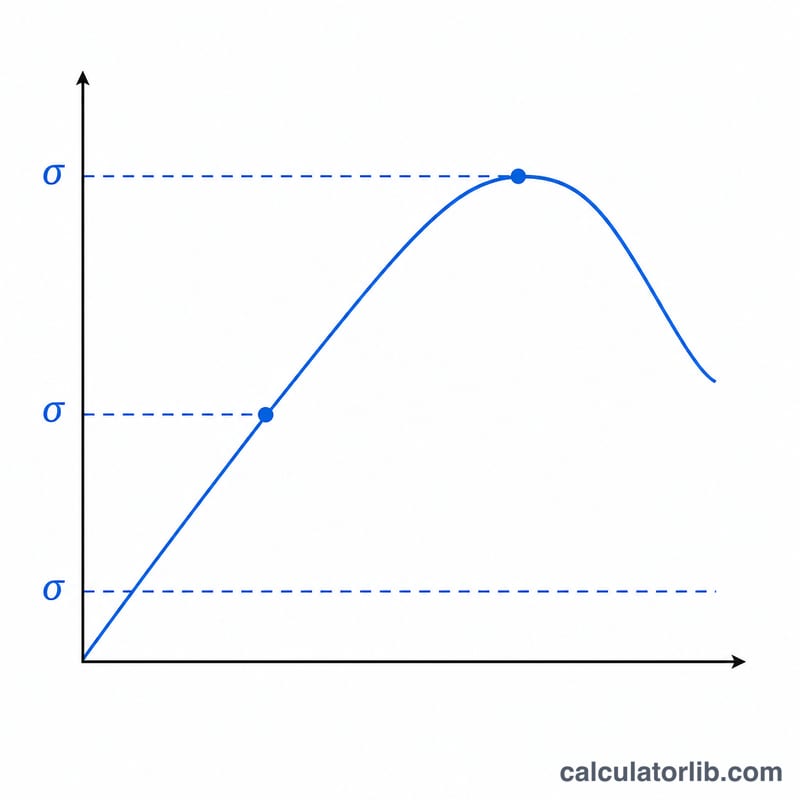
How to Use This Calculator
Enter the ultimate stress (or yield stress, depending on your design criterion) of the material and the allowable stress — the actual or maximum working stress the part will experience. Use consistent units (for example both in MPa or both in psi); since FoS is a ratio, the units cancel and the result is unitless. The calculator also returns the margin of safety, which is simply FoS minus 1.
The Formula Explained
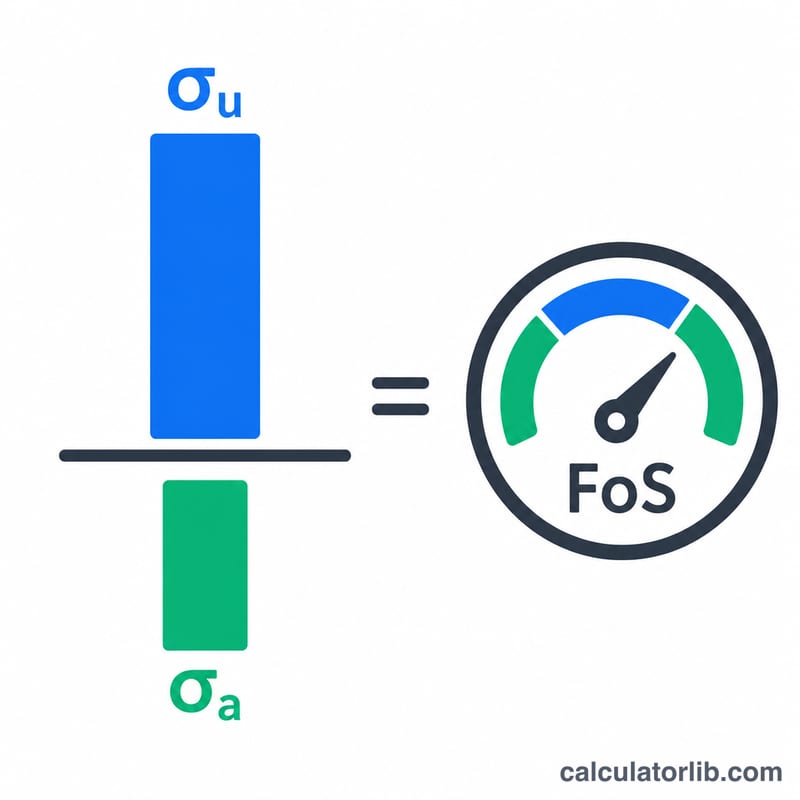
$$\text{FoS} = \frac{\sigma_{\text{ultimate}}}{\sigma_{\text{allowable}}}$$ A value greater than 1 means the structure can carry more than the applied load; a value less than 1 means it is overloaded and likely to fail. Typical design factors range from about 1.5 for aerospace (where weight is critical) to 4 or more for pressure vessels and lifting equipment.
Worked Example
Suppose a steel rod has an ultimate tensile strength of 400 MPa and is designed to operate at an allowable stress of 160 MPa. The factor of safety is $$400 \div 160 = 2.5,$$ and the margin of safety is \(2.5 - 1 = 1.5\). This means the rod could withstand 2.5 times its working stress before reaching failure.
FAQ
Should I use ultimate or yield strength? Use ultimate strength when you want a factor against fracture, and yield strength when you must prevent permanent deformation. Both are valid depending on the failure mode you are designing against.
What is a good factor of safety? It depends on the application, consequences of failure, and code requirements. Many general machine parts use 2–4; safety-critical or poorly-characterized loads may demand higher values.
Can the FoS be less than 1? Yes — a value below 1 indicates the applied stress exceeds the material strength, signaling an unsafe, failure-prone design that must be redesigned.