
What this calculator does
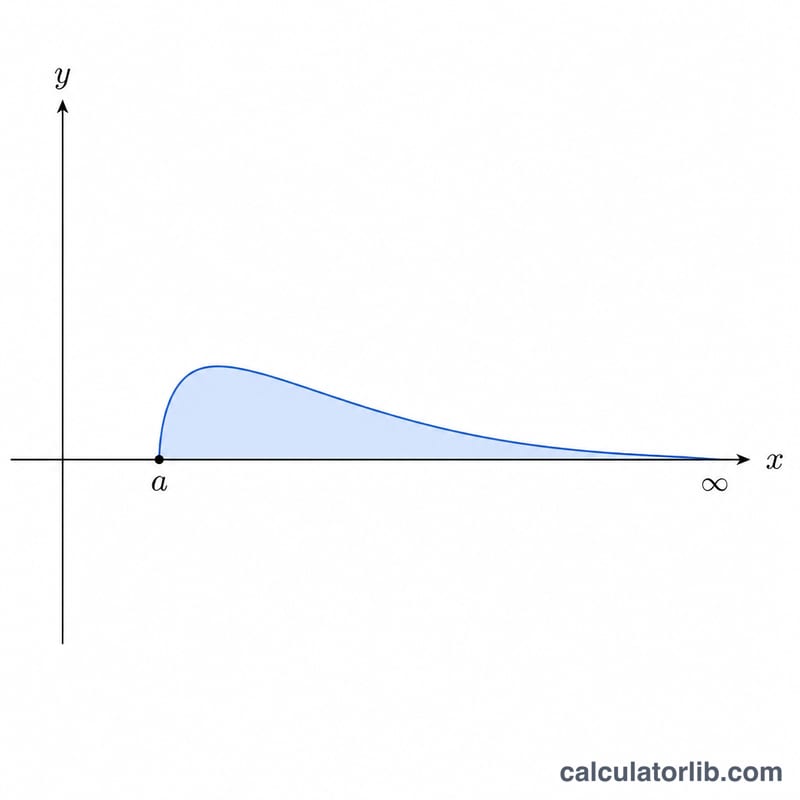
This tool numerically evaluates a definite integral over a semi-infinite interval, \(I = \int_{a}^{\infty} f(x)\,dx\), using the Double-Exponential (DE) quadrature variant designed for the half-line. The DE method is a universal, high-accuracy scheme that is especially well suited to integrands which decay algebraically (power-law, like \(1/x^{p}\)) toward infinity and may have a mild singularity at the lower endpoint \(x = a\). It is not intended for periodic or oscillatory integrands.
How to use it
Enter the integrand f(x) as a math expression in the variable x (supports + - * / ^, parentheses, and sqrt, exp, log, log10, sin, cos, tan, asin, acos, atan, sinh, cosh, tanh, abs, plus the constants pi and e). Enter the finite lower limit a, choose how many significant digits to display, and submit. The result is the numerical value of the integral.
The formula explained
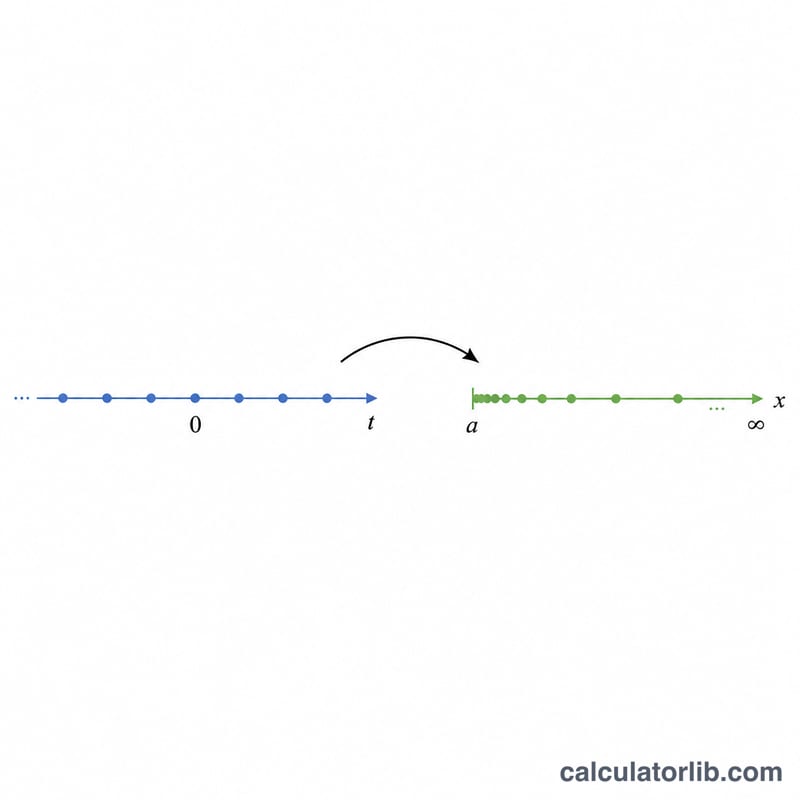
The half-line is mapped to the whole real line with the change of variable \(\phi(t) = \exp\!\left(\tfrac{\pi}{2}\cdot\sinh t\right)\), so \(x = a + \phi(t)\) sweeps from \(a\) (as \(t \to -\infty\)) to \(+\infty\). Its derivative is \(\phi'(t) = \tfrac{\pi}{2}\cdot\cosh(t)\cdot\exp\!\left(\tfrac{\pi}{2}\cdot\sinh t\right)\). The transformed integrand \(g(t) = f(a + \phi(t))\cdot\phi'(t)\) decays double-exponentially at both ends, so the simple trapezoidal rule on a uniform grid is near-optimal: $$I \approx h\cdot\sum_{k=-N}^{N} g(kh).$$ Nodes that overflow (large \(t\)) are skipped because the integrand is effectively zero there.
Worked example
For \(f(x) = 1/(1 + x^{3/2})\) with \(a = 0\) the exact value is $$\frac{4\pi}{3\sqrt{3}} \approx 2.4183991523.$$ The DE sum with \(h = 1/16\) reproduces this to many digits. At \(t = 0\): \(\phi = 1\), \(x = 1\), \(f = 0.5\), \(\phi' = \pi/2 \approx 1.5708\), so \(g \approx 0.7854\); summing all weighted nodes converges to \(2.41840\).
FAQ
Can I use it for exponentially-decaying integrands? It still works, but a different DE map converges faster for pure exponential decay; this variant targets algebraic decay.
Why does an oscillatory integrand fail? The trapezoidal sum of a non-decaying oscillation does not converge, so DE quadrature for the half-line is not appropriate there.
What does the digits setting change? Only the displayed rounding; the internal computation always uses full double precision.