
What is the Double Angle Formula Calculator?
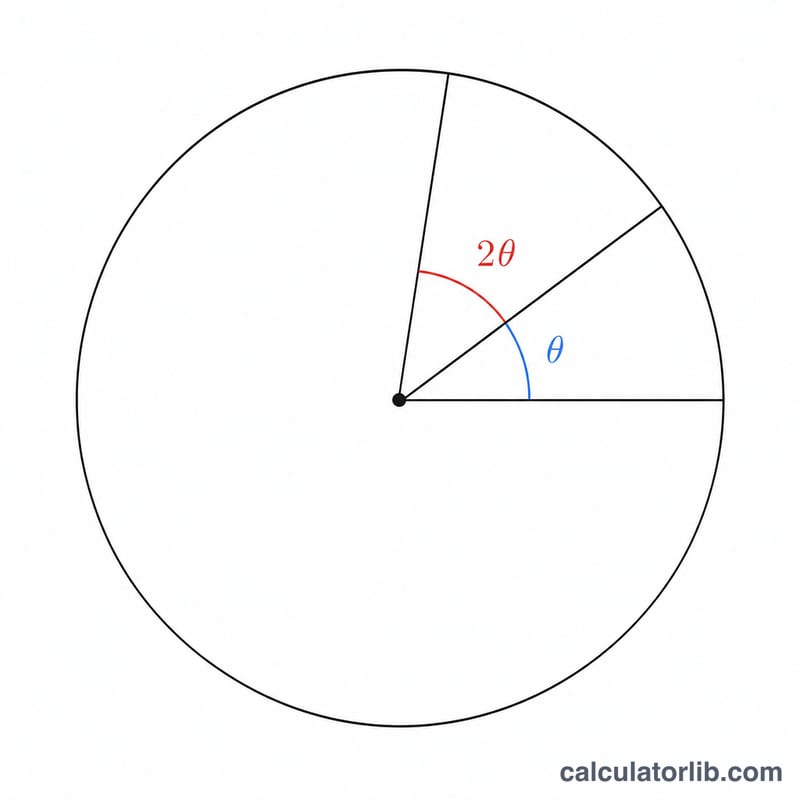
This tool evaluates the trigonometric double-angle identities for any angle θ. Enter an angle in degrees or radians and it returns sin(2θ), cos(2θ), and tan(2θ) at once. These identities express a function of twice an angle in terms of functions of the single angle, which is essential for simplifying expressions, solving trig equations, and integration.
How to use it
Type your angle θ, choose whether it is in degrees or radians, and read the three results. Degrees are converted to radians internally (multiply by \(\frac{\pi}{180}\)) before the trigonometric functions are applied.
The formulas explained
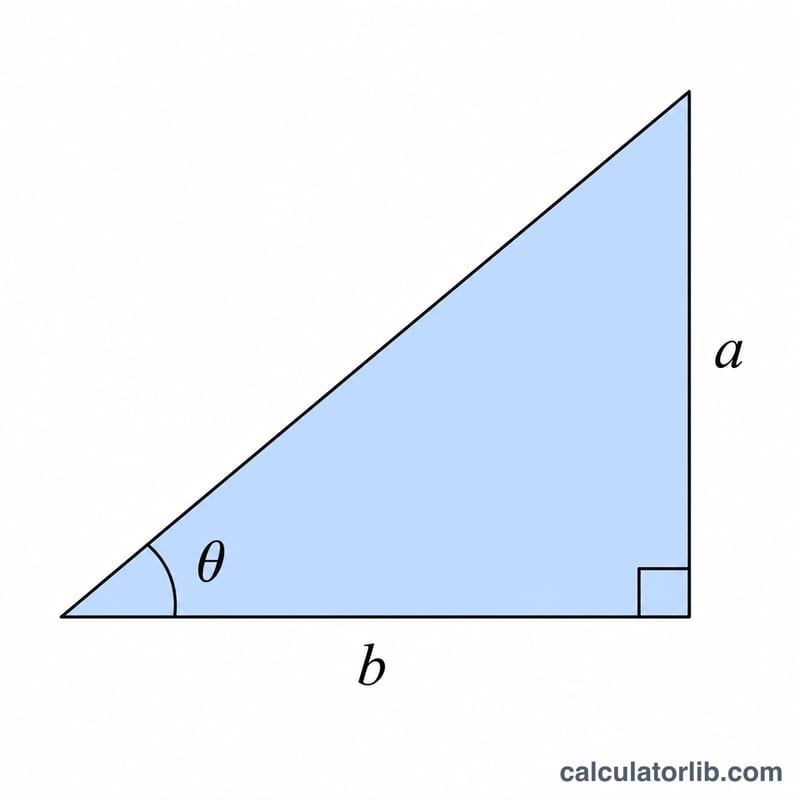
The sine identity is $$\sin 2\theta = 2\sin\theta\cos\theta$$ The cosine identity is $$\cos 2\theta = \cos^{2}\theta - \sin^{2}\theta$$ (equivalent to \(2\cos^{2}\theta - 1\) or \(1 - 2\sin^{2}\theta\)). The tangent identity is $$\tan 2\theta = \frac{2\tan\theta}{1-\tan^{2}\theta}$$ The tangent form is undefined wherever \(\cos 2\theta = 0\) (for example \(\theta = 45°\), where \(1 - \tan^{2}\theta = 0\)), so the calculator flags those cases as "undefined".
Worked example
For \(\theta = 30°\): \(\sin\theta = 0.5\), \(\cos\theta = 0.8660\). Then $$\sin 2\theta = 2(0.5)(0.8660) = 0.8660,$$ which equals \(\sin 60°\). $$\cos 2\theta = 0.8660^{2} - 0.5^{2} = 0.75 - 0.25 = 0.5 = \cos 60°.$$ $$\tan 2\theta = \frac{\sin 60°}{\cos 60°} \approx 1.7320.$$
FAQ
Why does tan(2θ) show "undefined"? Because tan is undefined where its argument hits 90° (\(\frac{\pi}{2}\)) plus multiples of 180°. At \(\theta = 45°\), \(2\theta = 90°\) and \(\cos 2\theta = 0\), so the ratio has a zero denominator.
Can I use radians? Yes, select the Radians option; no conversion is applied.
Do the results repeat? Yes, trig functions are periodic, so angles differing by full turns give identical results.