
What Is the Inverse Trigonometric Functions Calculator?
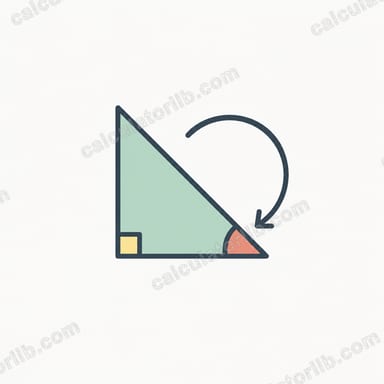
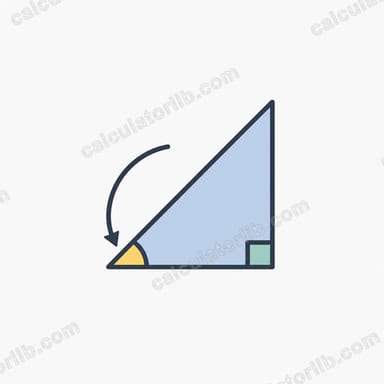
This calculator finds the angle θ that produces a given trigonometric ratio. While the sine, cosine, and tangent functions take an angle and return a ratio, their inverses — arcsin (sin⁻¹), arccos (cos⁻¹), and arctan (tan⁻¹) — take a ratio and return the angle. The result is shown in both degrees and radians.
How to Use It
Pick the inverse function you need, type the value of x, and read off the angle. For arcsin and arccos, x must lie between −1 and 1 (the range of sine and cosine), otherwise no real angle exists. arctan accepts any real number.
$$\theta = \arcsin\!\left( \text{Value }(x) \right), \quad -1 \le x \le 1$$ $$\theta = \arccos\!\left( \text{Value }(x) \right), \quad -1 \le x \le 1$$ $$\theta = \arctan\!\left( \text{Value }(x) \right)$$The Formula Explained
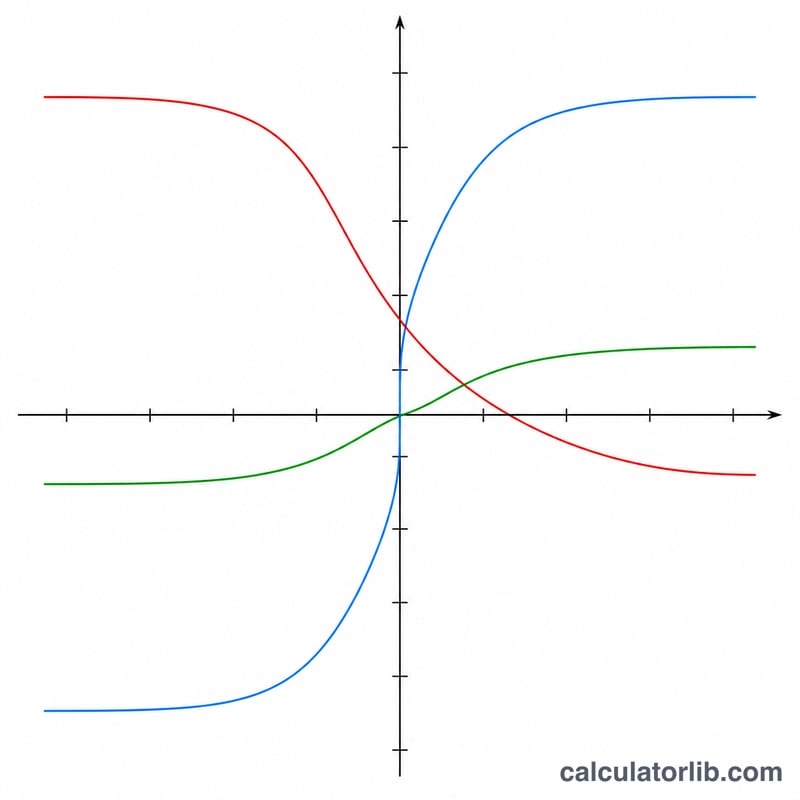
Each inverse function returns a principal-value angle: arcsin gives angles in [−90°, 90°], arccos gives [0°, 180°], and arctan gives (−90°, 90°). The calculator computes the angle in radians and converts to degrees using \(\theta_{\text{deg}} = \theta_{\text{rad}} \times 180/\pi\).
Worked Example
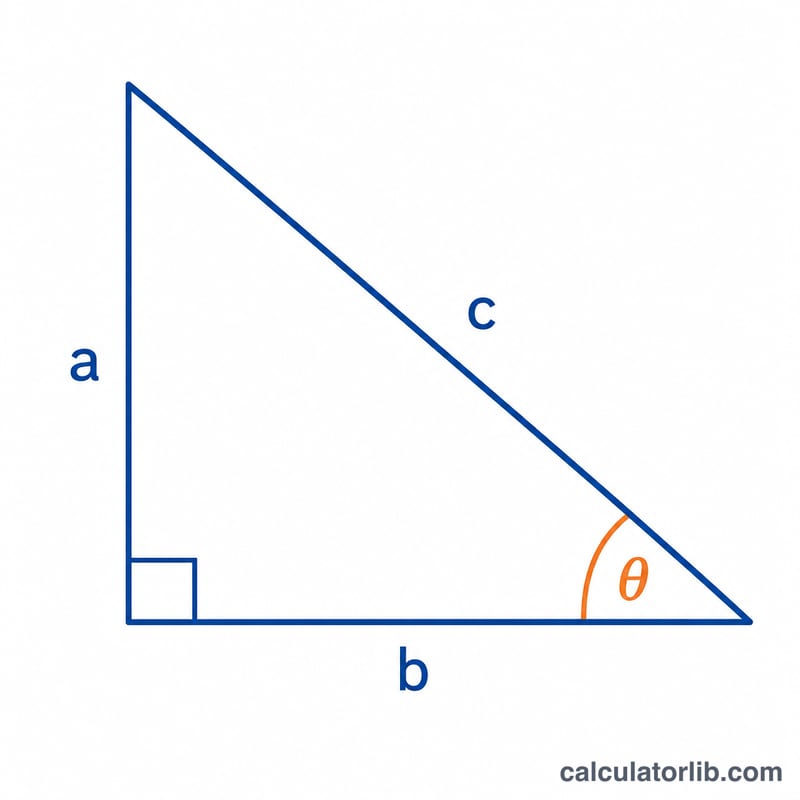
Suppose you want \(\arcsin(0.5)\). The angle whose sine is 0.5 is 30°, or about 0.5236 radians. Likewise, \(\arctan(1) = 45°\) because \(\tan(45°) = 1\), and \(\arccos(0) = 90°\).
FAQ
Why does arcsin only accept −1 to 1? Because the sine of any angle is always between −1 and 1, so values outside that range have no real inverse.
What is the difference between degrees and radians? They are two units for measuring angles. 180° equals π radians. This tool shows both.
Is sin⁻¹ the same as 1/sin? No. The superscript −1 here denotes the inverse function, not a reciprocal. The reciprocal of sine is the cosecant (csc).