
What is the 2×2 Eigenvector Calculator?
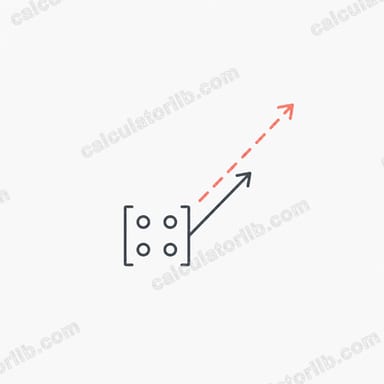
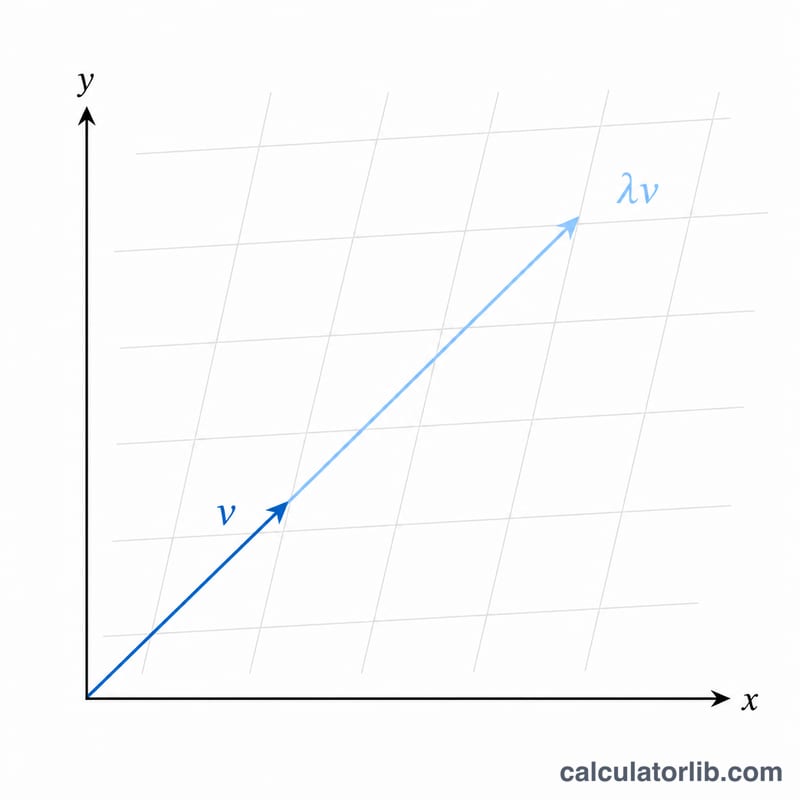
This tool finds the eigenvalues and eigenvectors of any 2×2 matrix \(A = \begin{bmatrix} a & b \\ c & d \end{bmatrix}\). An eigenvector \(v\) is a non-zero vector that the matrix only stretches or shrinks: \(Av = \lambda v\), where the scalar \(\lambda\) is its eigenvalue. Eigenvectors reveal the natural axes of a linear transformation and are central to differential equations, principal component analysis, vibration analysis and quantum mechanics.
How to use it
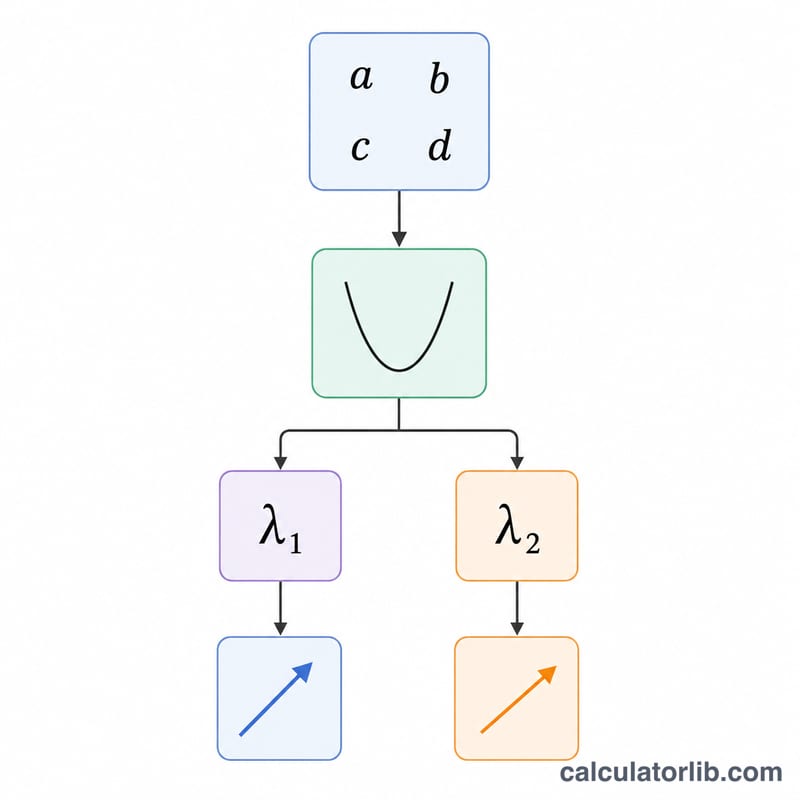
Enter the four matrix entries — \(a\) (top-left), \(b\) (top-right), \(c\) (bottom-left) and \(d\) (bottom-right) — then read off the two eigenvalues and a representative eigenvector for each. Eigenvectors are only defined up to a scalar multiple, so any non-zero multiple of the result is equally valid.
The formula explained
The eigenvalues solve the characteristic equation \(\det(A - \lambda I) = 0\), which expands to \(\lambda^2 - (a+d)\lambda + (ad-bc) = 0\). Solving with the quadratic formula gives
$$\lambda_{1,2} = \frac{(a+d) \pm \sqrt{(a+d)^2 - 4(ad-bc)}}{2}$$For each \(\lambda\) we solve \((A - \lambda I)v = 0\); a convenient eigenvector is \(v = (b,\; \lambda - a)\), or \(v = (\lambda - d,\; c)\) when \(b = 0\).
Worked example
Take \(A = \begin{bmatrix} 2 & 1 \\ 1 & 2 \end{bmatrix}\). Trace \(= 4\), determinant \(= 4 - 1 = 3\), discriminant \(= 16 - 12 = 4\). So
$$\lambda = \frac{4 \pm 2}{2} = 3 \text{ and } 1$$For \(\lambda_1 = 3\): \(v = (b,\; \lambda - a) = (1,\; 1)\). For \(\lambda_2 = 1\): \(v = (1,\; -1)\). These are the familiar diagonal directions of a symmetric matrix.
FAQ
Why are my eigenvectors different from the textbook? Eigenvectors are unique only up to scaling, so \((1, 1)\) and \((2, 2)\) describe the same eigenvector.
What if the discriminant is negative? The matrix has complex (conjugate) eigenvalues; this calculator reports their shared real part and flags the complex case.
Does it work for a diagonal matrix? Yes — when \(b = c = 0\) the standard basis vectors \((1, 0)\) and \((0, 1)\) are the eigenvectors.