
What This Calculator Does
The Linear Convolution Calculator takes two discrete sequences and combines them using the discrete linear convolution operation. Convolution is a fundamental tool in digital signal processing (DSP), used to compute the output of a linear time-invariant (LTI) system when you know its input signal and its impulse response. Enter your two number sequences and the tool instantly returns the full convolved sequence, along with its maximum and minimum values.
How to Use It
There are just two input fields:
- First Sequence – your input signal x, entered as comma-separated numbers, e.g.
1, 2, 3. - Second Sequence – your second signal h (often an impulse response), e.g.
0, 1, 0.5.
Decimals and negative numbers are both supported. Each value is trimmed and parsed as a number, so spacing does not matter.
The Formula
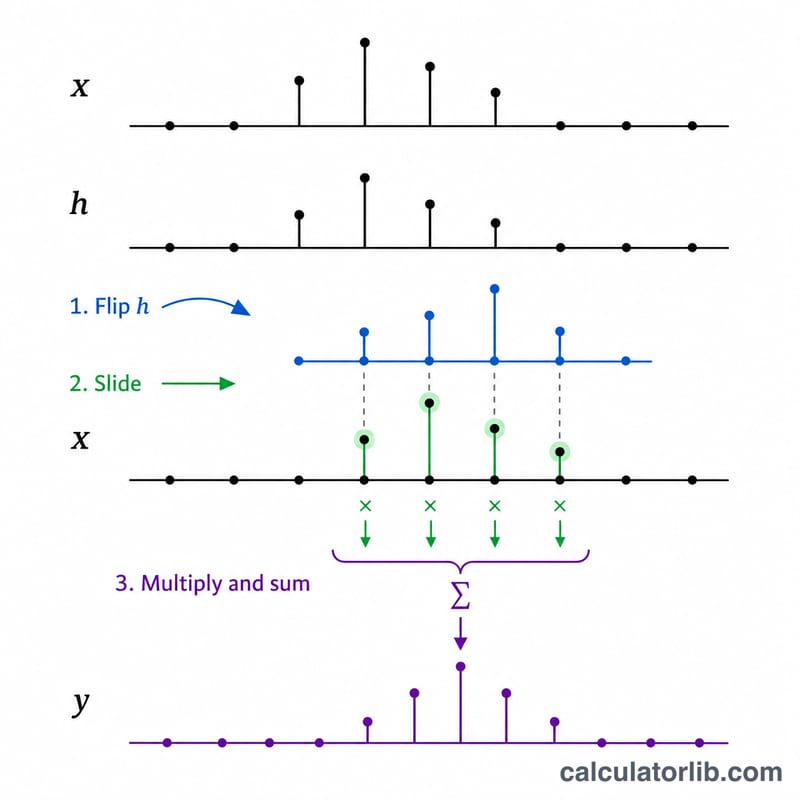
The discrete linear convolution is defined as:
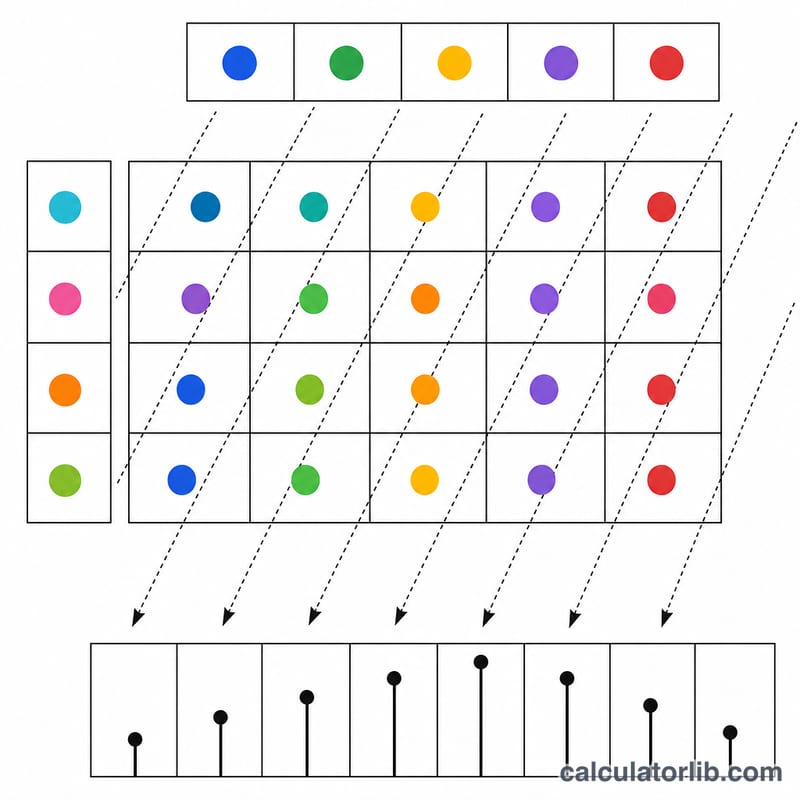
$$y[n] = \sum_{k} x[k] \cdot h[n-k]$$In practice the calculator implements this with a direct double loop: every element of the first sequence is multiplied by every element of the second, and each product \(x[i]\cdot h[j]\) is added into output position \(i + j\). The resulting sequence has a length of len(x) + len(h) − 1.
Worked Example
Let x = [1, 2, 3] and h = [1, 1]. The output length is \(3 + 2 - 1 = 4\).
- \(y[0] = 1\cdot 1 = 1\)
- \(y[1] = 1\cdot 1 + 2\cdot 1 = 3\)
- \(y[2] = 2\cdot 1 + 3\cdot 1 = 5\)
- \(y[3] = 3\cdot 1 = 3\)
So the convolution is [1, 3, 5, 3], with a maximum value of 5 and a minimum value of 1.
Frequently Asked Questions
How long is the result? Always the sum of the two input lengths minus one. Convolving a 4-element and 3-element sequence gives 6 values.
Does the order of the sequences matter? No. Convolution is commutative, so swapping the first and second sequence produces the same output sequence.
Is this the same as cross-correlation? No. Convolution flips one sequence (the \(h[n - k]\) term) before sliding, whereas correlation does not. They give different results unless one sequence is symmetric.