
What the Arctan Calculator does
The Arctan Calculator finds the angle whose tangent equals a value you supply. In other words, if you know that the tangent of an unknown angle is some number x, this tool reverses the operation and returns the angle itself. It works the same way everywhere in the world — trigonometry is universal — so there is no country-specific behaviour to worry about.
The inputs you provide
- Tangent Value: the number you want to take the inverse tangent of. This can be any real number — positive, negative or zero (for example 1, -0.5773 or 2.5).
- Result Unit: choose Degrees or Radians to control how the answer is displayed. The calculator always computes both internally, so you can see the angle in either unit.
The formula
The core calculation is the inverse tangent function:
$$\theta = \arctan\left(x\right)$$
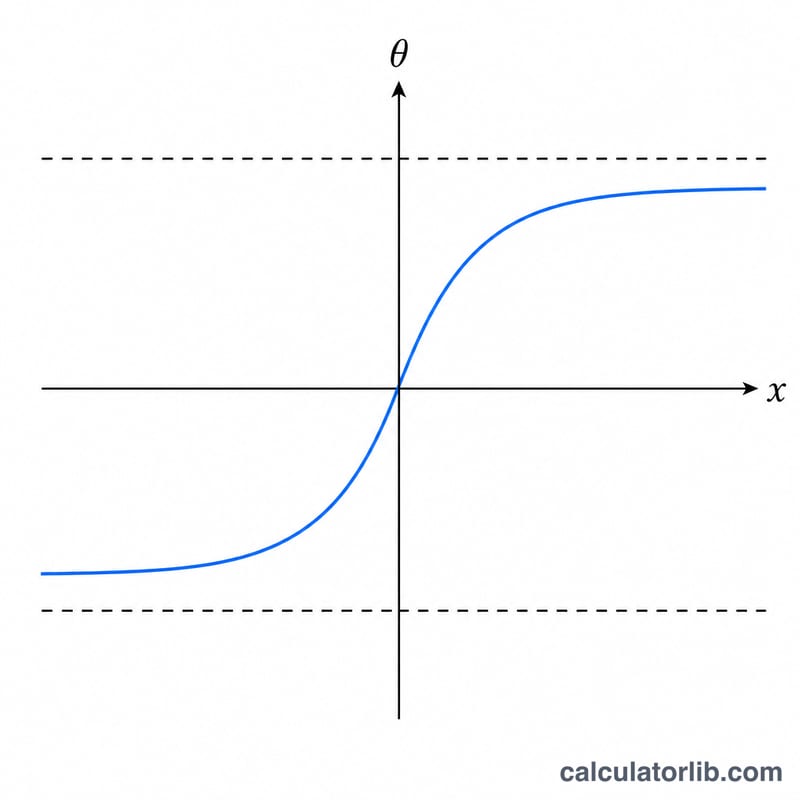
Internally the tool calls Math.atan(x), which always returns the angle in radians. That radian value is then converted to degrees with Math.toDegrees(). Whichever unit you select becomes the headline result, while both versions remain available. Note that arctangent has a range of −90° to +90° (−π/2 to +π/2 radians), so the answer always falls inside that interval — this is the principal value of the inverse tangent.
Worked example
Suppose you enter a Tangent Value of 1 and select Degrees.
- The calculator computes
Math.atan(1)= 0.7853981634 radians. - Converting gives \(0.7853981634 \times (180 \div \pi) = 45°\).
- Because you chose Degrees, the displayed result is 45°, with the radian value (0.7854) also shown.
This matches the well-known fact that \(\tan(45°) = 1\).
How to Calculate Arctangent by Hand
To find an angle from a known tangent value, follow these steps:
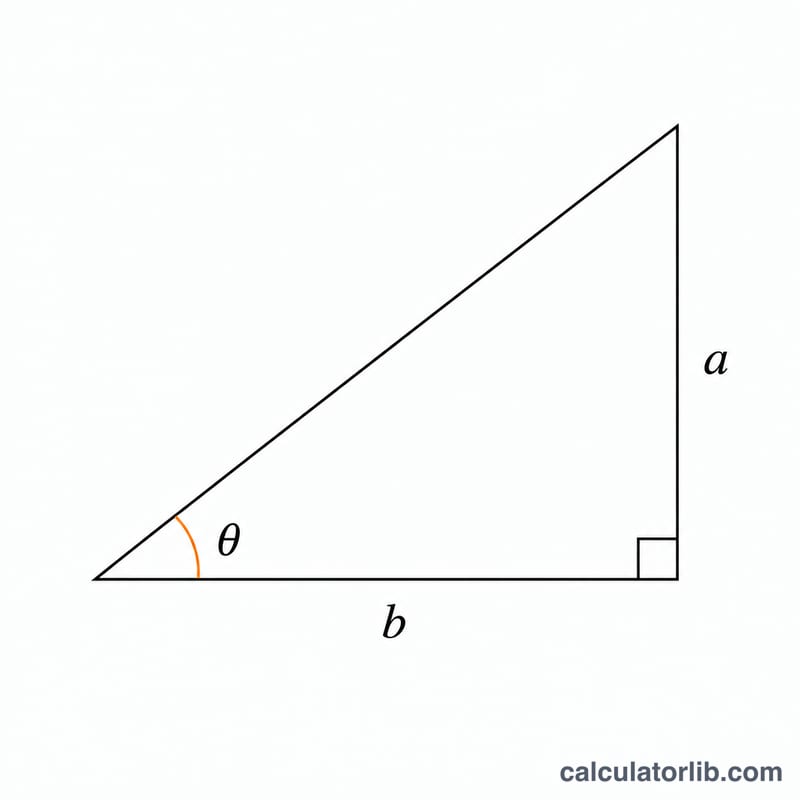
- Identify the tangent value \(x\). This is the ratio of the opposite side to the adjacent side of a right triangle, or any value you wish to invert. For example, take \(x = 1\).
- Apply \(\theta = \arctan(x)\) using a scientific calculator (the \(\tan^{-1}\) key) or a reference table to obtain the angle in radians. For \(x = 1\), \(\arctan(1) = \tfrac{\pi}{4} \approx 0.7854\) radians.
- Convert radians to degrees by multiplying by \(\tfrac{180}{\pi}\):
$$\theta = 0.7854 \times \frac{180}{\pi} = 45^\circ.$$ You can verify the radian-to-degree conversion with a 45° angle conversion. - Confirm the answer lies in the principal range \(-90^\circ\) to \(+90^\circ\) (i.e. \(-\tfrac{\pi}{2}\) to \(+\tfrac{\pi}{2}\)). The arctangent always returns this principal value; \(45^\circ\) qualifies.
- Add multiples of \(180^\circ\) (or \(\pi\) radians) if other coterminal solutions are needed. Because \(\tan\theta\) repeats every \(180^\circ\), the full solution set is \(\theta = \arctan(x) + 180^\circ \cdot n\) for any integer \(n\). So for \(x = 1\), valid angles also include \(45^\circ + 180^\circ = 225^\circ\).
Watch the sign: a negative tangent value yields a negative principal angle (e.g. \(\arctan(-1) = -45^\circ\)), placing the angle in the fourth quadrant of the standard range.
Frequently Asked Questions
Why does arctan never return an angle above 90 degrees?
Because tangent repeats every 180 degrees, infinitely many angles share the same tangent value. To give a single, unambiguous answer, arctan returns the principal value between minus 90 and plus 90 degrees (minus pi/2 to pi/2 radians). Add multiples of 180 degrees if you need other valid angles.
What is the formula the calculator uses?
It evaluates theta equals arctan(x), the inverse of the tangent function, where x is the tangent value you enter. The result is the angle whose tangent equals x. The output is computed in radians internally, then converted to degrees using degrees equals radians times 180 divided by pi when needed.
Can I enter negative tangent values?
Yes. A negative input produces a negative angle in the principal range. For example, an input of minus 1 returns minus 45 degrees, or minus 0.7854 radians. There is no limit on the size of the value; very large numbers approach plus or minus 90 degrees.
What is the difference between the degrees and radians settings?
They are two units for the same angle. 180 degrees equals pi radians (about 3.14159), so 45 degrees equals 0.7854 radians. The Result Unit setting only changes how the answer is displayed, not the angle itself. You can switch units to compare both representations.
What does arctan of 1 equal?
The arctangent of 1 is 45 degrees, or about 0.7854 radians (pi/4), because the tangent of 45 degrees is exactly 1. Similarly, arctan of 0 is 0 degrees, and arctan of the square root of 3 (about 1.732) is 60 degrees.
How accurate are the results?
The calculator uses standard double-precision arithmetic, accurate to roughly 15 significant digits, which is far more than enough for engineering, geometry, and trigonometry work. Displayed values are rounded for readability, so the shown decimals may be slightly trimmed compared with the full internal result.
Related calculators
- ATAN2 Calculator — angle from x and y coordinates.
- Arcsin (Inverse Sine) Calculator — angle from a sine value.
- Arccos (Inverse Cosine) Calculator — angle from a cosine value.
- Tangent Calculator — tangent of an angle.