
What This Calculator Does
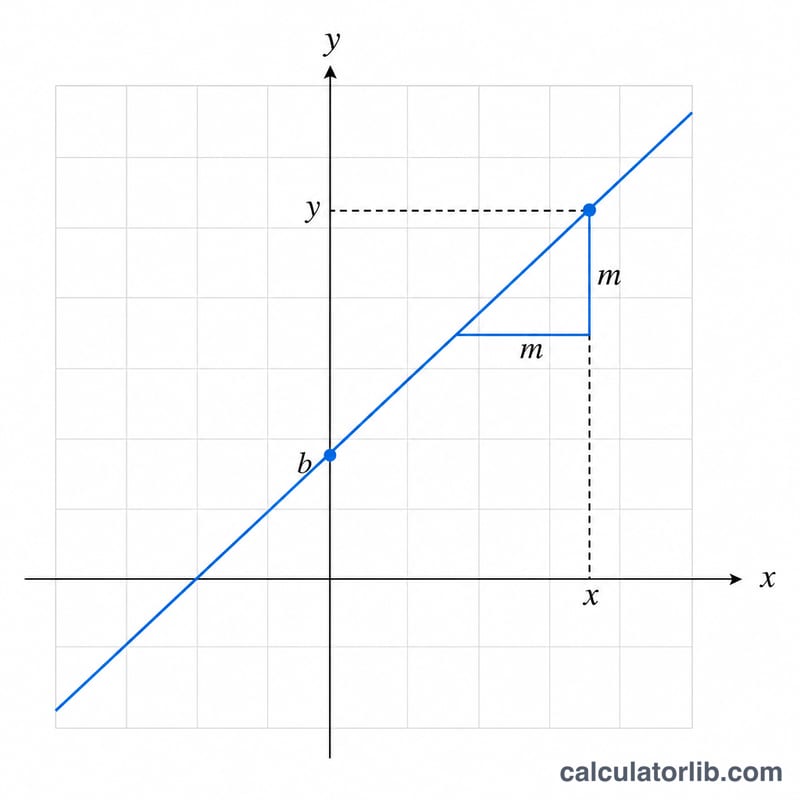
The Linear Equation Calculator solves the slope-intercept form of a straight line, \(y = mx + b\). You supply three numbers — the slope (m), the y-intercept (b), and an x value — and the tool instantly returns the matching y-coordinate. It also computes the line's x-intercept (where the line crosses the x-axis) and echoes back the full equation so you can confirm the line you are working with.
The Inputs You Enter
- Slope (m): how steep the line is — the change in y for each one-unit change in x. Positive slopes rise; negative slopes fall.
- Y-Intercept (b): the y value where the line crosses the y-axis (the point where x = 0).
- X Value: the x-coordinate you want to plug in to find its matching y.
The Formula Explained
The calculator applies the core equation:
$$y = mx + b$$
It multiplies your slope by your x value, then adds the y-intercept. Behind the scenes it also finds the x-intercept using \(x = -b / m\), which is the x value that makes y equal to zero.
Worked Example
Suppose the slope m = 2, the y-intercept b = 3, and you want y when x = 5.
- $$y = (2 \times 5) + 3 = 10 + 3 = \mathbf{13}$$
- $$x\text{-intercept} = -3 / 2 = \mathbf{-1.5}$$
- Equation displayed: \(y = 2x + 3\)
So the point (5, 13) lies on the line, and the line crosses the x-axis at (−1.5, 0).
Frequently Asked Questions
What happens if the slope is zero? With m = 0 the line is horizontal, so y always equals b regardless of x. The x-intercept becomes undefined (you cannot divide by zero), since a horizontal line off the axis never crosses it.
Can I use negative or decimal values? Yes. The calculator accepts negative numbers and decimals for all three inputs, so values like m = −0.75 or b = 2.5 work fine.
What is the difference between the y value and the x-intercept? The y value is the height of the line at your chosen x. The x-intercept is the specific x where the line touches the x-axis (where y = 0). The tool reports both so you understand the full position of the line.