
What the Exponent Calculator Does
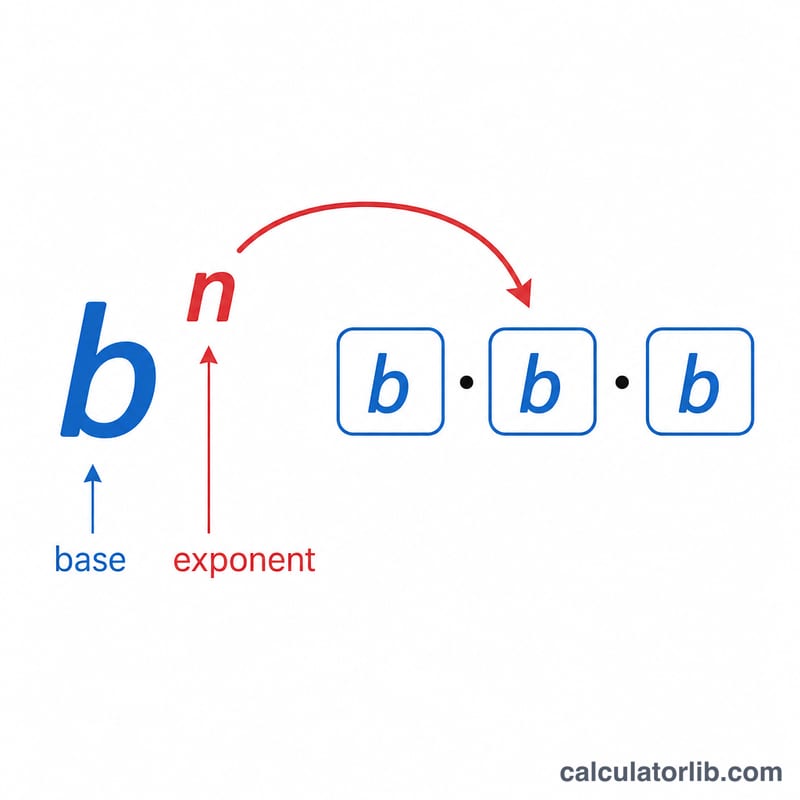
This Exponent Calculator raises a number to a power. You enter two values — a Base and an Exponent — and it returns the result of multiplying the base by itself the number of times set by the exponent. It works for whole numbers, decimals, negative values and fractional exponents, so it handles everything from simple squares to roots expressed as powers.
How to Use It
- Base: the number being raised to a power (the x in the formula). For example, 2, 10, or 1.5.
- Exponent: how many times the base is used as a factor (the n). This can be positive, negative, zero or a decimal.
Press calculate and the tool returns the result instantly. Both inputs are read as numbers, so decimals like 2.5 or negatives like -3 are fully supported.
The Formula
The calculator uses the standard power function:
$$y = x^{n}$$
Internally it computes Math.pow(base, exponent), the same operation used in most programming languages. This means:
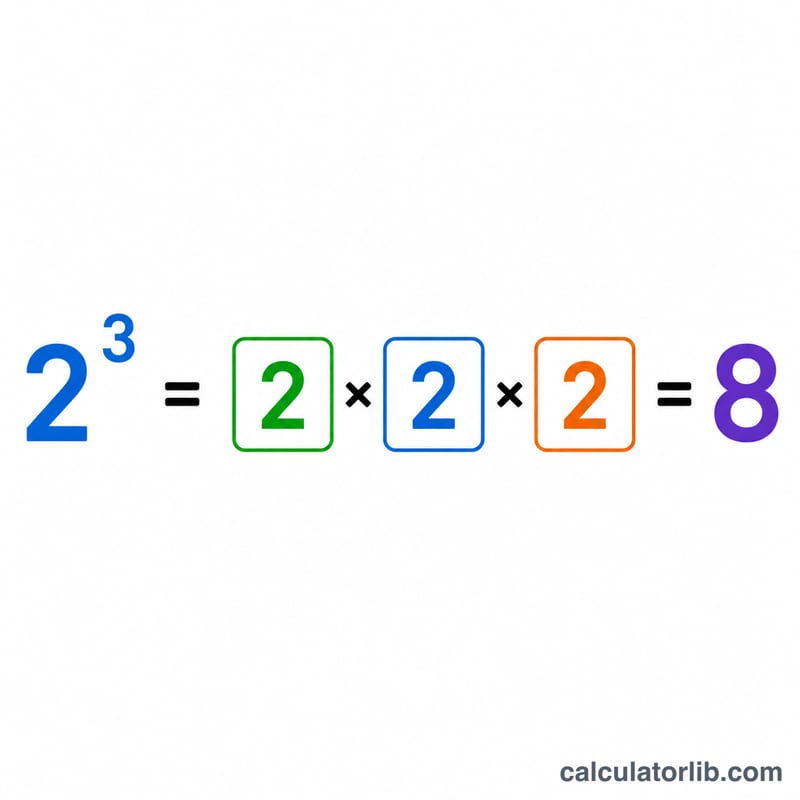
- A positive exponent multiplies the base repeatedly: \(x^3 = x \times x \times x\).
- A negative exponent gives a reciprocal: \(x^{-2} = 1 \div x^2\).
- An exponent of 0 always returns 1 (for any non-zero base).
- A fractional exponent gives a root: \(x^{0.5}\) is the square root of x.
Worked Example
Suppose you enter a Base of 3 and an Exponent of 4. The calculator computes:
$$y = 3^4 = 3 \times 3 \times 3 \times 3 = \mathbf{81}$$
Now try a decimal exponent: with a Base of 16 and an Exponent of 0.5, the result is \(\sqrt{16} = \mathbf{4}\). With a Base of 2 and an Exponent of -3, the result is \(1 \div 2^3 = 1 \div 8 = \mathbf{0.125}\).
Frequently Asked Questions
What happens if the exponent is 0? Any non-zero base raised to the power of 0 equals 1. This is a mathematical rule the calculator follows automatically.
Can I use a negative base? Yes. A negative base with a whole-number exponent works normally — for example \((-2)^3 = -8\). However, a negative base combined with a fractional exponent (like a square root) is undefined in real numbers and may return "NaN".
Does it handle very large numbers? Yes, within the limits of double-precision arithmetic. Extremely large results (such as huge bases with high exponents) may be displayed in scientific notation or, if they exceed the maximum, as "Infinity".