
What the Natural Log Calculator Does
This calculator finds the natural logarithm of any positive number you enter. The natural logarithm, written as \(\ln(x)\), is the logarithm to the base e, where \(e \approx 2.718281828\). In plain terms, \(\ln(x)\) answers the question: "To what power must e be raised to get x?" Natural logs appear throughout science, finance and engineering — in compound growth, radioactive decay, pH chemistry, and information theory.
How to Use It
There is a single input field:
- Number — the value you want the natural log of. It must be a positive number (greater than 0).
Once you enter a value, the tool computes several related results at once:
- Natural log — \(\ln(x)\), using base e.
- Common log — \(\log_{10}(x)\), the base-10 logarithm, for comparison.
- \(\ln(2)\) \(\approx 0.6931\) and \(\ln(10)\) \(\approx 2.3026\), two reference constants used to convert between logarithm bases.
The Formula
The core calculation is simply:
$$\ln\!\left(\text{Number}\right) = \log_{e}\!\left(\text{Number}\right)$$This is the inverse of the exponential function: if \(\ln(x) = y\), then \(e^{y} = x\). The calculator also reports the common log, related to the natural log by the change-of-base rule: \(\log_{10}(x) = \ln(x) \div \ln(10)\).
Worked Example
Suppose you enter 7.389:
- \(\ln(7.389) \approx 2.0000\), because \(e^{2} \approx 7.389\).
- \(\log_{10}(7.389) \approx 0.8686\).
- Check the change-of-base rule: \(2.0000 \div 2.3026 \approx 0.8686\) — matching the common log result.
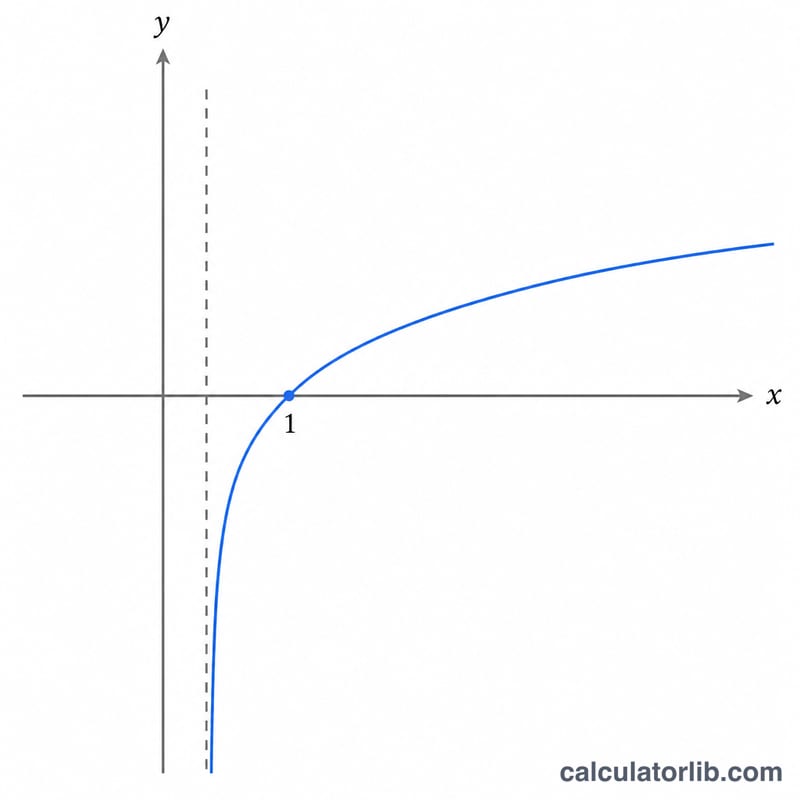
Another quick example: entering 1 gives \(\ln(1) = 0\), since \(e^{0} = 1\).
Frequently Asked Questions
Can I enter a negative number or zero?
No. The natural logarithm is only defined for positive numbers. \(\ln(0)\) tends toward negative infinity, and logs of negative numbers are not real, so the calculator expects a value greater than 0.
What is the difference between ln and log?
"ln" is the natural log with base e (\(\approx 2.718\)), while "log" usually means the common log with base 10. This tool shows both so you can compare them. Convert between them with: \(\log_{10}(x) = \ln(x) \div 2.3026\).
Why does the tool show \(\ln(2)\) and \(\ln(10)\)?
These constants are handy for changing logarithm bases by hand. For example, \(\ln(x) = \log_{2}(x) \times \ln(2)\), and dividing a natural log by \(\ln(10)\) gives the base-10 equivalent.