
What is the Negative Log Calculator?
The negative log calculator finds \(-\log_b(x)\), the negated logarithm of a number x in any base b. The negative logarithm shows up constantly in science: chemistry uses \(\text{pH} = -\log_{10}[\text{H}^+]\) and \(\text{pKa} = -\log_{10}(K_a)\), while information theory measures surprise as \(-\log_2(p)\). Because most calculators only offer base 10 and base e, this tool lets you pick any base you like.
How to use it
Enter the value x (which must be greater than zero) and the logarithm base b (a positive number other than 1). For pH-style calculations use base 10; for bits of information use base 2; for natural logs use Euler's number 2.71828. Press calculate and the negative logarithm appears instantly.
The formula explained
The calculator applies the change-of-base identity and then negates the result:
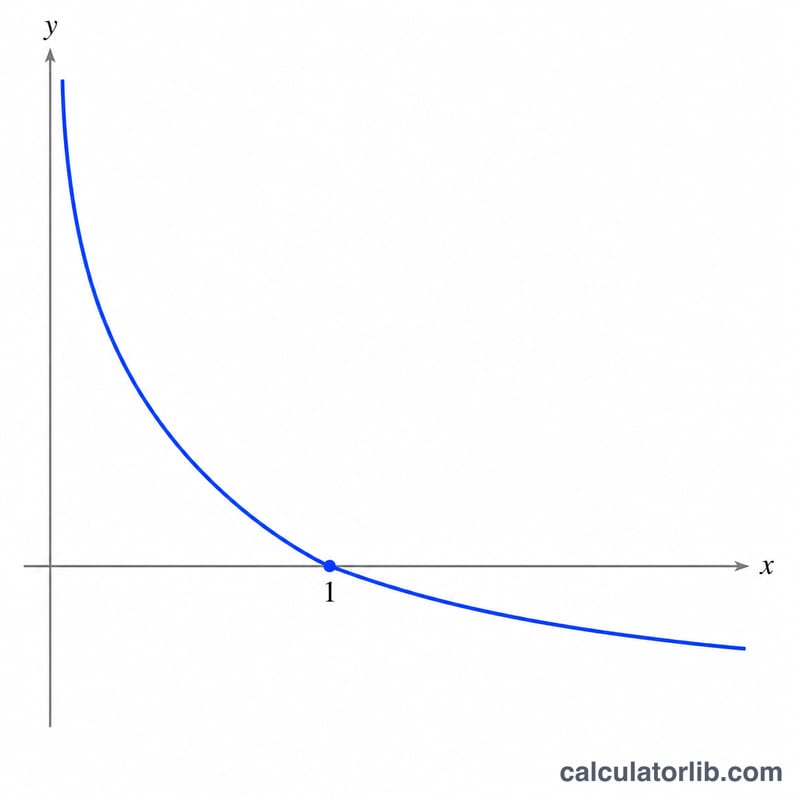
$$y = -\log_{\text{base } b}\!\left(\text{Value } x\right) = -\,\frac{\ln\!\left(\text{Value } x\right)}{\ln\!\left(\text{base } b\right)}$$Dividing the natural log of x by the natural log of b converts any base into base e, which every computer can evaluate. The leading minus sign simply flips the sign of the result, so numbers between 0 and 1 give positive answers and numbers above 1 give negative answers.
Worked example
Suppose a solution has a hydrogen-ion concentration of \(x = 0.001\) mol/L and we use base \(b = 10\). Then \(\ln(0.001) \approx -6.907755\) and \(\ln(10) \approx 2.302585\). Dividing gives \(-3\), and negating gives 3. So the pH is 3 — a moderately acidic solution.
FAQ
Why must x be positive? Logarithms are only defined for positive numbers, so \(x \le 0\) has no real answer and returns 0 here.
Why can't the base be 1? log base 1 is undefined because \(\ln(1) = 0\), which would force a division by zero.
What base should I use for pH? Always base 10. For information theory use base 2; for natural logarithms use \(e \approx 2.71828\).