
What is a Golden Rectangle?
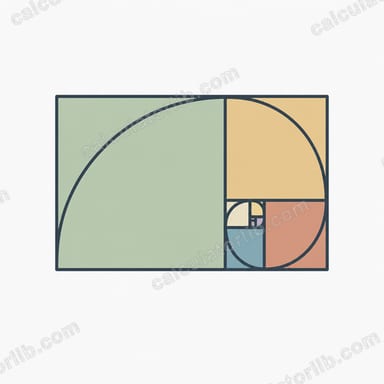
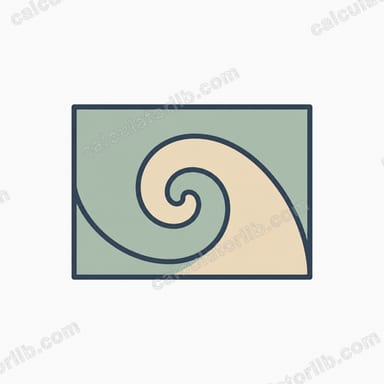
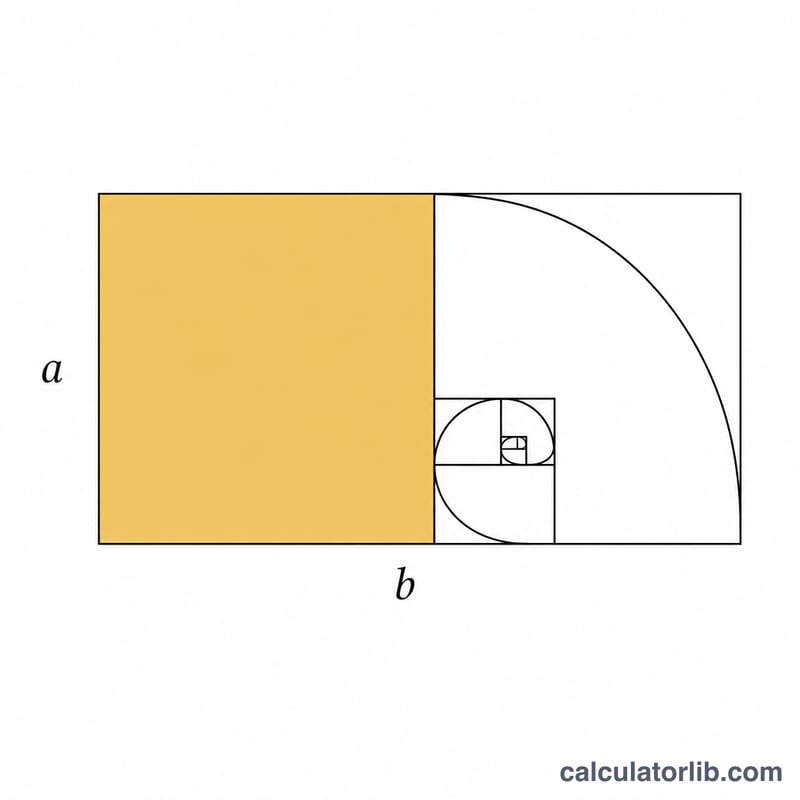
A golden rectangle is a rectangle whose side lengths are in the golden ratio, φ (phi), approximately 1.618. This proportion has fascinated artists, architects and mathematicians for centuries because of its pleasing visual balance — it appears in the Parthenon, Renaissance paintings and modern design. If the short side is a, the long side b equals \(a \times \varphi\).
How to Use This Calculator
Enter the short side a of your rectangle and the calculator instantly returns the long side b, the total area, the perimeter and the exact golden ratio used. Use any unit (cm, inches, pixels) — the output is in the same unit, with area in square units.
The Formula Explained
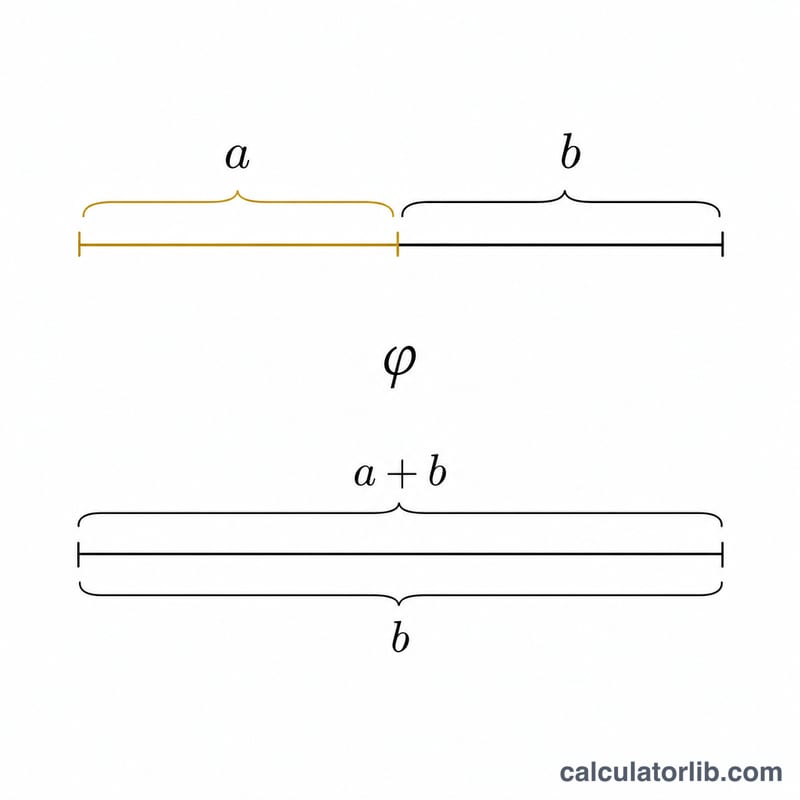
The golden ratio is defined as \(\varphi = \frac{1+\sqrt{5}}{2} \approx 1.6180339887\). A rectangle is golden when \(b / a = \varphi\). So from a known short side we compute the long side as $$b = a \cdot \varphi$$ The area follows from $$A = a \cdot b$$ and the perimeter from $$P = 2\left(a + b\right)$$ A key property: if you remove a square of side a from a golden rectangle, the remaining rectangle is also golden.
Worked Example
Suppose the short side a = 10. Then $$b = 10 \times 1.618 = 16.18$$ (more precisely 16.1803). The area is $$A = 10 \times 16.18 = 161.80 \text{ square units}$$ and the perimeter is $$P = 2 \times (10 + 16.18) = 52.36 \text{ units}$$
FAQ
Why is φ ≈ 1.618? It is the positive solution of \(x^2 = x + 1\), which gives \(\frac{1+\sqrt{5}}{2}\).
Can I enter the long side instead? This tool takes the short side. To find the short side from a long side, divide the long side by φ (\(a = b / 1.618\)).
What units does it use? Whatever unit you input — sides share that unit and area is in square units.